In fairness, ‘pride and care’ was looking a bit funny

The Hong Kong chapter of the Marco Rubio Fan Club is inundated with membership applications this morning as the US Senate passes the Hong Kong Human Rights and Democracy Act.

It would be easy to dismiss this as a symbolic gesture (though anything that sends Beijing spokesmen berserk can’t be all bad, and it’s delicious to fantasize about our senior officials’ kids being barred from US colleges). But there’s a lot happening.

Events at Poly U apparently encouraged Senators to vote for the act. There’s also a Protect Hong Kong Act in the works, which would bar US sales of tear gas and other materiel to the city. And lawmakers are proposing several laws to clamp down on certain foreign (ie Chinese) corporate listings and investments in the US. As George Magnus points out, these could hurt China economically. And the more harshly Beijing treats Hong Kong, the greater US politicians’ impulse to pass these laws. (Update: one on data.)

As a reminder that harsh treatment is not inevitable, here’s a pithy thread on how whoever is in charge could quickly calm Hong Kong down. It involves half-meeting some of the protest movement’s demands – enough to appease moderate public opinion and leave hardliners isolated. So obvious (and potentially threatening to hopes of keeping Beijing at bay), yet impossible so long as Beijing cannot overcome its extreme phobia about appearing to bow to the popular will. Beijing’s greatest enemy in the fight against Hong Kong is itself.

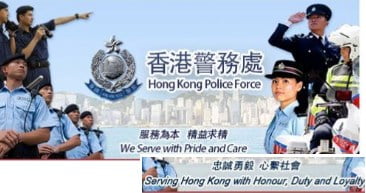
Instead, Hong Kong gets a new, reputedly even-more-big-and-tough, Police Commissioner, Chris Tang. Being committed to full transparency and frankness, the guy’s first order is to remove the words ‘pride’ and ‘care’ from the force’s slogan-motto. It now reads ‘We serve with utter bone-headed intransigence and slavish obedience’.

Posted in Blog | 17 Comments

Is that an interpretation I smell in the air?

The High Court rejects the Hong Kong government’s genius mask ban. A Beijing spokesman calls the ruling a ‘direct challenge to the authority of the Standing Committee of National People’s Congress and the chief executive’. Awkwardly, the CE’s own government says it will comply with the ruling (though possibly appeal).

More mouth-frothing follows from various Mainland ‘experts’ who suggest that the court is ignorant, living in a ‘dinosaur era’ and ‘inciting protesters’. One rants about ‘infiltration of politics into the judiciary’.

Assuming an appeal would be time-consuming and unpredictable, it looks like Beijing will use its ‘interpretation’ mechanism to overrule the court. The process is dressed up in blather about the NPC Standing Committee divining the true, authentic and original (but hitherto unnoticed) meaning of the Basic Law (the wording of which says mysteriously something totally different). In reality, it is an instant rewrite to make the mini-constitution say whatever happens to suit the Communist Party at the time.

It is so heavy-handed and unconvincing – and clearly a travesty of Hong Kong’s common law system – that Beijing has used it sparingly, either out of expediency in specific cases or to make a point of principle. It this case the ‘interpretation’ might rest on issues of security and public order, or on the Hong Kong court’s impertinence in ruling on a law’s constitutionality (or both). But to the world watching, it will look both absurd (a mask ban, seriously?) and a blatant violation of rule of law in Hong Kong.

Meanwhile, Hong Kong’s hapless officials must put on an act of respecting the local judiciary and groveling to the CCP simultaneously.

Posted in Blog | 19 Comments

Beijing escalating to defeat?

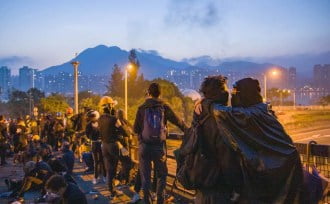
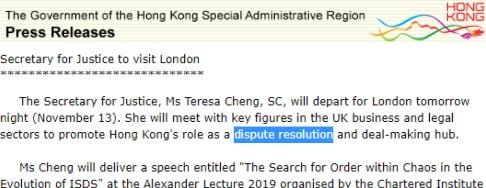
A column of smoke rises over Asia’s dispute-resolution hub this morning as Poly U burns. There are some intriguing theories as to why the Hong Kong Police are so obsessed with besieging and capturing university campuses – from the presence of a major Internet exchange at Chinese U to the oh-so strategic location of Poly U next to the Cross-Harbour Tunnel. More likely, the cops are simply driven by a need to vanquish something as a way to ease their frustration and prove a point.

Other developments over the weekend: an NYT scoop about Xinjiang adds to Beijing’s woes, pro-CCP figure Tsang Yok-sing gives an illuminating (pinch of salt required) interview on the worthlessness of the Hong Kong administration, and the PLA battle bricks in the road at Kowloon Tong.

Question: What do all the hundreds of observers now using the word ‘de-escalate’ have in common? Answer: none of them are in the Hong Kong or Chinese governments. Like many, Ben Bland ponders why the authorities are so determined to solve the unrest through force when it is so obviously not working. As he says, the idea that Beijing is deliberately choosing chaos as a tactic seems improbable – it is a high-risk approach and doesn’t square with the CCP’s paranoia about anti-government sentiment spreading across the border. A misinformed or deluded national leadership is more believable. Most likely, more than anything else, Xi and comrades have no idea what to do.

They can continue the cycle of repression-resistance-repression until Hong Kong is a cowed, censored, curfewed police state emptied of talent and capital. This would harm Mainland economic interests and be a national humiliation. Or they can back down and allow Hong Kong its promised autonomy and its own identity. This contradicts the Xi-Leninist impulse not to give in to the popular will and to tighten rather than relax control.

Both sound hard to believe – yet there is no conceivable third course that leads to a sustainable equilibrium.

The communique following the CCP’s Fourth Plenum (greater emphasis in Hong Kong on national security, direction of local officials and propaganda) clearly indicated the ‘full Mainlandization’ route. But if Hong Kong people (and maybe the international community) can make that more trouble than it is worth, that leaves only the ‘common sense’ course.

What counts as ‘more trouble than it is worth’? Absurd sieges of campuses? Office workers in Central occupying the streets at lunchtime? Hotels that are half empty for months on end? If these are not signs that Hong Kong people are winning, they are certainly not signs that they are losing.

Keith Richburg of the Washington Post makes the case for Beijing ultimately having to tremble and obey.

Posted in Blog | 38 Comments

Some weekend links for the gentry…

A prescient pre-protest look at Carrie Lam as collaborator – with a mention of the ever-intriguing question of how the CCP managed to exert such mind-control over her. And a move to get Cambridge University to strip her of an honorary fellowship. (As a civil servant with a genuine degree, she probably won’t be too fussed. But it’s hard to overstate how seriously Hong Kong’s tycoon caste and other establishment half-wits take these quasi-credentials. To them, depriving someone of their pretentious titles is as abhorrent and inhumane as it can get.)

Confessions of a radicalized PR guy who now supports the Hong Kong front-liners.

Without wishing to put ideas into anyone’s head – for price-comparison purposes only – a video showing what happens when the HK Police’s expensive water-cannon trucks encounter cheap bricks placed on the road.

Kevin Carrico on Why the Basic Law is Garbage, on the off-chance you hadn’t realized (link may be odd – poke around).

Alibaba is about to get its (yes but why?) Hong Kong listing – or perhaps I should say the Hong Kong Stock Exchange is about to get its Alibaba listing. The local bourse collapsed into paroxysms of panty-wetting the first time round when visionary Jack Ma took his IPO to New York. Now we’ve rejigged the rules to allow weighted voting to reduce minority shareholders’ rights, and everyone’s happy again, yippee. In case you’re tempted, or you’re reading Jack’s SCMP’s coverage of the story, here’s deepthroatipo’s latest on what he refers to as a mega-ponzi-scheme…

…the “analysts” sat by in the investor call with their thumbs up their collective asses, asking ridiculous, absurd, irrelevant questions which were presumably spoon fed to them by Alibaba management, as they dutifully failed, per their orders, to even mention this gigantic accounting shenanigan/transaction at all.

By the way, don’t say nasty things about Alibaba’s Singles’ Day.

Why China will never win over Taiwan. Not that we don’t already know, but it’s always good to refresh our memories.

For nostalgia fans, vintage photos of the Beijing Automotive Factory in those halcyon days between Mao’s Great Famine and the Cultural Revolution, with guest appearance by Deng Xiaoping.

I declare the weekend open with a cheery assurance that whatever happens, things could always be worse.

Posted in Blog | 13 Comments

HK to feel the Drooling Panda Wrath of Xi

This week’s Out of the Mouths of Babes and Innocents Award goes to Hong Kong’s deputy leader Matthew Cheung, who blurts out that he has no idea why people in Hong Kong are so angry at the government. This contradicts two official lines: that we know what’s going on; and that the majority of the population back us. It is reassuring to see that the man is human.

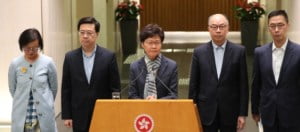
Top officials gathered last night for some sort of emergency meeting. Apple Daily reckons that, under pressure from Beijing, they were considering: ramping up police use of force; neighbourhood curfews; and cancelling the District Council elections (just as they sent me my voting card yesterday). This is depressingly dimwitted enough to sound credible.

Writing in HK Free Press, UK activist Benedict Rogers laments the inanity of trying to solve Hong Kong’s crisis of government and police legitimacy through more tear gas and arrests. However, he lays the blame squarely at Chief Executive Carrie Lam. While the woman is undoubtedly incompetent beyond belief, this is a bit like blaming a toddler for having soiled pants. The buck stops in Beijing, where (as CCP spokesmen constantly remind us) ultimate authority lies.

What is flabbergasting is why not one of Carrie, Matthew and all the other sad mediocrities…

…will tell Beijing that this problem cannot be solved by force and that they will resign rather than cooperate with this stupidity that is killing their home town. Not one.

Bill Bishop in his Sinocism newsletter today says…

There however seems to be no obvious pathway to the restoration of anything resembling order in the city. It appears Xi Jinping has decided to allow chaos to increase, believing that the growing contradictions inside Hong Kong society will ultimately lead to so much anger from most of the Hong Kong populace towards the “radical” protestors that the protests will eventually end…

The growing chaos and economic pain in Hong Kong does have real propaganda value for the Communist Party. The CCP has railed for years against foreign interference and color revolutions, and now the propagandists can easily argue that one has arrived in PRC territory, and as in other countries it has brought chaos, violence and economic pain, and that the stability that the CCP brings demonstrates the superiority of the PRC system.

Beijing and its propagandists are indeed increasingly portraying the situation as a cataclysmic struggle with foreign-backed terrorism. To add to the ambience, Chinese authorities have arranged ‘evacuation’ of Mainland students and are encouraging social media stories like the one saying Hong Kong police shot protesters to protect (non-existent) buses of cute Mainland schoolkids from attack.

China analysts know that when the CCP focuses on its domestic audience it often alienates the overseas one. Maybe Hong Kong is to be the ultimate example.

Local officials are still trying to maintain some sort of ‘business as usual’ façade. Only with reluctance did the government declare schools closed today. Xi’s ‘Extra Tough’ directive implies far more disruption to life and business. Curfews and additional police-rampaging must mean a further collapse in tourism, cancellations of conferences and events, closures of retail businesses and some suspensions of bank and market operations. It will mean departures of expat executives, and perhaps such phenomena as bank runs, panic-buying, even looting. Not to mention increased resistance from the population at large.

Are the CCP prepared to destroy Asia’s World City in order to save it? Don’t they fear a pyrrhic victory (see Minxin Pei)? Will influential interests with Hong Kong exposure – CCP elites, local tycoons, overseas investors – challenge the Emperor? Or will our establishment do nothing and accept their fate, as promised by students, that ‘if we burn, you burn’?

It’s hard to believe that no-one is going to do anything as Beijing tries bludgeoning its most developed and international city into submissive ruins. He says, hopefully.

Posted in Blog | 19 Comments

HK Police perform ‘Taking Tiger Mountain by Strategy’

HK Chinese University looks more like Hamburger Hill as the police are apparently consumed by some sort of obsessive-compulsive need to assert their authority over the campus at any cost (and last time I checked, still hadn’t).

Open any history book about a modern-era popular movement against the authorities in the Greater English-speaking world, and somewhere around page 200 or so, you will find the part where (to use the authors’ invariable phrase) the government starts ‘enrolling special constables’. And here we are. These books usually last about 300 pages.

While many idealistic types are disappointed that Western governments are not doing more, the last few days’ events in Hong Kong have attracted renewed overseas interest. From the Financial Times

Examples of police double standards when it comes to dealing with pro- and anti-government protesters are too numerous to count. Members of criminal triad groups who attack anti-government protesters have been dealt with incredibly leniently, while anyone who looks like they might be a demonstrator is at risk of being beaten unconscious.

The Independent

Anyone wanting to experience the sudden imposition of a police state and white terror, try a short break in Hong Kong.  

And, beyond mere commentary, a damning Korean television report (follow the links) featuring someone claiming to be a Hong Kong cop. (Among the claims: that senior police management let triads overrun Yuen Long MTR on July 21 in order to convince the Hong Kong public how much they need the police. So deranged, it must be true.)

The HK Police have become the story. Every pepper-spraying of a pregnant woman, every clubbing of a motionless arrestee lying on the pavement, every handcuffed schoolgirl further isolates and diminishes whatever passes for a Hong Kong government.

A small sign of establishment nervousness comes as 125 more-or-less prominent public figures sign a statement calling for the November 24 District Council elections to go ahead. (One, John Tsang, goes further and calls for an inquiry into the police.) They include moderate pan-democrats, but also former government officials, academics and business types (like landlord Allan Zeman) who at least straddle the bureaucrat-tycoon/shoe-shining/Beijing-friendly fraternity.

District Councils have no power, but the elections will represent a glorified public opinion poll (in which the pro-Beijing camp will probably do badly). Postponing them would be inflammatory. But the issue is conveniently bland and uncontroversial enough for anxious pro-establishment people to use as a signal – not least to Beijing – that they want to distance themselves from this wreck of an administration being dragged down by an out-of-control police force. Whether this is out of conscience or self-preservation I couldn’t possibly comment.

Posted in Blog | 16 Comments

Carrie Lam shock announcement: ‘I have nothing to announce’

It was 100% predictable that Hong Kong Chief Executive Carrie Lam would have nothing new or constructive to say at her press conference after yesterday’s Mayhem Monday.

If we want to examine her words carefully, we might detect an extra brittleness-cum-desperation in her tone following her meeting with Xi Jinping last week. She stated that it was ‘wishful thinking’ that the government would yield to protesters’ demands, adding that the protesters are ‘enemies of the people’ – a phrase with a dark history. (By some definitions, Carrie’s own words are an act of violence.)  

But essentially she just reminded us that Hong Kong does not have a functioning leadership: she is not empowered to make any decisions (even if she had a clue how to), and the supreme authority in Beijing is similarly unable – for whatever reason – to provide any direction.

So all that’s left is to order the police to continue tear-gassing the city until social harmony returns.

The authorities seem to be grasping at the hope that continued police repression of protests, other gatherings and displays of opposition will eventually wear everyone down. You might think that, after five months, this approach is yet to yield much in the way of success. But Hong Kong bureaucrats – and probably the cops in particular – are well-known for focusing on the trees rather than the forest. To them, a decline in the number of mega-marches (following MTR closures, the mask ban, thousands of arrests) suggests they are on the right track. Another three or four months should do it!

In their own ‘wishful thinking’, they fail to see that resistance is organic, decentralized, flexible, ‘like water’. And widespread. At noon yesterday, white-collar types filled the streets and walkways outside my office in Central chanting ‘murderer’ and ‘rapist’ at riot police (who, after giving great consideration to the many and varied options at their disposal, went for more tear gas). Tomorrow it will other people, in different places, doing something else (complete with an equally original and insightful police response).

It looks like we will be waiting months for Beijing to do something.

In the meantime, don’t forget the Hong Kong ‘business community’ – the local tycoon caste and the multinationals. While residents naturally rejoice at the lack of tourists, the owners of the malls and hotels are looking at months (at least) of suffering. Landlords must also worry that expatriate senior executives with delicate wives and precious kiddies in their rented luxury apartments might start moving offshore.

These local and overseas business folk are accustomed to having a government in Hong Kong that does everything for them – yet it is now actively undermining their profits and net worth. And they cannot speak out, for fear of upsetting Beijing. It will be interesting to see at what point, especially if the stock and property markets seriously drop, the pain is such that they openly squeal.

Some more for anyone who feels insufficiently depressed…

A night of vandalism in Tin Shui Wai

…it was targeted and surprisingly controlled. It’s about Beijing’s and HKG’s political failure. In a place with the social trust and development HK has, only a catastrophic meltdown in leadership can cause scenes like this.

Why violence can only get worse

Is there a way back? In theory, yes. In practice, probably not.

…It appears more likely that Beijing will follow the course outlined following the recent Fourth Plenum leadership meeting: greater control, the implementation of vague “national security laws,” and perhaps even martial law – almost certainly enforced by Hong Kong’s police bolstered by mainlanders, rather than by the Chinese army. It’s unlikely that this death will be the last.

And (from polling results pre-dating this horror) the latest figures on public trust in the HK Police.

On a brighter note: Bette Midler chimes in.

Posted in Blog | 20 Comments

Martial-Law Monday

Since Friday, when the big story was the death of student Alex Chow, we have had yet another weekend of impossible-to-keep-up-with mayhem.

An accusation that police gang-raped a teenager in a police station – her lawyers say they have DNA from aborted fetus. The police invasion of various shopping malls, including Festival Walk (hailed by media as the most ‘middle class’ retail complex to get the HKPF treatment so far). One of the ‘international experts’ brought in as advisers to burnish the toothless police watchdog goes rogue and denounces the body as incapable of doing its job.

Activists planned a ‘general strike’ for Monday and seem to have tried disrupting some transport connections. The police grasp the opportunity to maximize the potential chaos. They move in on several university campuses to fire tear gas and/or make arrests. And in Sai Wan Ho a cop shoots someone (apparently with a .38 revolver) in the abdomen and then fires a couple more times in a crowded street, hitting another person. Then pepper-spray everyone to be sure. More reports of similar things elsewhere. Also something nuts with a cop on a motorbike trying to ride into protesters. Oh, and groups of riot police are hanging around all over Central this morning, to add to the ambience.

More on the Martial-Law Monday Mess here and here.

This method of treating someone who’s just been shot in the abdomen seems an apt metaphor for the way Hong Kong is being run today.

I’m going back to bed. Will try again tomorrow.

Posted in Blog | 26 Comments

Another week in the death-spiral

While I was appeasing the wrathful Gods of Toil, Hong Kong suffered too much outrage, idiocy and mystery to keep up with. A young protester badly injured dead after falling from a car park. Slimeball Junius ex-‘Dr’ Ho apparently semi-stabbed. Talk of postponing District Council elections. A 16-year-old convicted of carrying a laser pen. The government banning political and satirical products at the Chinese New Year fair.

Understatement of the Week Award goes to an SCMP op-ed

A shift in Beijing’s approach to governing Hong Kong is about to start. We do not know precisely what form it will take. But it appears the central government is preparing to further tighten its grip on the city. There is a danger it will opt for measures which cause further discontent.

It has already started. Beijing will tighten its grip. You can bet this will provoke further resistance.

The current crisis builds on backlashes against Beijing’s earlier attempts to impose national security laws, national education and permanent top-down CCP-appointed cronyist government, accompanied by attacks on the rule of law. The Chinese leadership’s solution: try to do them again, but more forcefully.

One more explanation-by-Twitter-thread of this process: how freedom of assembly has been curtailed in Hong Kong in recent months. In brief: the banning of public marches, use of authorized assemblies as ‘arrest traps’, and police incursion into private premises.

Another example is the transformation of the HK Police into a colonial-style paramilitary force primarily tasked with keeping the natives down. The police tactics have probably irretrievably alienated the bulk of the public. This points to, among other longer-term trends, higher crime rates as the cops focus on suppression of dissent and lose public trust. The behaviour of the police has probably now surpassed the incompetence of the government as an ongoing cause of popular discontent (which the cops were deployed to deal with in the first place).

Here’s a depressing explanation of the HK Police use of the word ‘cockroaches’ for protesters. Basically: ‘Use of dehumanizing language is necessary for police to justify violence against protesters and civilians. It is hard to be brutally violent against your own kind otherwise.’

And all you want to know about the effects of tear gas on the population.

If you read only one thing today, make it this Asian Affairs Report on the Hong Kong 2019 Protests by a former cop, with a focus on the role of the police – or the authorities’ refusal to use alternatives – in worsening the situation…

…because of the absence of a political solution, every time the Police respond with force they alienate more of the public.

…The Hong Kong Police moved from a situation of widespread public acceptance and support to one of public distrust and even hatred. This is a crisis of legitimacy for the Police.

…the strategy remains to use force against all participants in unauthorised political protests. This inevitably results in strategic political defeat.

Note that last sentence: if the Hong Kong people win this uprising, thank the cops.

I declare the weekend open with a variety of worthwhile links.

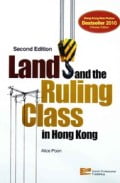
An interview with Alice Poon, author of the magnificent Land and the Ruling Class in Hong Kong. Ignore the factual errors in the introduction by lausan.hk – the rest is a good summary of land policy’s role in screwing up Hong Kong.

Richard McGregor on how Xi Jinping’s hard line on Hong Kong undermines China’s aim to take over Taiwan.

The logic of Chinese politics in the Xi era makes a softer, more accommodating line from anywhere in the system untenable, unless it comes from the top. In turn, Xi himself is determined not to display any weakness on either issue, lest he should give his critics ammunition that can be used against him…

The “one country, two systems” formula was devised by Deng Xiaoping and once sounded like an ingenious way to win over Hong Kongers and bring them gradually and willingly under Chinese rule. Now it just looks like another form of colonization.

I remember a time when strategists dismissed China’s putative invasion of Taiwan as ‘the million man swim’. A more up-to-date analysis of the situation

President Xi seems willing to use force.  He increasingly sounds like a resentful drunk talking himself into a fight in a South Boston bar at 1:00am…

Onto cultural matters. I thought it was just personal taste that leads me to like listening to Indian ragas (click on pic above for one) but never to Chinese music. But it seems experts agree: Indian and Western music are much richer, and the Chinese pentatonic-scale-with-no-harmonics stuff really is a big snooze.

Having said that, in all fairness, there’s always Cantopop. Here’s Shirley Kwan set to Hong Kong protest footage.

And a mystery sighting in Taiwan – and it’s not Elvis.
Posted in Blog | 6 Comments

In a rush today, but…

In its communique following the recent Plenum, the CCP said it would (among other things) strengthen and enhance Hong Kong’s legal system and enforcement to protect ‘national security’. In the meantime, Beijing and its local proxies must make do…

A good thread on the legal technicalities of the two interim injunctions the courts have rather generously granted the government (banning doxing of cops and promotion of violence online). Bottom line (to the non-legal mind): the injunctions are flawed and perhaps worthless.

An interesting summary of a recent talk at HKU on freedom of assembly and policing of protest. When you’re in riot gear, an expert says, everything looks like a riot.

And an update on the number of protest-related arrests – estimated at some 3,400. I recall that two or three months ago, the cops advised officials that once they arrested around this number, the protests would end and everything would be tickety-boo. I think the phrase was ‘a hardcore of 2-3,000’, so of course maybe they’ve caught the wrong ones.

Posted in Blog | 28 Comments