Decline of the Hong Kong murder

Boring Hong Kong newspapers lead today with the official confirmation of China’s new leadership, including the appointment of Li Keqiang as the new Premier – an event that was pretty much cast in stone years ago. Alongside the reports are lengthy discussions and analyses, all skirting around the fact that nobody has a clue about these people or what they think.

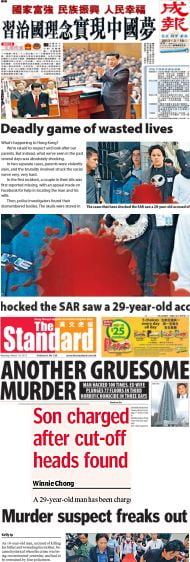
The more entertaining newspapers, on the other hand, cover gruesome murders. On average, Hong Kong has barely a couple of homicides a month, so when three gory cases come along on successive days, it’s quite something. Faster than you can say ‘clustering illusion’, the Standard’s tastefully blood-spattered ‘Mary Ma’ editorial demands to know what’s happening.

All three cases, totaling four slayings and a suicide, are domestic, which is not statistically improbable. In the first, discovered on Friday, a 29-year-old male plus a companion are accused of killing both his parents in dismemberment-of-bodies, heads-in-fridge fashion. Debts, a childhood of forced piano lessons and subsequent inability to get a girlfriend may figure in all this, along of course with spending too much time alone on the computer – which as we all know turns anyone into a violent criminal, present company excepted.

In the second, an 18-year-old, again with a companion, is accused in the killing of his father and injuring of his mother. Among potentially juicy ingredients here are creepy comics, freaking out at the crime scene reconstruction, and maybe even the fact that the mother is Filipino (marriages to Filipinos are fairly uncommon among Hong Kong Chinese men, who perhaps find it hard to handle the Southeast Asians’ incessant cheerfulness). Plus, no doubt, excessive computer use.

The third is rather up-market. The male victim was a member of the Chinese People’s Political Consultative Conference, racehorse owner and ‘fruit logistics’ magnate living in a luxury Tsimshatsui duplex that rented for HK$130,000 (now of course subject to a discount for possibly being haunted). The ex-wife stabbed him nearly a hundred times and, after a call to her German current-but-separated husband, threw herself from the 77th floor window. Two little kids survive. All very messy, in every sense.

Of the crimes, the third would probably be destined for the highest profile if it weren’t for the fact that with the perpetrator beyond the reach of the law there will be no trial. A movie maybe? On the surface, all three tragedies look like pretty classic examples of Hong Kong murders (and suicides for that matter), with the key element looking, essentially, like unacknowledged and untreated mental problems that fester and intensify before erupting. They won’t go down in history alongside the Braemar Hill killings (memorable for dashing the colonial-era assumption that Chinese didn’t kill white people) or the Nancy Kissel milkshake-and-carpet dysfunctional-luxury-lifestyle extravaganza. And obviously, none comes remotely close to the ultimate, archetypal Big Lychee homicide: the Hello Kitty murder.

We are all relieved that among those people who have not been unlawfully killed in recent days is BC Lo, vice-chairman of something called the HK Association of Amusement Parks and Attractions. His SCMP article on Saturday calling for ‘joined-up thinking’ on Hong Kong’s tourist influx proposes exciting new ways to attract even more visitors, especially once the Zhuhai bridge opens in a few years’ time. Among his profound and visionary proposals for cramming tens of millions of additional tourists into the city…

…the government can consider using Lantau as a holding area. As long as we develop the area properly, our guests will be happy to shop, wine and dine there before returning home or going into the city centre.

Lucky Lantau.


Posted in Blog | 11 Comments

Footnote…

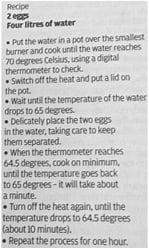
On the subject of food pretentiousness, here’s a recent South China Morning Post epic recipe for two boiled eggs…

I declare the weekend open.

Posted in Blog | 3 Comments

Restaurant review: Amber (in which a foodie draws the line)

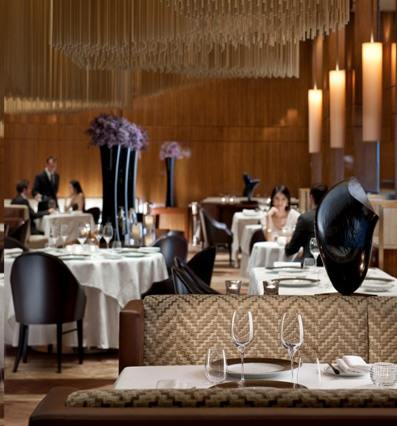
Some really, really classy restaurants, it says here, have banned patrons from photographing their meals. This anarchist got away with it a couple of weeks ago in the Michelin two-star Amber in the Mandarin Landmark in Central, the only establishment in China to make it into the World’s 50 Best Restaurants. The chef is Richard Ekkebus, of whom I had vaguely heard in an isn’t-he-a-tennis-player sort of way. World famous among serious foodies, it seems.

The cuisine describes itself as French, but I’m not sure an average Parisian or Lyonais citoyen would recognize any of the dishes here.

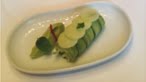
We began with this amuse bouche. If sculpture using green edible plant material were an artistic genre, it would be a masterpiece. The little discs, barely half an inch across and a few microns thick, are slices of apple. The tube beneath is made of cucumber and contains yogurt. (All ingredients are of course very special, coming from remote valleys in the Andes, etc.) The stuff next to it is guacamole, even though it looks like guacamole. Some nimble-fingered underling in the kitchen must have taken hours, and it’s gone in one bite. Nice: a lovely combination of crunchiness, creaminess and fresh, tangy tastes. I make a mental note to consider combining apple and cucumber more often – possibly with a bit of salty cheese? With a thick grainy bread?

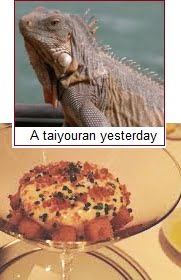
When looking through the menu, my host – a Henry Tang wannabe devoted to the whole wine-collecting, golf-playing thing – had recommended the ‘Cauliflower velouté with taiyouran egg sabayon’ as the starter. Filtering out the mystery vocabulary, I was left with cauliflower and egg, which sounded OK. It all depended on what a taiyouran was. An egg-laying animal, obviously. But a special superior breed of chicken – or an exotic species of giant iguana? My host said it was Japanese. Imagining some sort of vegetable teppanyaki you could dip in soy sauce, I chose it.

Wrong. It looked quite like this and came in a similar giant wine-glass vessel, to be eaten with a spoon. The staff linger and talk you through dishes, and the waitress suggested that I stir this one before eating it; behind her smile was a grim urgency that said ‘you’ll regret it if you don’t’. Beneath the foamy surface was a black, tarry mucus with brown lumps. Then, delving deeper down, I saw raw egg yolk. I stirred thoroughly before devouring. It was lukewarm and sticky. Obviously, you’re supposed to get off in a big way on the mushy/crunchy textures and sweet/savoury flavours. I didn’t feel a desperate need to gag, exactly, but I certainly had a sense that I could do so at will, with little effort. It wasn’t… what’s the word I’m looking for? Enjoyable, that’s it. I’m showing my age here, perhaps, expecting food to be enjoyable.

(OK: velouté is a sauce based on chicken stock; Taiyouran is a Japanese brand of hyper-expensive eggs laid by chickens that are fed only secret magic herbs and have daily massages; sabayon – the foamy stuff – is a chic version of the Italian zabaglione, an egg-based dessert.)

I was so disturbed by the above course that I didn’t have the presence of mind to snap a picture of it or the main event that came next. This looked like a glistening square of French caramel pudding with chopped shallots, beetroot, herbs and cranberries painstakingly arranged on top, and a dark sauce artistically drizzled around. It was in fact ‘Stew ravioli wild venison’. A big pasta shell containing slices of deer. Edible and tasty, even, but no improvement on a conventional arrangement of venison with pasta.

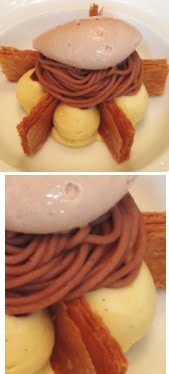
Recovering from the raw yolk-black mucus trauma, I pulled the trusty camera out to capture pudding: ‘Chestnut ice-cream, brown rum marinated raisins & pastry diplomat cream served as a deconstructed mille-feuille’. (Whaddya mean, ‘What’s diplomat cream?’) I was suspicious at first. It was magnificent visually – possibly the finest ever expressionist figurine crafted from dairy products and marron glacé. But where, or rather what, was the challenge? Was there shaved air-dried hedgehog loin scattered into the gaps left by the deconstruction of the mille-feuilles? Did chili-stuffed pickled garlic lurk within the cream as a tantalizing contrast to the soothing sweetness? Had Richard Ekkebus’s minions left delicate shards of specially imported broken glass in every mouthful?

No. As if to reward the victim diner for getting through the earlier courses, the restaurant served up something you would actually want more of.

Just as you add a pinch of sugar to offset lemon or vinegar, so Amber includes a dash of humour to ensure you’re not overcome by the earnest pretentiousness. For example, lollipops made of paté as a between-course nibble. My host, well-known to the staff, got a lot of bowing and scraping, but the heavily-accented French uber-attendant – straight out of central casting – seemed to sense I was a skeptic; as with other supernatural powers, Richard Ekkebus’s mystical gifts with food don’t always work in the presence of negative vibes. Trying a bit of telepathy with the Filipino and HK Chinese waitresses, I got the impression that deep down they were on my wavelength: why not just have a bowl of noodles?

You’re supposed to say the surroundings are amazing (it cost loads and the designer was someone really famous). One thing I noticed is that the artful ceiling radiates a gilded halo over the restaurant’s rich spectrum from amber to russet. I did – honest. One thing you get for your money here is space; the surface area of our table for two equalled the square footage of a whole Soho concept themed eatery.

Otherwise, this is the level at which this particular foodie declares that pretentiousness officially begins, thus perhaps revealing himself to be only a semi-foodie after all. Some of us can consider ‘sake in a cup that was also previously filled with smoke’ and ‘liver … paired with a hibiscus reduction’ without laughing out loud, some of us just can’t manage it.

Click to hear ‘Sexy Anarchist Boy’ by Cheese on Bread!

Posted in Reviews | 16 Comments

Relevant professional knowledge, insightful comments produce constructive dialogues

Ceaselessly jabbering National People’s Congress deputy Rita Fan says, to no-one’s great surprise, that it was she who started the Great Hong Kong Preliminary Election Debate Controversy Scare of 2013. Essentially, her proposal was that 100 pro-Beijing loyalists would meet in a secret conclave and announce the Chinese Communist Party’s approved Chief Executive candidates via smoke signals from a chimney, and the city’s voters could then choose between them via universal suffrage. It was just something she blurted out. Just as most of us jerk our leg when a doctor taps our knee, Rita involuntarily yacks when a reporter puts a microphone before her. It’s surely not my fault, she basically pleads, if they take what I say seriously.

Mercifully, the two-week circus in the nation’s capital comes to an end tomorrow for another year.

Back home, the Economic Development Commission has its first meeting. A gushing government press release informs us that…

Members with immense experience and relevant professional knowledge have made insightful comments and entered into interactive and constructive dialogues [sic] with the Government on how to grasp the opportunities provided for under the National 12th Five-Year Plan and other plans, as well as how to promote further economic development and how to maintain Hong Kong’s long term competitiveness.

Fatuous Waffle ‘R’ Us. Chief Executive CY Leung set the body up a couple of months back. Members include a generous number of pro-establishment business figures from former-CE Donald Tsang’s time, which suggests a rift-healing effort to please Beijing.

However, there is a less symbolic side to it all, concerning a question that dates back to colonial times: should Hong Kong stick with its supposed non-interventionism or should it go for Singapore-style state planning? Today’s China Daily columnist is a typical proponent of the latter approach, saying the old approach has left our economy…

…too lopsided, relying too much on a few sectors, particularly real estate and finance…

The Chief Executive’s move to help develop other industries and diversify the economy is the right step for tackling the city’s deep-seated social problems. A diversified economy and thriving industries will help improve the city’s job-market structure, providing better employment opportunities and upward mobility to workers while giving rise to a stronger middle class.

Government’s direct investment in certain industries or projects is necessary, especially when they are still in nascent stages and fail to attract sufficient private investment, or when they are critical to the development of other industries…

The argument is that because there is so much profit to be made out of real estate, capital fails to flow into other industries. It is an analysis that confuses cause and effect. Capital fails to flow into other industries because it gets sucked up by the real-estate sector and its highly supportive associate, Government Land Monopoly Inc. Thanks to an artificial shortage of space, rents (landlord/developer/government earnings) are so high that only financial services and luxury brand retailers can generate enough profit to exist. The economy does not ‘rely’ too much on real estate; real estate is a parasite.

If government and developers sucked up less of the profit made by wealth-creating economic activities, a hundred commercial flowers could bloom. What would they be? They might be health care, or nanotechnology, or creative blah-blah, or some state-picked ‘pillar’ industry. Or they might be something else that hadn’t occurred to bureaucrats. Investors and entrepreneurs would put their resources into whatever they thought would bring the best returns. The key is: they would have an incentive to do so because they would no longer have to share so much of the returns with property tycoons and John Tsang.

Proponents of more government intervention in capital allocation, rather than less government control of land, must be doing one of two things. Either they are putting the cart before the horse, out of sheer simple-mindedness. Or they want to nurture certain industries without disrupting the property cartel-government racket – said industries just so happening to be ones they are involved in, and said nurturing to be accomplished with your and my money.

Many of the academics involved in this debate belong to the first group. They are so accustomed to the distortions of the land system they don’t notice them. Certain business figures, however, surely come in the second, rather more odious, category. The South China Morning Post quotes two members of the Economic Development Commission…

…The government is ready to plan for the next 10 to 20 years, Allan Zeman, chairman of Ocean Park, said. “The government used to have its hands off. Now, like Singapore, it is showing quite a strong leadership.”…

…Allen Ha, chairman of the Lantau Economic Development Alliance, called upon the government to … boost the city’s tourism capacity by supplying more land for hotels.

Pro-democrat politicians could demand: “Whose land is it anyway?” Instead, they loudly demand that EDC members make declarations of interests. Sheets of paper? Look all around – their interests are staring you in the face.

Posted in Blog | 14 Comments

Beijing identifies new threat: tall female lawyer

CPPCC chairman Yu Zhengsheng states that China will “more strictly follow the socialist path of political development with Chinese characteristics [and] not imitate Western political systems under any circumstances.” We have been hearing this from dozens of top officials, what – once a month on average? – for at least a couple of decades now. If they’re so sure about it, why do they need to keep saying it? My guess is that they know the current system is unsustainable, but, out of self-interest or genuine practical doubts, cannot accept the only known viable alternative. There is nothing left to do but rule out the alternative with frenzied vehemence and pray the Beijing Model ‘China Dream’ comes true. In fact, it is rising vehemence: note the “under any circumstances” added to the usual phrasing.

It is our friend Mr Yu, of course, who prompted the recent fuss about how any future Chief Executive of Hong Kong must be a patriot who loves the country and loves Hong Kong. More than a few rumours suggest that Beijing is petrified of the Civic Party’s Audrey Eu getting on the ballot. For what it’s worth, the Standard’s ‘Mary Ma’ column alludes to this. (Perhaps someone on the Mainland is still smarting from then-CE Donald Tsang’s awkward TV debate with the 5ft 10in barrister in 2010.)

Audrey will be a sprightly and fragrant 63 at the time of the 2017 election, with – one might venture to suggest – a trace more charisma than the Democratic Party’s Albert Ho. If Chinese officials really are that worried about her, she has an intriguing opportunity to engage in some effective realpolitik: essentially, do a deal for better governance in exchange for not trying to run in 2017.

One way would be to produce, sooner rather than later, a dynamite policy platform guaranteed to win strong public backing (all our favourites: land reform, a cap on tourists, proper health funding, a fairer school system, crush the Heung Yee Kuk, kick Disney out, free beer on Fridays, etc, etc). This would put Beijing in a spot. They might push their preferred man to promise to match her reformist proposals; they might offer her a minister-level job in exchange for backing their guy – who knows? Sadly, such a practical, results-oriented, getting-your-hands-dirty approach hardly seems likely from Audrey or any of our pro-democracy idealists. It’s so much more fun being a martyr for an abstract cause.

On a far more serious note, respected China-watcher Steve Tsang explains the black hair dye conundrum: the top leadership in Zhongnanhai sport identical heads of hair (and suits) to avoid standing out, which could mean being blamed for mistakes. Danwei’s Jeremey Goldkorn adds that the uniform look also reinforces the image of group responsibility as opposed to rule by an individual. It all makes sense: the idea of ruthless, Communist-trained engineers indulging in vanity-driven preening always seemed a bit jarring. So, logically, we can infer that anyone who does stand out is someone with no power or influence at all, but is present purely as a token. Thus…

Click to hear ‘Song for Audrey’ by Backseat Goodbye!

Posted in Blog | 18 Comments

All must have prizes

With a sort of not-sure-why-I’m-here look in his eyes, Former Hong Kong Chief Secretary and unsuccessful Chief Executive candidate Henry Tang is ‘elected’ to the Standing Committee of the Chinese People’s Political Consultative Conference. Ex-CE of Macau Edmund Ho advises us not to view the appointment as a consolation prize after Henry failed to get the Big Lychee’s top post, even though it was handed to him on a plate. In other words, yes, it is a consolation prize. And a pretty worthless one too. In the old days, the Queen would give you a knighthood and you could call yourself ‘Sir’. (Some people, like Hopewell Holdings boss Gordon Wu, still pretty much insist on it. Is this a tycoon’s version of waving a colonial flag?) Ho adds that Henry got the job because ‘he knows many people from various sectors’ – in case anyone was wondering how they too could qualify for this esteemed body.

Among other lucky new or continuing Hong Kong members of the CPPCC Standing Committee: Hospital Authority chairman Anthony Wu; Peter Lee Ka-kit, son of Henderson Land boss Lee Shau-kee; Sing Tao chairman Charles Ho; Victor Li, son of Cheung Kong/Hutchison boss Li Ka-shing; New World Development chairman Henry Cheng; and Wharf chairman Peter Woo.

That list includes representatives of all the top four members of the Hong Kong property cartel save Sun Hung Kai, whose owner-bosses are sadly busy facing corruption charges. It might seem strange that the people who are in many ways responsible for the Big Lychee’s most serious social, political and economic problems are given such honours. In fairness, it is government policy rather than the lucky developers who are the cause of Hong Kong’s property pyramid scheme and its attendant evils. The reason is that, apart from Cheng, all the people on the list supported Henry in his tragic and doomed bid for CE last year, and Beijing needs to give them all this rather vacuous consolation prize. Cheng is there to make it look as if this is not the case.

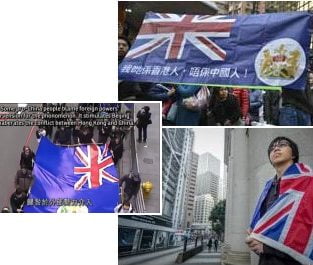
Most pitiful name in the line-up is surely Peter Lee. The podgy heir to Henderson Land recently slammed young Hongkongers for the ‘outrageous’ act of waving the colonial flag (a pronouncement that had me rummaging around in my cupboards to dig out my trusty old lion-and-dragon banner). It is single, Buddhist Peter who famously sired triplets via a surrogate mother. His younger brother Martin is by all accounts relatively switched-on. The bizarre thing is that someone in Beijing seems to imagine that all of us here in Hong Kong will somehow respect this bunch for their senior CPPCC status. (The CPPCC as a whole seems far from exclusive; it looks like they’ll take anybody.)

Back home, the big boss at Radio Television Hong Kong, Director of Broadcasting Roy Tang, denies accusations of political interference in editorial decisions, calling them ‘regrettable’. We increasingly see this word used in such circumstances. Rather than dismiss others’ charges as ‘incorrect’, ‘wrong’, ‘erroneous’ or plain ‘bullshit’, wounded innocent parties call them ‘regrettable’, which means something very different, and they do so in a sort of whiny, defensive tone. Most mysterious.

Another mystery is solved, however. Admittedly, the Standard and the South China Morning Post disagree about the number of dead pigs floating around in the river upstream from Shanghai. But who among us could seriously manage to work out whether it’s 2,800 or 3,300 of things all bloated, bobbing up and down and bumping into each other in the muddy waters? How did they get there? It suggests here that people are breeding too many pigs and, following a crackdown on trading in contaminated pork, there’s not enough land in the villages to bury the carcasses. So now we know. Simple, really.

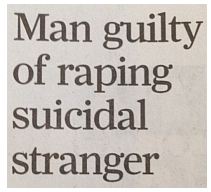
And finally, courtesy of the SCMP, the Headline-You-Have-To-Read-Twice of The Day Award goes to…


Posted in Blog | 8 Comments

Another step to guided democracy

An anonymous source ‘close to Beijing’ suggests that some sort of preliminary election will take place when Hong Kong chooses its Chief Executive by universal suffrage, presumably in 2017. Most of us don’t need to be told the Chinese Communist Party cannot allow a popular vote without a guarantee that all candidates accept its monopoly of power; the Basic Law refers to universal suffrage in the context of ‘nomination by a broadly representative nominating committee’. As with the current Chief Executive Election Committee, ‘broadly representative’ means rigged via the selection of members who appear to represent ‘various sectors’ but are mostly loyal, with a crucial number who are totally obedient.

But some people can’t bring themselves to accept or admit this. Pro-Beijing and United Front figures insist on maintaining a fiction about how the CCP is cool with democracy. Former Justice Secretary Elsie Leung claims that whatever system emerges will be free and fair, while non-stop chatterer National People’s Congress delegate Rita Fan blathers away about how the process will be the equivalent of, say, a party-based primary election in the West.

Similarly, pro-democrats cling to their own fantasy about the ability of a one-party state to give up complete ultimate control. Former Chief Secretary Anson Chan is probably right in saying that Hongkongers wouldn’t vote for someone hostile to Beijing, but that cuts no ice with a paranoid CCP that detects foreign subversion all around.

This is not the first time Beijing has managed expectations about democratic development in the Big Lychee. On this occasion, it will likely undermine potential popular support for some forthcoming pro-dem activities.

Last month, law professor Benny Tai proposed a carefully planned ‘Occupy Central’ sit-in for July 2014, drawing on the principles of civil disobedience. There would have been something eloquent and inspiring about 10,000 people peacefully and willingly putting their own liberty at risk for the cause of universal suffrage. Citing Thoreau, Gandhi and Martin Luther King, participants could expect broad support in the community – especially if Chief Executive CY Leung hadn’t solved his trust and effectiveness problems. The local and national authorities would cringe under the international attention. The one-party state would not collapse, but as we have seen with Article 23 and National Education, Beijing can be induced to blink first. The exercise could at least prompt a much firmer commitment to a semi-democratic poll in 2017 and possibly even help produce a slightly more open system.

Now that’s probably not going to happen. The Democratic Party’s excitable lawmaker Albert Ho and other impetuous, hyperactive and self-indulgent pro-dems will want to push ahead with an ‘Occupy Central’ of their own this year. Unlike Benny Tai, they will not conceive and design it to produce a specific outcome. They will drag other demands, from ‘CY Leung stand down’ to ‘universal pension’ to ‘free Liu Xiaobo’ into the protest. They will leave the public bemused, if not irritated, at the traffic jams and extra policing costs.

Albert Ho is also thinking of standing down as an at-large democratically elected lawmaker in order to trigger a by-election that would serve as a de-facto referendum on democracy. Last time the Civic Party tried to pull this potentially effective but easily wasted stunt, the DP refused to go along. The pro-Beijing camp undermined it by refusing to run any candidates, and the result was an embarrassingly low turn-out and charges of wasting taxpayers’ money. Ho is also proclaiming how willing he is to be jailed and/or lose his right to practice law. He would be better off storing his ego wherever he keeps his charisma.

A rigged preliminary quasi-election poses an interesting possible challenge. What if, say, CY Leung wants to get on the ballot in 2017, and has a feeble 20% opinion poll rating, and another pro-Beijing figure like Tsang Yok-sing also declares an interest and similarly has only a 20% rating – and a pro-dem figure comes forward with 50% in the opinion polls? How does the process and subsequent Chief Executive have any integrity when the rigged Primary Election Committee ‘votes’ to put only Leung and Tsang on the ballot? Thanks to the pro-democrats, Beijing doesn’t have to worry about this problem.

Posted in Blog | 17 Comments

The Tony Chan soap opera – just a few more episodes to go

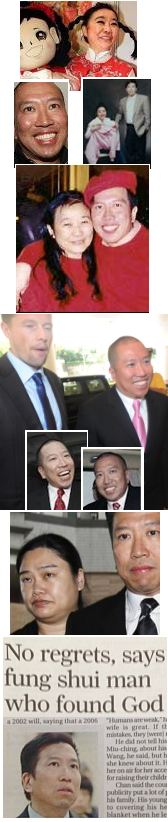
The rise and fall of Tony Chan seems to be about 80% complete now. It would be tempting to see the saga as a metaphor for something, but it seems to be no more than a simple morality tale: a warning of what happens when someone born to be a bartender gets ideas massively above his station.

How he reinvented himself as a feng-shui master, and how he inveigled his way into eccentric billionaire widow Nina Wang’s affections and chequebook is mercifully a bit murky. What they got up to is more graphic and stomach-churning: geomantic rituals connected with Nina’s kidnapped-presumed-dead husband Teddy; transfers of vast sums of cash; sex (please spare us the details); the naming of his son ‘Wealthee’. Then at last comes the bit we had all been waiting for: the inevitable downfall, starting with court proceedings, which Chan attended accompanied by dim-looking Western bodyguards and a ludicrous grin just begging to be wiped off his face with maximum prejudice.

Nina’s will leaving him her billions was – inevitably – forged. That alone is a serious offence. Then the Inland Revenue came round sniffing after a slice of the billions Nina had paid him for the voodoo sessions. To our understandable glee, the private jet had to go, as did the grin – goodbye Lear, goodbye leer! From what we could see, Chan’s impassive, moon-faced wife slowly started to realize deep down in her perhaps less-than-perceptive mind that this whole thing was not a dream but really happening, whatever it was.

Now we are eagerly awaiting the trials (one begins next month), the sentencing and the slamming of the prison door. In a separate drama, Wang’s family have bickered over the fate of the fortune; it now seems it will end up as some sort of charitable trust overseen by, among others, property tycoon-playboy Cecil Chao and the immortal and omniscient Ronald Arculli – all so predictable it is barely worth mentioning.

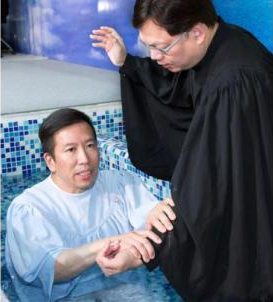
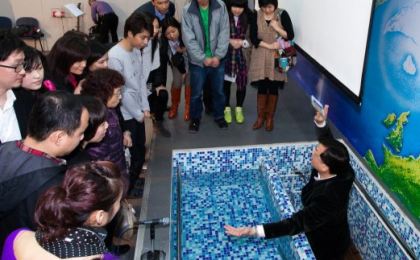
In Matthew 16:16-18, Jesus renames Simon the apostle Peter, which of course means ‘rock’, and pronounces him the foundation of the church. As if to wrest a bit of the limelight back at this juncture, Tony Chan renames himself likewise through christening at Crossroad Community Baptist Church in that land of spiritual devotion, Tsing Yi…


Evildoers who find God provoke an obvious question: is it real, or a publicity gimmick? Watergate conspirator Charles Colson spent his whole post-prison life back behind bars spreading the word among convicts. We can’t rule out the possibility that Tony/Peter Chan is genuinely distraught about the terrible things he has done and has sincerely accepted Jesus, who died for these and our other sins, into his heart. His denunciation of feng-shui as (correctly) the work of the devil suggests that he has sensed a whiff of fire and brimstone and is petrified of what awaits him in the hereafter.

But there is a problem – apparent in the picture of Chan in the Tsing Yi baptism pool. The poor bastard was born with the face of a fraud that probably not even plastic surgery could fix. The perfect lighting and composition of the photograph magnify it. Could it be that he fears Correctional Services Department congee for breakfast every day for a few years more than eternal damnation? Will a Hong Kong judge be fooled?

Of all parts of the entertainment industry (in the broadest sense), religion is especially prone to taking itself too seriously. Crossroad Community Baptist, to which the charming christening photo is credited, no doubt has its own agenda here. Rescuing a fallen celebrity villain can’t be bad for business. (Note also that the shot was taken before the dunking into the water, after which the subject would have look disheveled and basically silly, not in keeping with the image of perfection and piety.)

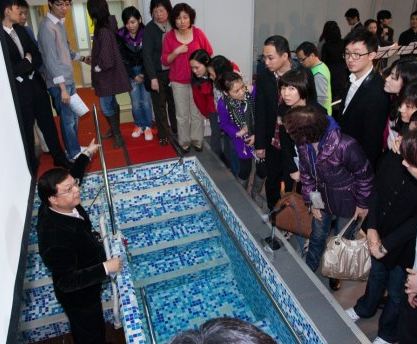
I declare the weekend open with an exclusive look at that baptism pool up close…

What’s underneath it? Does it protrude out of the ceiling in someone’s apartment downstairs?

Click to hear the Byrds’ ‘I am a Pilgrim’!

Posted in Blog | 12 Comments

Finger-wagging on flag-waving

One of the differences between Mainlanders and Hongkongers is that if someone mentions, say, ‘Guizhou’, a Mainlander will know that it’s a province in the southwest, the capital is Guiyang, the cuisine is distinctive spicy-sour, and the women are exceptionally beautiful and intelligent, while a Hongkonger will vaguely assume that it’s one of those cities near Shanghai or something. So it is with Yu Zhengsheng, well-known north of the border as Politburo member and Party Secretary of Shanghai, but hitherto pretty much unheard-of in the Big Lychee, where most people would be pushed to explain the difference between a Party Secretary and a Mayor.

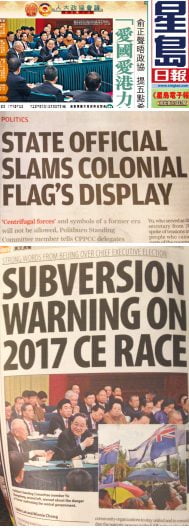
This morning, everyone in Hong Kong has suddenly heard of Yu, and everyone knows what he does for a living: he drums up business for Shenzhen flag factories. Just as the colonial banner-waving fad seemed to have died down, the guy dredges it up again at a meeting with Hong Kong NPC/CPPCC delegates in Beijing. Voicing displeasure at ‘subversive’ protests and imaginary independence movements is a sure-fire way to encourage them.

Yu’s basic point was that anyone elected to power in Hong Kong under a system of universal suffrage would have to be a patriot. If this sounds familiar, it’s because we went through all this before. It was nine years ago, following Hong Kong’s mini-uprising on July 1 2003 and the subsequent backlash against pro-Beijing parties at that November’s district polls. A Politburo member and Vice-President called Zeng Qinghong suddenly cropped up in charge of a sort of witch-hunt against pro-democrats who were engaged in a foreign-led plot to seize power in the city.

A big, contrived debate took place about what it took to be a patriot, and who wasn’t one. Now-leader of the Democratic Party Emily Lau was out, for example, as she supposedly supported Taiwan independence. To be a patriot, you had to love China and love Hong Kong. Idealists complained that was just a euphemism for loving the Communist Party. But cynics knew it simply meant saying you loved the Communist Party. Kowtow. Shoe-shine. Publicly, and looking like you’re enjoying it. No-one, other than a few dreamers, has warm emotions about something so unlovable.

In early 2004, Beijing seemed to be genuinely panicking that popular demand for democracy would result in the regime losing Hong Kong. (It seems Beijing officials in the city had bureaucratic and political interests in convincing higher-ups that then-DP leader Martin Lee was bent on pulling off some sort of US-backed coup.) Since then, the Chinese leaders have wised up and pretty much promised a form of universal suffrage for 2017. Apart from the pro-dems, still stuck in their late ‘90s time-warp, everyone accepts that the system will be rigged; a one-party system is incompatible with a pluralist one. Instead, Hongkongers are now angry about housing, milk powder, overcrowding, property hegemony, shop closures, schools, the air and a few dozen other things.

Lately, the mood has been one of growing despair. The new CY Leung administration is bogged down in bureaucracy, petty details and pseudo-scandals; the Financial Secretary is clearly suffering from some sort of obsessive-compulsive budget-making disorder; malevolent tourism authorities apparently on a mission to suffocate and bury Hong Kong are dementedly seeking ways to increase the number of visitors. It seems there is nothing anyone can do to get the message across that this is all going wrong.

And then Yu Zhengsheng comes along with the answer.

Click to hear ‘Enjoy Your Worries, You May Never Have Them Again’ by the Books!

Posted in Blog | 10 Comments

Not very important person gets not very important job

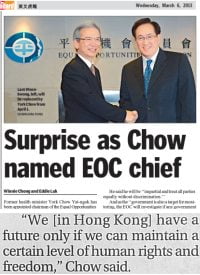
Much wailing and indignant gnashing of teeth, as the Hong Kong government appoints York Chow, former Secretary for Health, to run the city’s Equal Opportunities Commission. The real surprise would have been if someone fervent about human rights got the job.

The EOC was set up just before the 1997 handover at least partly as a symbolic assurance that rights would be protected under Chinese sovereignty. Under establishment-friendly liberal chairman Anna Wu, it sued the Tung Chee-hwa administration for gender bias in allocation of school places.

Superficially, giving girls only 50% of desirable school places when they got over 50% of the highest exam results was clear discrimination. If, as some educationalists and bureaucrats claimed, those results were an aberration caused by girls’ earlier development at that stage of life, it would be discriminatory against boys to give them less than 50%. Either way, the government felt humiliated. Wu was replaced by one Michael Wong, which led to a humungous and embarrassing fuss, though we can’t quite remember the details.

Ever since then, the EOC has been one of those tiresomely sensitive issues people get worked up about. It has played a role in expanding Hong Kong’s half-hearted legislation against various forms of bias – though for all we know, the administrations of the day might have passed the same laws anyway. Like so many public bodies, it has become a sinecure for former civil servants seeking to ‘serve the community’ without having to defend the executive branch’s hare-brained policies or get torn to shreds by legislators.

The outgoing chairman, Lam Woon-kwong, left because pro-democrats who felt the EOC’s key mission was to oppose the government objected to his simultaneous membership of Chief Executive CY Leung’s Executive Council. If Lam was at odds with anyone, it was a largely uncaring public who can’t see what’s so special about ethnic minorities, single mothers and gays.

The chattering classes assume that Chow will be a yes-man. They did with ex-civil servant Lam, too, but he proved keener on human rights than they expected. The thing is, it’s a high-profile job, and you will look like an idiot if you don’t take up the noble causes the activists present to you. Obviously, as a glance at the Selection Board’s composition shows, the appointment was the same old stitch-up, complete with officials falling over themselves to cite Chow’s ‘administrative experience’ as the clincher. But provided bureaucratic or business interests or national sovereignty aren’t affected, no-one here or in Beijing has any particular hostility to equality for Nepalese and lesbians. Like so many others, they couldn’t care less.

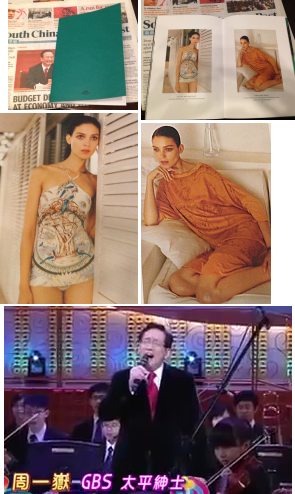
As well as insisting that some of his best friends are gay, York Chow promises to apply his medical background to protecting the rights of the physically and mentally afflicted. He could start by looking at the glossy little green book inserted into today’s South China Morning Post. To produce this perverted item, the Hermes company has taken a vulnerable young woman who is clearly both educationally sub-normal and suffering from anorexia nervosa, and forced her to pose wearing startlingly ugly clothes. And Dr Chow should know an assault on human dignity when he sees one.

Click to hear ‘Enough About Human Rights’ by Moondog!

Posted in Blog | 12 Comments