After the 2014 Umbrella Movement, Beijing (via the Hong Kong administration, via district-based civil-servant ‘Returning Officers’) barred many younger localism-tinged hopefuls from the ballot using a concocted political test. Oddly, many activists you would expect to be disqualified, like Eddie Chu Hoi-dick, have been allowed to run in November’s District Council elections.
The only one still waiting for a decision is Joshua Wong. The Returning Officer in his area has mysteriously gone sick, in the way someone might if her conscience did not allow her to obey anti-democratic orders from above (or, you may consider, in the way someone might if she was actually sick).
What brings about (the boy Joshua aside) this outbreak of tolerance among Returning Officers? It would be Beijing’s instinct, after four months of a popular uprising, to suppress opposition voices. It could be that, in a freakish fit of common sense, local officials convinced the Liaison Office that disqualifications would provoke yet more loathing for a government that has run out of legitimacy. Another theory is that the civil servants or their local superiors are petrified of being blacklisted by the US – though this assumes they have a choice.
District Councils are a big yawn, but there has been a recent strenthening of support for pan-dems, and a surge in new voter registrations – and this is a golden opportunity to give the government a big kick up the backside, and Beijing a message.
I declare the weekend open with a multitude of painstakingly curated reading matter.
More evidence that Hong Kong’s political
middle ground is evaporating: moderate columnist Michael Chugani tears
Carrie Lam to shreds.
A warning
to keep away from security or ‘bodyguarding’ companies.
I get copied in on email-newsletters from a couple of local ‘risk consultancy’
types. One is a company run by an ex-cop trying to drum up business; the analysis
is purely focused on gory mayhem in the streets. Another – some sort of
personal security outfit – issues lengthy blood-curdling advice copied to everyone
in and around the government on how best to crush the radical fanatic terrorists
in our midst. At best they are pandering to corporate clients’ paranoia; at
worst, they are mouth-frothing jackboot fetishists.
One thing they don’t mention, but AFP does:
violence
against Hong Kong government critics.
Not only does the protest movement create artwork – here’s a Yuen Long MTR attack infographic. The Resistance also does mass-spectrometry (or something fancy like that): an analysis of the Hong Kong Police’s new Made-in-China tear gas.
The Diplomat
goes inside
Hong Kong’s leaderless uprising…
Many young Hong Kongers face a terrifying choice: Continue a grotesquely uneven battle against a superior power or acknowledge that the rest of their lives are going to be without civil liberties, without democracy and under Beijing’s strict and brutal control.
A Chinese U professor in Asia Dialogue
says Hong Kong’s protests are asking
only for the city has been promised…
The protest is a small price to pay in the short term if the people of Hong Kong want to preserve the city’s future. Without it, the outcome is inevitable: the city’s gradual absorption into the Chinese system, losing its identity, culture, values, and everything that makes Hong Kong unique and different from the rest of China.
Some historical perspective from
Manchester, England: Hong
Kong and the Peterloo Massacre of 1819.
And the first time I have ever linked to Teen Vogue: Joshua Wong (need you ask?)
Bloomberg looks for signs that wealth is fleeing Hong Kong for Singapore, and doesn’t find many, really. Bear in mind that people with vast fortunes to move around try not to leave signs, and that the stability of the monetary and financial systems would be the last things to go – long after the rest of us have emigrated or been used for organ-harvesting. That said, it is amusing to see Singaporean
officials’ crocodile tears over the plight of Hong Kong.
Foreign Policy reports on how Hollywood’s shoe-shining of the CCP is backfiring in Southeast Asia. As with the NBA drama – another Xi Jinping hubristic overreach screw-up.
Asia Dialogue again, on why
the CCP fears religion…
Inspired by American propagandists including Walter Lipmann (1889–1974) and Edward Bernays (1891–1995), the CCP assumes that if a government wants to change the content of its citizens’ beliefs, it can.
(In related news, Beijing has just released
new ‘guidelines on ethnic unity’ – perhaps ‘forced cultural uniformity’ would
be a better description.)
And say a big welcome to China’s
new (‘learn from’) Comrade Lei Feng!
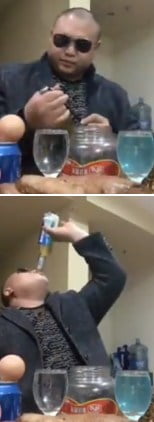
Finally, someone you shouldn’t learn from at all – but he’s the last hope for China’s Soft Power: that amazing/heroic stunt drinker from Hebei you’ve watched in horror.