Government joins HK Coalition in mask-inundation

Busy lining up for one of the Hong Kong government’s ultra-sexy free crony-manufactured ‘underwear masks’ (with a view to keeping in original packing for sale as historic artefact on eBay in 30 years’ time). So an early plunge into a weekend’s worth of attention-worthy links…

The Diplomat on ways Beijing might try to neuter Hong Kong without provoking the West into ending the city’s special status…

The Chinese government knows that if it can persuade the world that terrorism exists in Hong Kong, and that it is as severe as the terror threat facing many other nations today, the international community will be less critical of Beijing’s actions in Hong Kong.

On a similar theme, Just Security on the ending of One Country Two Systems

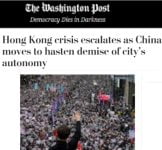
…Beijing’s latest crackdown in Hong Kong is a dramatic escalation … it represents the fruition of several gradual processes in which Hong Kong’s autonomy was undercut. Each of these processes has been visible in Hong Kong’s political landscape for years — in some cases, they predated even the Umbrella Movement. Yet, until the protests of 2019, mainstream consensus on Hong Kong among outside analysts was that there was little cause for concern.

To put these two articles in context, the HK & Macau Affairs Office issues a blood-curdling warning about the ‘political virus of black forces trying to undermine Beijing’s authority and make Hong Kong independence through bombings etc’ – violence that the SCMP thoughtfully recounts at length unquestioningly.

Wonder how the Hong Kong government’s search for a PR agency is going while the Central Government releases statements like this?

The venerable Ian Buruma in Harpers on the emerging resistance to Chinese Empire

The Chinese president, Xi Jinping, sees it as his patriotic duty to return Taiwan to the motherland, by force if necessary, under the same formula as Hong Kong: “one country, two systems.” He was foolish enough to stress this goal last October. President Tsai Ing-wen, who was lagging behind Han Kuo-yu in the polls, vowed to resist the idea. Her campaign motto was a warning: “Hong Kong today, Taiwan tomorrow.” Her poll ratings shot up, and in the end, she won the election in a landslide.

Another Geremie Barme translation – Academic Zi Zhongyun’s essay An Old Anxiety in a New Era 1900 & 2020 on…

…the disturbing echo that can be readily detected between the xenophobic extremism of late-dynastic Qing politics and recent developments occasioned by the 2019-2020 coronavirus epidemic.

Top CCP-watcher Richard McGregor having a ‘chinwag’ (you can read the transcript or listen to the recording) about what Beijing’s behaviour over the virus tells us.

The also-venerable Francisco Sisci on why China is nervous about North Korea (genuinely illuminating, with historical and US-Russia-HK-Taiwan angles).

China Digital Times compiles Chinese diplomats’ greatest hits. And a Twitter thread summarizing Beijing’s (or a Beijing think-tank’s) oh-so classy and sophisticated PR strategy to win over the world.

Via HK Free Press, the China Media Project on Chinese regimes’ fondness for ‘blood-soaked dumplings’ – or contrived tear-jerking, emotion-blackmailing, suffering-laden propaganda.

Reuters’ award-winning photos of the Hong Kong protests. And more on the Human Rights Press Awards.

A journalism student writes about his time in Hong Kong for his hometown paper in Nebraska (might help if you’ve ever been to the featureless and snooze-inducing state).

Another victory for Hong Kong soft power: the (never-seen-it TV thing) Westworld creator credits the city’s protests for inspiration.

Bitter Winter on how Uighurs became ‘terrorists’ and what it’s like to look like one.

Bloomberg looks at how Taiwan had a good pandemic. Also a plan to de-Sinicize liveries and documents. And a stunning painting of old gritty urban Taiwan – looks like Renegade Province is acquiring Hong Kong’s heritage-retro-nostalgia.

In case you missed it…

Posted in Blog | 9 Comments

Depressingly hackneyed alliance of shoe-shiners unveiled

The Hong Kong government decides its number-one harmony-promoting priority following the virus pandemic is… pushing through the National Anthem (Compulsory Adoration) Bill.

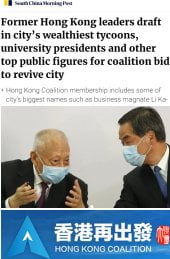
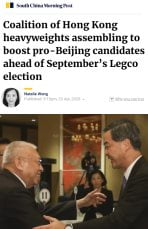
And former Chief Executives Tung Chee-hwa and CY Leung launch a ‘Hong Kong Coalition’ to counter the city’s anti-government movement.

The new grouping is almost a parody of a Liaison Office-driven United Front operation. Its other faded and unpopular leading members are ‘heavyweights’ Tam Yiu-chung and Maria Tam. As if that’s insufficiently unappealing to public opinion, it drafts in every property tycoon and his son(s). Its first Big Original Initiative to grab hearts and minds: to distribute face masks to the peasantry.

Like that lame idea, the website suggests that the supposed alliance has been hastily put together – though someone must have worked overtime arm-twisting 1,500 other shoe-shiners, especially from business and universities, into signing up.

Maybe a few less-discerning blue-ribbon types will get a kick from this stale concept and its stale cheerleaders. Its main purpose is the classic United Front tactic of ‘unifying’ loyalist elements – forcing fence-sitters to publicly align themselves with the Party. Maybe this worked under Lenin in 1920s Russia or Mao in 1950s China. But in Hong Kong in 2020, the masses will find it amusing at best, otherwise just pitiful, and certainly alienating.

Some mid-week links…

From HK Free Press, a handy explainer on the Expat Cops Illicit Property Scandal Uproar. And a great thread on the subject, complete with delightfully unflattering commentary on the officers involved.

If the Shoe-shining Alliance of Shoe-shiners want some ideas on how to design a website with cool graphics, some HKU people have released an Anti-Extradition Bill research database, including a timeline, stats and a glossary of phrases. Also, an amazing and addictive poster search engine.

Asia Sentinel proposes a fascinating theory about how Beijing’s paranoiacs see the unrest in Hong Kong. It’s not the CIA that’s behind it – it’s Xi Jinping’s enemies in the Bo Xilai faction.

Also perhaps to be taken with a pinch of salt, the latest leak received by Reuters suggests that Beijing fears the virus pandemic could boost global anti-China sentiment (hey, d’ya think so????) A ‘pinch of salt’ because of course the leak could itself be a deliberate message to the US to not mess with us when we’re in extra-fragile hyper-panicky freak-out mode.

And in the spirit of Positive Energy – not only the people but maybe even the government of Hong Kong (or at least some departments) deserve a pat on the back for beating back COVID-19.

Posted in Blog | 22 Comments

In-your-face CCP toadies need new name

Just as you had to let the inept kid play in a game because he owned the ball, the SCMP has to allow its editor-in-chief to write an occasional column. We might imagine hardened, normally brutal, subs treating her copy with a light touch, out of deference, distaste, or maybe disinterest – or (the nasty among us might think) spite.  

The result is so bad (aside from being grammatically perfect) that it can be worth reading for the sheer denseness of non-sequiturs, contradictions and derailed trains of thought wrapped up in irrelevant and meaningless blather, all connected by lashings of clichés. Today’s starts like an earnest but vacuous Ted Talk…

Is Beijing really tightening its grip on Hong Kong?

The writing is clearly on the wall and that poses more questions. Is Beijing losing its patience to the extent that it now has to step in and play its part? Why?

After an inconclusive discussion about recent protests and associated official statements, and an inane diversion into Mainlanders’ supposed reaction to a local teacher’s odd take on the Opium Wars, it ends with…

The paradox is, Hong Kong is facing an inconvenient truth in Beijing becoming more hands on at a relatively convenient time as it sees more of the mainland population losing sympathy for the city.

At the same time, Beijing has also realised an equally hard-to-swallow truth – it risks losing Hong Kong’s next generation for complex reasons, but surely that includes a weak local government, either hamstrung by bureaucracy, lacking sensitivity, or, even worse, without the political will to get the job done.

More than ever now, the people of Hong Kong need a determined leadership that can truly bridge the cross-border divide and enhance mutual understanding.

Well, quite. And on the subject of Jack Ma’s newspaper – a pressing question:

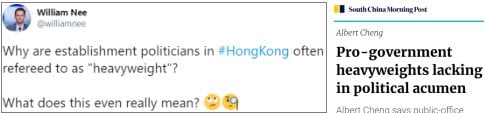
This seems to have originally been an SCMP usage, though Reuters, HK Free Press and others have adopted it. It is especially used to describe Starry Lee, Maria Tam, Tam Yiu-chung and (when she was a thing) Rita Fan.

What these folk have in common is that they are prominent Beijing supporters with important-sounding roles (DAB chair, National People’s Congress deputy, etc). Under the CCP’s top-down Leninist system, these positions are essentially ceremonial. These individuals have no input into national policy – they are simply loyalists who parrot the party line.

So ‘heavyweight’ is obviously a misnomer, since they have no influence within the power structure. However, these people are relatively accessible (presumably under United Front instructions), and the media like to quote their ‘insights‘. I would guess the SCMP started to use the tag partly to flatter the bores and to give their empty-vase quotes an air of authority.

Also, perhaps, for lack of an alternative. The more obvious title of ‘shoe-shiner’, while accurate, would equally apply to dozens of nonentities we rarely hear from. ‘High-profile shoe-shiner who gets wheeled out a lot’ would be better, but I guess wordy.

Another unavoidable fact about the ‘heavyweights’ is that they are in fact rather insubstantial. One SCMP headline even said (roughly) ‘the heavyweights are dimwits’.

The more serious CCP loyalists do not seem to be called ‘heavyweights’. Mainland officials certainly aren’t. Hong Kong business-bureaucrat toadies aren’t. And the heftier local pro-Beijing political figures tend not to be. Tsang Yok-sing – who occasionally has opinions of his own – is usually not. Nor is CY Leung, who has a distinctive, if thoroughly obnoxious, personality.

A pro-government ‘heavyweight’, is, in short, a lightweight.

We probably need a new word. It can wait until after Maria Tam goes into retirement.

Posted in Blog | 15 Comments

The weekend in review

Hong Kong’s business establishment are feeling the heat as the old cozy tycoon-bureaucrat relationship gives way to direct Liaison Office control of the city. The outgoing boss of the HK General Chamber of Commerce puts on a brave face by overlooking the rapid shift in the power structure and asking for clarity about what happens after 2047: ‘We must start the dialogue with Beijing now’.

But the CCP doesn’t do dialogue. You can have one of two relationships with it: either you kowtow and obey, or you are the enemy and a threat.

The tycoon caste had their chance 10-20 years ago. They could have practiced a bit of enlightened self-interest and accepted a need for more inclusive and responsive governance. Instead, they went full crony-snouts-in-trough screw-everyone-else. Today, they’re shoved to one side as Beijing shreds rule of law. Too late now.

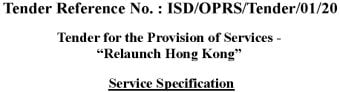
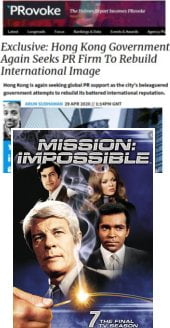
The bureaucrat side of the old alliance is also fighting a rearguard action. The Hong Kong government embarks on a second attempt to enlist public-relations expertise to restore the city’s battered international image. (Link includes fun tender documents.)

Like their business buddies, the officials are desperate and naïve. You can’t PR your way out of extensively documented incompetence, police brutality, banana-republic stunts like round-ups of lawyers, and Beijing’s unconcealed, unilateral ending of local autonomy. The Liaison Office is now pretty much even dictating the Hong Kong government’s own press statements (compare CCP-style shrieking-hysterics with the administration’s overblown mouth-frothing about foreign interference).

As if to prove the point, the HK Police find yet another of their shock-horror terrorist bomb-factories. (What is this – the fourth, fifth?) This time, the evil radical fanatics have chosen to store their explosives in a disused school that also serves as a police training site. World’s dimmest terrorists, or least-original cops?

We are of course expected to beg for anti-sedition National Security laws. If you didn’t get the message, the Liaison Office delivers a major freak-out rant over Friday’s (barely noticeable) protest activities – ‘radical protesters re-instigating and inciting violence to disrupt society once again and plunge the public into panic and pain, and ignoring the rules of the free market, plus political abduction of the economy, by enemies against the people who are destroying Hong Kong’s hopes’. Otherwise known as going to pro-yellow restaurants.

In whatever shape or form they come, Article 23 laws will (among other things) criminalize opinions, enable censorship, institutionalize intimidation and generally undermine rights, freedoms and rule of law. Nothing the General Chamber or some wretched PR agency can do about it.

Posted in Blog | 13 Comments

Beijing ramps up PR campaign ‘Operation Unlovable’

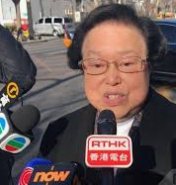
Not one, not two, but three SCMP pieces on how China is making itself unpopular around the world, encouraging online xenophobia, unleashing rabid ‘wolf warrior’ diplomats and (eeeww) nagging Germans to say nice things about them. And a fourth, in Australia. Meanwhile, Hong Kong’s police commissioner is undermining his force’s sorry reputation by freaking out at RTHK and denouncing every criticism as a dastardly smear.

There’s a parallel here. Beijing is not going to restore halfway-amicable relations with the international community unless it accepts some basic responsibility for letting the virus loose through early cover-ups. And Hong Kong isn’t going to return to any sort of normality unless the police man up about Yuen Long, Prince Edward and other mayhem.

We’re in for a long wait. Certainly nothing until Monday! I declare the four-day weekend open with some time-absorbing intellectual stimulation (please, no Chinese diplomat-style whining if some links are paywalled)…

The Bar Association boss asks the government to clarify the extent of the ‘supervisory’ power Beijing’s non-departments have over Hong Kong. Where does the power actually come from, how long has it existed, and where’s the accountability? Does the power extend to prosecutors, the ICAC, or the judiciary? (Will the government actually give answers?)

More from Webb – officials’ (deliberate) confusion of laws against gatherings for disease control with those against assembles for public-order reasons.

A vid from district councilor Lo Kin-hei on Hong Kong as a Harry Potter story.

Journalist Lian Yi-zhen in the NYT on Beijing’s obsession with control in Hong Kong…

…the recent developments actually are remarkable. For the first time, the traditional pan-dems are being treated as enemies just like the separatists. And for the first time, Beijing is violating the very letter of the Basic Law, which it itself has promulgated; the Chinese government typically only contorts the law and distorts its spirit.

…Even short of a replay of Tiananmen 1989 or Taiwan 1947, there can be no doubt anymore that Beijing is determined to dismantle what remains of HK’s freedoms and, much as it has done with Tibet and Xinjiang, to ensure that HK is autonomous only in name.

Antony Dapiran in Foreign Policy on the pandemic and the crackdown

Beijing mobilized various public institutions in Hong Kong to support the government line and oppose the protesters. From the police force to the MTR (operator of the city’s subway system), from the Airport Authority and Hong Kong’s flag-carrier airline, Cathay Pacific, to the city’s largest bank, HSBC, all were pressed into service by Beijing and forced to publicly take a stand against the protests. The result was a collapse of public trust in these institutions whose identity had hitherto been closely tied to that of the city and on which citizens relied in their day-to-day lives.

HK Free Press on Benny Tai’s latest idealistic/fiendish/naïve plan to push democracy in Hong Kong through elections – a contest rigged by Beijing and with a CCP umpire who can impose whatever decisions he wants. After DC elections, he says…

This election is not taking place in an ordinary democratic society but rather within an autocratic environment.  This election is itself like a zone of resistance… ‘A  Legislative Council majority is the most lethal constitutional weapon.’

See also a summary of Benny’s 10-stage plan for getting Hong Kong and the CCP to leap off a cliff together.

Given Beijing’s utter rejection of any infringement of its monopoly of power (see the Dennis Kwok freak-out), a pan-dem takeover of LegCo will not happen. Beijing would just pull the plug on the council, if not the election.

Asia Sentinel gets nasty

After voter rejection of the Beijing proxies in last November’s district council polls – where 17 out of 18 councils flipped to the pan-democrats – the loyalists in LegCo are spooked. None of them seek endorsement from Carrie Lam, the current chief executive. She is a political liability, cry the faithful. Beijing agrees. Lam is tied to the stake as the lightning rod to absorb the people’s wrath, while the patriots scheme…

…If Hong Kong is not sufficiently frightened by 7,000 youth detained and peaceful protest leaders arrested, and the community remains defiant, an emergency could be declared and martial law imposed. The LegCo elections can be canceled and more leaders arrested without regard to legal niceties. Beijing does not care what liberals in the West think anymore. It is a Superbrat on its own terms.

From the Wall Street Journal, more on the arrest of Martin Lee

Most Westerners look at Hong Kong, observe that the big protests from last year have gone away, and believe the way ahead is by letting things continue to cool down. Hong Kong people, after all, aren’t looking to overthrow China’s government; all they want is to be left alone. So Westerners have a hard time fathoming why Beijing is being so heavy-handed, treating an elderly barrister who wouldn’t harm a soul as a criminal.

But this isn’t how a Communist thinks. He sees protests in Hong Kong as a challenge that must be crushed, at all costs. And when he looks at that 81-year-old lawyer, he doesn’t see a gentle old man. He sees an enemy brandishing the most fearsome weapon of all: the truth.

And another China Heritage translation from Geremie Barme – Lee Yee on Margaret Ng’s Way, going back to her essay as a schoolgirl patriot in the early 1960s.

Brian Fong in The Diplomat on how the tables could turn, and the West could see Hong Kong as a CCP-influenced threat.

The UK’s Spectator gets into China hawkishness with coverage of another needy, whimpering Beijing diplomat, and a merciful reassessment of Britain’s sad bid to be Xi Jinping’s buddy.

A very long account in the Harvard Crimson about how the oh-so-classy university ended up prostituting itself for CCP cash and pats on the head.

The Oz Daily Telegraph further refines the noble art of massively annoying the Chinese consulate.

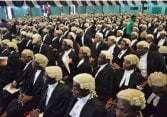
From Lagos’s Daily Post, Nigerian legal types sue China over the You-Know-Where Virus. (And – seriously – do those normally laughable/unflattering wigs look cool on a load of black lawyers or what?)

And the Globe and Mail digs into the authoritarian-friendly background of the WHO’s Mr Dr Tedros (trigger warning: comes complete with references to stuff like ‘acute watery diarrhea’).

Over in Taiwan, abducted book-seller Lam Wing-kee reopens Causeway Books in Taipei (includes a previous HK Free Press video interview).

For history buffs, the Nation looks back at Hong Kong’s early 1970s radical leftists.  

Finally, in the business department, The Wire China tells the story of the epic collapse of Luckin

Luckin, in many ways, exemplified the China hype. What Baidu is to Google and Xiaomi to Apple, Luckin was supposed to be to Starbucks — a homegrown competitor, backed by state and private financing and cheered on by state media. Luckin promised low-priced coffee, ubiquitous store locations, and delivery to your home in 30 minutes. It also promised a way for global funds to invest in China’s economic miracle…

Posted in Blog | 17 Comments

Civil servants to resume work – will anyone notice difference?

If the Hong Kong government thinks it might be OK to send its precious staff back to work, we can assume it is probably safe to relax the city’s internal anti-virus social-distancing regime. But there are three challenges.

First, can panicky types get over wetting themselves at the sight of anyone socializing? What will nervous ninnies worry about instead?

Second, will the police oppose easing the controls, which have become a convenient pretext for the suppression of political gatherings, protests, shopping-mall singalongs and other national-security threats?

And most of all, can officials resist the inevitable calls to open up the borders to the tourist hordes and risk unleashing the pestilence so their landlord friends can hike the rents back up?

For a good summary of Hong Kong’s success in quashing the virus, and the dilemma concerning cross-border and international travel, see David Webb’s latest.

The worst-case scenario is that Hong Kong lets Mainlanders pour in to give Beijing face (though at the moment Shenzhen authorities are if anything more aggressive about imposing quarantines on inbound travel).

The ideal outcome is (see Webb) the establishment of an international community of virus-free zones, allowing Hongkongers, Macanese, Taiwanese, Vietnamese, New Zealanders and Icelanders to travel freely among their own jurisdictions and the rest of the planet just has to stay put. Maybe for decades. Sounds pretty good.

Posted in Blog | 5 Comments

Twilight of the AOs

A letter to the SCMP editor welcomes the government’s recent cabinet reshuffle as a boost for diversity and meritocracy.

It is tempting to say good riddance to the colonial-era type of Administrative Officer career civil servant. These lazy, blinkered, arrogant, out-of-touch and imagination-phobic bureaucrats are, after all, responsible for perpetuating Hong Kong’s most ruinous core policies: high-priced-land-and-housing, cars-first-pedestrians-last, dump-ordinary-kids-in-rote-learning-schools, cram-in-more-tourists, splurge-on-white-elephant-projects, and (not least) give-ourselves-huge-pay-rises.

Politics prof John Burns in HK Free Press takes a less rosy view, seeing the reshuffle as Beijing getting rid of AOs with their self-image of being above politics and their ‘lack of understanding’ of the Glorious Motherland…

…the CCP observes that civil servants in Hong Kong have violated their duty of loyalty to the government, based on a colonial-era understanding of political neutrality, with relative impunity.

Forty thousand mostly civil servants demonstrated against the government’s position on the extradition bill on August 2, 2019. Presumably, authorities removed the minister for the civil service for this and other transgressions.

The CCP never trusted Hong Kong’s British-trained civil servants, and the feeling was mutual – remember the ejection of Dame Conscience back in Tofu-for-Brains’ time. Over the years, Beijing no doubt worked on taming and co-opting the next generation of bureaucrats, culminating in the dazzling success that is Carrie Lam.

Now Xi Jinping and his newly appointed Hong Kong Affairs knuckle-draggers have lost patience with AOs, as they have with everyone else in Hong Kong. The recent reshuffle suggests that our future ministerial talent will come from the disciplined services and the DAB – people who are not too bright, find authoritarianism pleasurable and of course just do what they’re told. Being dim is a real plus: obviously it means you don’t ask questions, but it also means you are easy to ensnare and compromise. Just how the CCP like it.

Still, Prof Burns concludes with a note of slight optimism, hoping that a shift away from AOs might at least ‘dilute the power of big business, giving voice and hope to the people of Hong Kong’. I guess we need to think this way – the alternative is that the new ministers will be even worse than their entitled, pompous, tycoon-sucking predecessors.

Meanwhile, in international affairs: win-win Belt and Road cooperation takes a beating in Kenya.

Posted in Blog | 6 Comments

A Coalition of the Shoe-shining

The Hong Kong Coalition – fronted by former Chief Executives Tung Chee-hwa and CY Leung – is apparently supposed to lure the middle ground to vote for the pro-government bloc in September’s Legislative Council elections. Instead, it is a vivid reminder of how unappealing the pro-Beijing brand is.

Its recruits so far are the usual depressing ‘heavyweights’ like Maria Tam, Henry ‘basement’ Tang, Regina Ip and the less recognizable industrialist Irons Sze. You can picture the rest: former Justice Secretary Elsie Leung perhaps, Executive Council people like Fanny Law and Arthur Li, some tycoons/tycoons’ kids and semi-forgotten retired officials. To add a dash of sexy and trendy, actor Jackie Chan or landlord Allen Zeman.

They will generally be old. Most will be rich. Most will have some base motive, like wealth or status, for publicly backing Beijing. Many will be ugly, in terms of personality if not physically. Only the spineless who parrot the official line will be accepted. Anyone under 40 will either be pitifully dim or (if they drag in some medal-winning cyclist) dependent on the state.

The HK Coalition will be a rancid line-up of not-very-nice-people. Nobody remotely hip or cool will join in because no-one who is smart, intellectual, sensitive, funny, caring, aware, creative, noble or heroic supports the Chinese Communist Party.

It is a toxic product, and this is the marketing campaign from Hell. For example: your target audience is the sort of person who admires the hospital staff who risked their lives working on the front-line and their jobs by striking to force the government to close the border. And this Coalition wheels out a spite-filled woman who rants about punishing and suing the doctors and nurses.

I declare the weekend open with a quick selection of diversions…

China Heritage/Geremie Barme translates an essay by journalist Lee Yee despairing at the arrests of Martin Lee et al as the end of any possibility of a third way for Hong Kong…

As the Communist authorities have directed the local authorities to arrest men and women such as these — remember, they have consistently been the most mild advocates of democratic norms in the territory — they have, in effect, wiped out what remained of a middle ground. Now the only choices open to Hong Kong people are: align yourself with a totalitarian regime or rise up to resist and oppose it. 

A Hong Kong Free Press interview with Martin Lee. Another is from DW, translated here. He still shows a touching faith in the US Cavalry coming to the rescue, and in constitutional niceties – hoping a pan-dem majority in the legislature could prevent National Security laws, as if the CCP lets voters give the orders. Also, the Catholic Herald does a feature on the veteran pro-democrat.

Ben Bland at the Interpreter looks at the CCP’s recent power-grab in Hong Kong

Beijing has always seen the One Country, Two Systems arrangement as a messy compromise to smooth the handover from British rule in 1997 rather than a long-term basis for political freedoms and autonomy for Hong Kong. In the last 10 years, and especially since Xi Jinping took power in 2012, it has intensified efforts to assert control over Hong Kong’s politics, economy and society…

By pushing so hard, the authorities risk intensifying the very nemesis of political violence that they claim to be opposing.

Prospects for the pro-democracy movement include…

…fighting a rear-guard action to disrupt the authorities while hoping to keep the flame of resistance alight until something dramatic changes in Beijing.

We could also add that Beijing is doing all the right things to encourage the growth of a genuine pro-independence movement.

Michael Davies in the SCMP asks (more or less) why we bother having a Basic Law if Beijing can change it anytime it likes.

From Harpers – a rather literary inside account of last year’s protests.

To celebrate HK-Taiwanese-Thai solidarity against the CCP, Milk-Tea Alliance protest artwork.

For heritage enthusiasts – the abandoned Peak Tram station.

And 7-Eleven has launched a worthwhile initiative where customers can team with the chain and some charities to donate lunch boxes to the needy (using a convoluted high-tech system involving gamma rays and blockchain – because just putting cash in a box wouldn’t be any fun).

A thread on the craziness of China’s latest South China Sea claims.

Bloomberg thinks China has pushed Europe too far this time on the virus crisis. It sounds serious, provided there is an entity called ‘Europe’ that carries weight on the world stage, and the region’s various national leaders have backbones.

Posted in Blog | 13 Comments

Conspiracy Corner

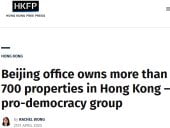
Beijing’s Liaison Office in Hong Kong, when not increasing its ‘supervision’ over the local administration, has been amassing property in the city. The pro-dem Demosisto group’s research into this is not new, but the update is timely enough to annoy the government.

Not unreasonably, the activists equate the number of apartments in the portfolio with the size of the Office’s staff. What is interesting is that the purchases of the flats go back decades. The conspiracy-theorists among us might ask whether Beijing’s local officials anticipated the land and housing policies that contributed to the huge uplift in property prices during that time, and took steps to insulate their organization from the results. By ‘anticipated’ we mean ‘had advance knowledge of’ or ‘actively engineered’.

A less suspicious mind would point out that it would be standard practice for a Mainland public-sector employer to provide its expatriate staff with housing, not least to keep tabs on them.

That would score a 1 or 2 on the Conspiracy Theory Scale. Here’s something that would rate a lot higher…

This article in The Diplomat begins with the sentence: ‘We often ascribe a basic level of humanity to even the cruelest leaders…’ Personally, I don’t, so this isn’t a very promising start. But it gets better. The author postulates that at some point between the original cover-ups and the eventual semi-transparency over COVID-19, Beijing knowingly allowed the virus to spread from Wuhan out into the big wide world.

The suggestion concerns the CCP leadership’s crude, zero-sum attitude to international relations…

Why should China suffer the effects of a pandemic while others stayed safe — and increased their strength relative to China…?

If we are going to take a massive economic hit in the first half of 2020, foreign countries can damn well do the same.

It is an appalling accusation. But – to anyone who has even passing knowledge of the CCP’s cold thuggery – it makes disturbing sense.

Daniel Bell (a fan of China’s ‘meritocratic’ model) quibbles about details on flights. And of course China doesn’t exactly benefit from a collapse in Western consumer demand. Sinocism’s Bill Bishop says in his daily newsletter that overdoing the finger-pointing…

…ultimately will only hurt the efforts to hold Xi and the CCP accountable. Do people really need to embellish their bad behavior? I think a much more effective approach is to sit back and let the CCP and its wolf warrior diplomats torch their reputation in many countries around the world. 

On the other hand, Beijing is not exactly keen on the idea of an independent inquiry. And isn’t there something hard-to-imagine about Xi and pals putting humanity first?

With Trump and Biden preparing to compete on who can blame China most, perhaps the truth doesn’t matter.

Posted in Blog | 12 Comments

Purge of the mediocrities

In a Night of the Long Knives for charisma-free nonentities, Mainland Affairs Minister Patrick Nip is shoved sideways in favour of the Xi fanboy from Immigration, and several other top posts are reshuffled. This entails a fond farewell to the laughable Lau Kong-wah and a warm welcome for a couple of rising, ideologically reliable officials drawn from the pro-Beijing DAB.

An anonymous insider suggests Chief Executive Carrie Lam was disappointed in the individuals’ performances – though they were relatively uninvolved in the last year’s horrendous screw-ups, and anyway she’s not in charge. The lateral-thinker in me wonders if, perhaps, they were not mediocre enough? There’s also a hint that, in his new role as Civil Service Secretary, Nip will be tasked with enforcing political discipline among rank and file government staff.

The HK & Macau Affairs Office issues a buy-two-get-one-free pack of general-purpose mouth-froth, accusing Joshua Wong and Martin Lee of an independence plot, blasting lawmaker Dennis Kwok, supporting police arrests of pro-dem veterans, repeating Beijing’s authority over Hong Kong, whining about foreign forces, and on, and on.

Dennis Kwok expects to be disqualified.

RTHK is criticized for allowing opinion that is opinionated. And the police have a panty-wetting fit about ‘hate speech’ directed at themselves, which they will ‘follow up’.

Cue the news that Hong Kong falls another seven points to 80th place in the World Press Freedom Index, courtesy of police violence and government evasiveness (this would pre-date the late-night press-release-airbrushing).

Hong Kong U’s SPACE extramural department reportedly fires a lecturer for saying the virus cover-ups make him ashamed to be Chinese.

Human Rights Watch struggles to keep up.

For those who find it all too bewildering, bear in mind that the Chinese Communist Party inhabits a parallel universe. Rational observers might wonder why Beijing can’t come to terms with an educated, free, pluralist society that essentially just wants to be left alone. But the CCP sees mortal enemies everywhere, and in its paranoid mind, Hong Kong’s mainstream middle-class population is a (foreign-led) threat – and this is a fight for survival.

Posted in Blog | 13 Comments