History repeats, maybe

Chinese officials and experts celebrate the anniversary of one Special Administrative Region’s handover by having a few digs at the other. Hong Kong should emulate Macau by having patriots in charge and passing national security laws. And it should accept that Beijing has ultimate jurisdiction over everything, so there.

One big difference between Macau and Hong Kong (along with size and economy) is what happened in the mid-late 1960s upheavals in the two cities arising from social discontent and aggravated by the Cultural Revolution over the border. In Macau, the colonial authorities permanently lost much of their control and influence to pro-Beijing labour and business forces. There has since been large-scale immigration of Fujianese Mainlanders. When Leftists tried something similar in Hong Kong, the population largely resisted them and the colonial power kept control. This contributed to the development of a stronger and distinct Hong Kong identity. (Yes, this is all over-simplified.)
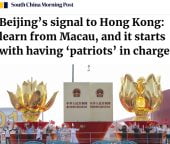
Macau has been docile for half a century. Only now is Beijing starting to think how to tame Hong Kong.

One of the many ways Beijing will try is through pressure on companies to punish employees for their dissenting views. Cathay Pacific have fired staff for participating in the protest movement, and there’s a report (somewhere) that the Jockey Club has just sacked someone for pro-movement comments on social media. Mainland financial institutions are reportedly steering clear of Hong Kong staff. Other banks will no doubt feel a need to discipline staff for ideological incorrectness (several big ones already Panda-grovel by maintaining ‘Belt and Road’ departments and publishing economic analysis taking China’s official data literally).

This provides us with another echo from the 1967 riots. Many Leftists in Hong Kong were arrested and jailed. They and known supporters were also blacklisted, so the only employers that would hire them for decades after were ‘patriotic’ pro-Beijing companies and schools. Who will there be to hire all the blacklisted pan-dems in the future?

Posted in Blog | 22 Comments

It won’t all be over by Christmas

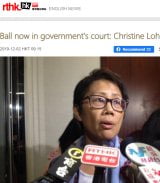
Growing signs of impatience… Chief Executive manqué-to-be Christine Loh warns that following the district elections the ball is in the administration’s court. It must seize this opportunity (the one that disappeared behind clouds of tear gas on Sunday) to take action to solve the city’s political crisis. Even the SCMP, in yet another whiny editorial bemoaning oh-so awful radical vandalism and arson, manages to squeeze in some criticism of Carrie Lam’s inaction.

It is undeniably true that the Hong Kong government has, for the last six months, been as lifeless as the stuffed waxwork taxidermy thing in the glass case at the Mao Mausoleum. It is also true that, left to her own devices, Carrie would be responding to the ongoing calamity with a sort of barely noticeable dithering.

But, as the lady has managed to indicate discreetly, her hands are tied. She would love to get up and do something utterly useless and indecisive – but she’s not allowed to. Beijing insists that the problem be solved through force alone. After 11,000 rounds of tear-gas, 5,000 arrests, a constitution-warping and counterproductive face-mask ban, the probably-irreversible dissolution of a service-oriented police force, a collapse in tourism, partial shutdowns of the transit system, and the total alienation of most of the public (plus Taiwan’s), Beijing remains adamant that crushing and suppressing is the only way.

Last week, the screw tightened with possible civil-service loyalty tests. This week, it’s purging the private sector.

And so we approach Month Seven, wringing our hands and lamely reciting the eternal delusion that only after the violence stops can ‘dialogue’ (whatever it might mean, between whomever) begin…

Posted in Blog | 9 Comments

The DAB has deep pockets

Following the election massacre, the pro-Beijing DAB will reportedly keep its ejected District Council members on their previous (taxpayer-funded) stipends. The money is no problem – the party gets big contributions from pro-Beijing businesses, if not the Liaison Office directly.

This looks like the United Front is going to set up parallel District Council-type operations to continue serving their neighbourhood constituents (such as helping senior citizens and new Mainland immigrants with officialdom).

The aim may be to ‘maintain the grassroots support base’, but it would also be to marginalize the pro-democrats who will now occupy most DC seats. If they are serious about it, the Liaison Office would pressure government departments to prioritize contacts with the unofficial DAB community workers and neglect approaches from the newly elected opposition representatives. Childish – but classic United Front. And it would not be unprecedented: pan-dem Legislative Council members have complained for years about unequal treatment from bureaucrats.

Might Beijing officials even order senior government figures to ‘boycott’ pan-dem DC members and simply refuse to have contact with them? It would be perfectly in character, and they must be tempted. It would of course send a clear message to Hong Kong’s silent or non-silent pro-dem majority that no, peaceful means don’t work.

As an indication: although the District Council elections presented the government with (another) perfect opportunity to de-escalate, the tear-gassing resumed this weekend. Among the menaces to society being punished, an elderly ice-cream vendor.

For an insight into the inexplicable police tactics, an ex-cop says it’s because their procedures manuals give them no choice. The manuals say (roughly): if tear-gas and beatings don’t work, try them again (and again, repeatedly, for ever and ever). Only the senior management can change the manuals, and for some reason (stupidity? pressure from Beijing?) they don’t/haven’t/won’t. So, you see, counterproductive measures must continue because they have to.

At the very least, this raises the question of why, if they just implement set procedures without question, the police are paid at levels appropriate for employees who use discretion and brains. (This goes for most of the civil service.)

The highlight of my weekend: Hong Kong people’s revolutionary hero doing the dishes at my birthday party…

Posted in Blog | 16 Comments

Mainlandization of the Day

At the behest of Beijing (we can be sure), Hong Kong’s Justice Dept is inviting the courts to concede that the ‘executive-led’ system overrides separation of powers. This would probably mean the government can use emergency laws to ban the wearing of masks (or curb the people’s rights in any way it wants) without oversight from the legislative or judicial branches.

After the ‘learned judges’ overruled the emergency-laws mask ban as unconstitutional, the government appealed, and they suspended the ruling for a week. They have now extended that for another week via an ‘interim interim temporary suspension order’. Beijing’s officials behind the scenes must smell spinelessness.

I declare the weekend open with the usual exciting links…

More on the District Council elections. A spirited account from Vivienne Chow, who wonders whether history will remember Carrie Lam for achieving the impossible: uniting Hongkongers. Atlantic buries the ‘silent majority’. SCMP does an in-depth look into why people voted against the government (hint: they hate it). For cartography freaks, a map of Hong Kong showing only the areas that voted pro-government – the rest under a rising sea of resistance. And some protest-art at the far heart-breaking end of the scale.

Alvin Cheung has a go at oh-so sophisticated US commentators who (pretty much) side with Beijing against the Hong Kong people.

Peter Humphrey, who knows what is talking about, discusses the televised forced confession of Simon Cheng.

Although the CCP seems to be successfully luring the Pope into kowtowing, Benedict Rogers is made of sterner stuff and explains Beijing’s threat to Hong Kong and the church, in particular.

The Diplomat on why Beijing’s approach to Hong Kong is so messed up (in case you didn’t know).

The CCP is censoring Chinese Americans on social media, surprise.

For history fans, a comparison of Elizabeth I and the Ming empress Xiaozhuang (their reigns were 10 years apart). Lizzie had much flashier clothes, for a start.

And Taiwan as a beacon for the Hong Kong protest movement

Pro-democracy supporters see in Taiwan a fully developed Asian democracy that practices the democratic ideals and values for which they are fighting: freedom of speech, a free press, a vibrant civil society, and universal suffrage.

(Looking forward to a visit to Taichung in a few weeks.)

Posted in Blog | 6 Comments

‘In a move sure to anger China…’

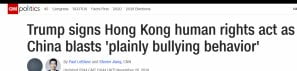
Donald Trump signs the HK Human Rights and Democracy Act. As well as annoying all the right people (‘a slander of China to a level close to madness’), it could in theory lead to sanctions against officials involved in rights abuses here. Probably won’t. But penalties potentially include freezing of assets in the US. Mmmmmm! These people are drawing up a list of names. Suggestions welcome (provide serious evidence).

Meanwhile, leftists are struggling to get their heads round US support for the Hong Kong protest movement. (It’s all so icky bourgeois-liberal. Also, they can’t bear to be on the same side as Ted Cruz, Marco Rubio, et al. This is a milder and localized version of the tankies who venerate the Chinese, Cuban, Venezuelan regimes out of blind hatred for the evil West.)

Predicted but perhaps arriving sooner than we thought: the Hong Kong government is pondering loyalty tests for civil servants. Teachers should expect similar treatment some time. A politically impartial civil service is of course incompatible with Beijing’s Leninist principles. One result will be to stir up resentment among the bureaucrats.

The CCP is also coming for the Hong Kong business community. The tycoons felt sure they had shoe-shined enough. They were wrong. After making billions from local and Mainland opportunities, number-one plutocrat Li Ka-shing has for years been adroitly ‘reweighting’ his family’s extensive assets away from this part of the world (to Western democracies). He has also failed to sufficiently demonize the protest movement/praise the administration – thus incurring the Wrath of the Panda. Reuters has managed to squeeze a few quotes out of him. The comments are on the enigmatic side, but the guy so rarely does any sort of interview that it counts as an exciting exclusive scoop. (Some interesting reminiscing about the time a young regional official called Xi Jinping groveled to Li for investment.)

A couple of worthwhile topical links…

A Hong Kong Free Press explainer on what the new-look District Councils can do with their pan-dem majorities. (No, I shouldn’t have called the newcomers ‘inexperienced’. As well as experience and skills, they will bring the creativity and idealism of the last six months with them – the contrast with their DAB predecessors could be vivid.)

And a Comparativist article on Hong Kong’s recent paranoia-driven conspiracy theories and the in-depth video and other analysis volunteers perform to get to the truth. (As Superman tells Reuters: “In the world of social media, some people are hard at work in sowing toxic doubts and disinformation to undermine trust.”)

Posted in Blog | 7 Comments

Back at ground level…

The main impact of the District Council elections will be in the response from Beijing and the local administration to their major kick in the teeth. The Hong Kong government is, predictably, blinking stupidly and struck dumb. Its CCP masters are frantically trying to come to terms with it all.

Meanwhile, pro-democrats find themselves with some 390 of the 452 seats on District Councils, and in control of 17 of the 18 bodies.

Over-excitable observers foresee greater pro-dem influence over the Chief Executive ‘Election Committee’ mechanism. They should calm down. The CCP does not allow unexpected or external factors to influence its rubber-stamp CE selection system. Remember that this system generated 689 votes (57% of the total) for someone everyone hated. Don’t fuss about the structural and procedural details – the outcome is decided by Beijing and Beijing only.

The DC elections result will give pan-dems the District Council (First) Functional Constituency seat in the Legislative Council, but does not itself much affect the likely outcome of the five at-large seats representing the District Council (Second) Functional Constituency. (As with CE ‘election’, the idiotic complexity is by design; it masks the way the underlying system is rigged.)

The 390 newbies on the advisory, largely powerless boards are mostly young and inexperienced. Their work as District Councilors will be to handle complaints about often very mundane matters (like location of bus stops). But in theory – especially if they break with pan-dem tradition and get their act together – they could use their combined influence to pressure government on planning and other issues. Indeed, with a clear mandate, of the sort Carrie Lam can only dream of, they can potentially add massively to the opposition voice in general.

One interesting aspect of this is the financial compensation. Each councilor gets a monthly salary of HK$33,950 and another HK$44,800 for expense such as assistants and office space. That’s around HK$950,000 a year. The pan-dem movement will find itself HK$370 million a year better off. While Beijing’s officials were happy about this sort of taxpayers’ money going into the pro-Beijing camp’s district operations, they will be mightily miffed to see government bankroll the evil CIA-backed unpatriotic traitors of the opposition.

Pro-government types are dying to see the new councilors mess up (wah – no administrative experience!) It’s possible that Beijing officials will try to sabotage their work and turn constituents against them, for example by demanding that civil servants delay handling pro-dem councilors’ queries or (as in Singapore) simply deliver lower-quality services to opposition neighbourhoods.

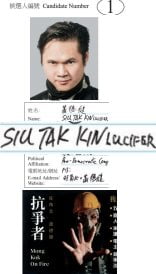
On the other hand, if Hong Kong ever gets representative government, Lucifer Siu and the other 390 are likely to form the foundation of the city’s political talent.

Posted in Blog | 17 Comments

Sour and sweet

Angry and bitter people out there following Sunday’s District Council elections.

China’s domestic state media are all but ignoring the results, in line with Xinhua’s report that an election took place and nothing else happened. Beijing’s overseas propaganda organs apparently had pre-written stories on patriotic candidates’ great victory, suggesting that senior CCP officials genuinely expected that outcome – raising serious questions about how they gather intel, and the full extent of their cluelessness. (Reuters reports that Beijing might defenestrate Liaison Office boss Wang Zhimin for hobnobbing with Hong Kong’s rich rather than doing anything useful.) China Daily and others hurriedly patched together stuff about violence affecting the polls, evil foreign interference and so on.

(Update: Xinhua publishes a commentary complaining that the election fell victim to ‘black terror’, but hoping that correct understanding of Belt and Road will offer Hong Kong’s kids a brighter future.)

After months of ranting about protesters as unrepresentative extremist psycho-kids, the SCMP’s Alex Lo condemns the Hong Kong electorate to hell for hating the government more than they love the city (no, I don’t get it either).

Pro-Beijing lawmaker Paul Tse (affectionately described as ‘maverick’, otherwise as ‘pitiful wacko’) admits that the election is a warning to the government and urges faster prosecutions of arrested protesters to make everything OK again.

Most other CCP apologists are wisely keeping their heads down. Out in Twitter-land, my favourite tankies are trying to put a brave face on things, conceding that the Hong Kong public does not like the government, but insisting that pro-US, anti-Beijing radical subsets must be dealt with and doubting that it will happen – so let Hong Kong rot, etc.

The Hong Kong government has – predictably – clammed up. Some of its supporters are comforting themselves with the fact that the pro-establishment vote held up quite well.

A few points to remember on this. First, elections took place in many wards where the pro-Beijing candidate has previously been returned unopposed (thus the turnout had been zero, so obviously every party’s vote increased). Second, the United Front efforts to get the vote out (offer gifts, etc) was huge. Third, gerrymandering.

The new-age touchy-feely dialogue brigade also seem somewhat discomfited. Christine Loh (promoter of a recent HK Forward Forum on reconciliation) insists that it is still up to Hong Kong people to get into ‘informed deliberation’ on ‘One Country’ in order to avoid provoking Beijing. Learn to like kowtowing to the CCP, and everything will be bliss.

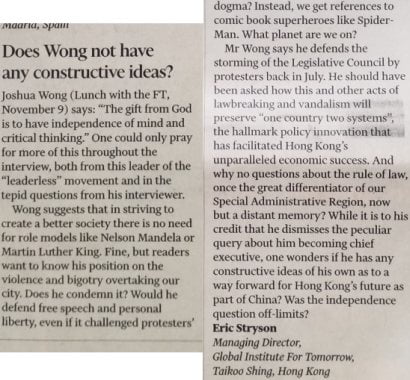
Perhaps the most cringe-making sourness (pre-dating Sunday) comes from someone at the warm and fuzzy Global Institute for Tomorrow (also in the recent HK Forward Forum) who was so incensed by a trivial-but-harmless Financial Times interview with the boy Joshua, that he wrote a seething, almost chip-on-shoulder, letter to the editor in response…

Posted in Blog | 20 Comments

Hong Kong’s referendum

Blam. Who would ever have thought District Council elections could be so interesting?A few thoughts…

The big turnout (over 70% to elect mainly powerless bodies) must reflect both public anger against the government and additional effort by the Liaison Office/United Front forces to get loyal/persuadable voters out.

Actual breakdown of the vote behind the landslide outcome in DC seats looks to be around 60-to-40 pan-dem-to-pro-government (broadly in line with Legislative Council elections in the past). Pro-Beijing voices will try to convince/console themselves that this is a partial rather than unanimous kick in the teeth. (It would be interesting to know how many people didn’t vote because of huge lines outside polling stations.)

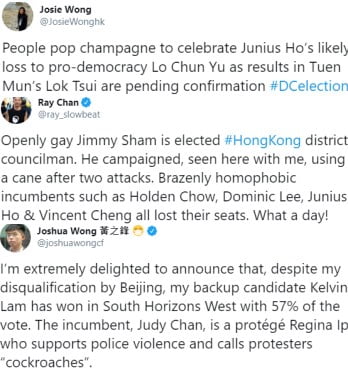
Some serious scumbags (see Tweets below) got a good thrashing.

We don’t have a breakdown of voting patterns by age group, but we do know the number of new and younger voters registering in the last year went up quite a lot. The role of teens and 20-somethings in protest activities suggests that not many of this age group are big fans of the CCP. Their first experience of voting will have been memorable.

Fortunately, a few pro-Beijing folk have won seats on councils. I say fortunately, because the experience of being heavily outnumbered by true representatives of the community will be instructive for them. (It is possible that the bodies will pay more attention to residents and less to cronyism – you never know.)

We will hear a lot about how District Council members have votes in the Chief Executive ‘Election Committee’, and how this could influence the 2021 CE ‘election’. (Example here.) This is rubbish: despite the apparent complexity of the structure, the Committee is designed in such a way that it can produce only the result pre-ordained by Beijing (essentially through an inbuilt majority). The parts of the body that Beijing cannot totally and certainly control (including the democratically elected members) are in practice just there for show. The CCP does not leave these things to chance.

It’s unlikely that this will increase the CCP’s fondness for democracy. Don’t be surprised if a few shoe-shiners tut-tut about how Beijing has ‘lost trust’ in Hong Kong people as a result of yesterday.

Obvious question: can Beijing and its local proxies Carrie Lam et al seriously just sit there, blather inanities, and do nothing after this?

Obvious answer: yup.

Posted in Blog | 23 Comments

About time for the government’s next screw-up

It’s been a fraught couple of weeks. The District Council elections are on Sunday. Will Hong Kong have a relatively calm weekend? Many have been asking this question for 20-something weeks in a row – the answer must be ‘yes’ eventually. Yet the government or police always manage to do something stupid that sets everything off again. Cancelling or otherwise messing around with the elections would be such an obvious mis-step that even these idiots could see it. More likely, some frazzled cop with an assault rifle sprays a whole magazine into a crowd of grannies going to vote.

I declare the weekend – peaceful or chaotic – open with a selection of worthy viewing matter.

A riveting Stand News report from Poly U under siege – the Longest Day. And another one from the embedded team at Reuters.

Antony Dapiran in New Statesman on the week Beijing let Hong Kong burn

With no signs of any compromise on the horizon, it appears that Beijing’s strategy for the moment is simply to let Hong Kong burn, with the expectation that the growing disruption and violence will ultimately undermine support for the protest movement, deepen the divisions in Hong Kong society, and create fertile conditions for Beijing to step in and impose order on a society-wide basis in the medium term.

As the author mentions, Mao Zedong had a roughly similar policy to Tibet in 1959. I’m not so sure Xi Jinping would calculatingly choose such a reckless approach to a major international city in 2019. Much of the mayhem is due to the disproportionate measures Beijing officials have demanded to Crush the Protests Now for fear they spread over the border. More likely, Beijing’s apparent indifference to imposing a political solution masks cluelessness or internal disagreement over what to do.

Mary Hui at Quartz looks at the bottom-up, decentralized nature of Hong Kong’s not-leaderless-but-leaderful protest movement as an example for future uprisings worldwide.

The Hong Kong Bar Association’s statement on Beijing’s panty-wetting hysterics after the High Court’s rejection of the government’s mask ban.

Some scurrilous and obviously untrue stuff from LIHKG about new Police Commissioner Chris Tang.

From deep inside the Beltway, Richard Bush of the Brookings Institute pens a laboriously even-handed survey of how Hong Kong came to this (apparent) end.

Basically, it’s everyone’s fault. It’s Beijing’s fault for letting greedy tycoons and their bureaucrat buddies treat the place as their personal ATM. It’s the greedy tycoons’ fault for being so ridiculously and outrageously greedy. And it’s the disgruntled Hong Kong people’s fault for misjudging Beijing’s reaction to their disgruntlement. (To inspire the disgruntled on correct Panda-handling – should you ever again find your city being wrung dry for decades by CCP-backed rent-seeking ogres – the author quotes Gandhi Lord Acton Oscar Wilde Kenny Rogers.)

So determined is he to point out that we are all, in our own ways, to blame, he even hints that it’s partly the fault of the British for handing the place over to China with rule of law and civil rights pre-installed – thus politicized, you see.

On to culture and creativity… The Chinese national anthem (all about refusing to be slaves, etc) set to an Entirely Wrong video. From Quartz again, Vivienne Chow on what Hong Kong’s protest aesthetics owe to One Piece. And Radical Art Review on Hong Kong’s Lennon Walls.

In Mekong Review, Richard Heydarian takes a Southeast Asia-oriented look at George Magnus’s book Red Flags: Why Xi’s China Is in Jeopardy. (If you missed it, Magnus on how China’s approach to Hong Kong could affect the wider world.)

An Australian Strategic Police Institute piece on how the NYT’s scoop on Xinjiang could hurt Xi Jinping. Also from Oz, Sydney Morning Herald on CCP proxies sustaining a Chinese Traditional Quack Medicine ‘institute’ that some idiot started up.

Some updated advice for doing business in China (it’s not getting easier).

Finally, for map freaks mainly – those old bird’s-eye view maps of Japanese cities.

Posted in Blog | 13 Comments

Stop fixating. Thank you.

Hong Kong has a large community of people bursting with anger after seeing (first-hand or, more frequently, on video) thugs attacking pro-democrats and cops bullying schoolkids, stomping on people’s heads, using crazy amounts of tear gas, pepper-spraying bystanders and even shooting protesters. It also has a fair number of (typically rather older) people equally outraged by transport stoppages, road obstructions, a guy being set on fire, the stabbing of a pro-Beijing politician, bow-and-arrow attacks on police, vandalism of shops and campuses and other nastiness.

These things are all undeniably horrible and disturbing. But to fixate on them as morally abhorrent or unacceptably disruptive is to ignore what is really happening. The legitimacy of Hong Kong’s government has largely collapsed. Look beyond the highly visible and sometimes traumatizing local strife, and set aside your own ‘yellow’ or blue’ inclinations, and what you have is a conflict between the people of Hong Kong and the Chinese Communist Party. The violence on either side is not ‘right’ or ‘wrong’ – it is just an inevitable side-effect of that (highly asymmetric) struggle.

Got that off my chest. Been hearing too much whining from expats whose daughters were late for their piano lessons.

(And I just received an article doing the rounds on blue-ribbon social-media headed ‘From Nury Vittachi, who works at Poly U’. A quick Google search reveals the same text posted on a  Singapore forum called SG Talk, so I’ll just link to that: behold CITIZENS OF THE WORLD: YOUR MEDIA IS LYING TO YOU. A major rant about Western media finding Hong Kong sexier than Chile, people crying at bus stops, and then a descent into ‘National Endowment for Democracy financing guerilla vandals’ land. This is fixating squared.)

Back to the action…

Jerome Cohen adds his opinion on Beijing’s claim that Hong Kong courts have no right to rule on constitutionality of laws. As it happens, it seems Chinese state media have quietly toned down the mouth-frothing about the High Court’s rejection of the mask ban.

They have their hands mouths full freaking out about the US Hong Kong Human Rights and Democracy Act, which has now passed in the House. A brief but cliché-packed Reuters report (‘a person familiar with the matter’, ‘speaking on condition of anonymity’, ‘a move sure to anger China’) says Trump will probably sign it.

In a move sure to impede the Chinese Communist Party’s efforts to win Hong Kong’s hearts and minds, UK Consulate staffer Simon Cheng has opened up about his mysterious disappearance on the Mainland. (His account, and the BBC report.) Many astute observers vaguely guessed that he had: a) been nabbed by Mainland security at West Kowloon High-Speed Rail Station; b) confessed to the inevitable ‘visiting prostitutes’ charge; and c) been tortured to admit British involvement in the protest movement. And they were right. Surprise, surprise.

Posted in Blog | 21 Comments