The year ahead, Pt 2

This Diplomat article explains why China’s stance towards Taiwan alienates rather than wins over the population. Essentially, Beijing’s Leninist mindset presumes the masses to be led from the top down, so they focus on attacking government figures like Tsai Ing Wen.

This attitude is clear in their policy towards Hong Kong, where they blame ‘foreign influences’ or the schools for the population’s refusal to adopt correct attitudes.

At best, Beijing’s attempts to win Hong Kong people’s hearts and minds have been laughably bad (‘Belt and Road opportunities’). At worst, Chinese officials come across as alien, menacing and sinister – on a different wavelength from the city’s culture and identity.

Out of deference, Hong Kong government PR is now adopting the same phraseology, giving the impression that the local administration is not even talking to its own people. Officials’ boldest attempt at sophistication is a grotesque anti-protest rap video. Security Secretary John Lee’s claim that ‘foreign training’ is behind protesters’ organizational and media skills echoes Mainland attitudes that the populace is a malleable, dim-witted mass rather than millions of educated, thinking individuals.

The CCP has never before had to clamp down on a developed, free society. It took power by force in often impoverished, even semi-feudal regions. It has maintained control by suppressing opposition in places that are typically closed off to the outside world, and in societies that have little or no collective awareness of human rights or a heritage of a free press or rule of law.
In short, Beijing has no idea that its top-down coercive approach might be driving a significant part of the Hong Kong population to form a more cohesive and underground resistance movement.

Apparently unknown to John Lee, Hong Kong has a large middle class with cash to spare to raise millions for initiatives like crowdsourced ads in overseas media and the Spark Alliance for legal aid. (There’s also a wealthy Hong Kong diaspora.) As InvestHK confirms, this is a community rich in skills, including IT, design and creative talent that obviously runs rings around that of civil service spin doctors. The protest movement has developed aps and online forums to communicate tactical information and enable debate and decision-making while remaining leaderless.

A shadow support network is growing online. This includes legal assistance, transport and supplies pools, underground medical services and even a pro-movement labour exchange where protesters who have been fired can find jobs with ‘yellow’ employers.

Which brings us to the ‘yellow economy’ – encouraging consumers to patronize pro-democracy (and boycott pro-government) businesses (app link here). Not only does it punish pro-Beijing business owners, it is possibly paving the way to an alternative, mutually supporting, non-establishment/tycoon economy. It seems to make the government nervous.

Activists are also trying to organize pro-democracy unions (with a nod to 1980s Poland). Hong Kong has never been fertile ground for organized labour in the private sector (most unions are United Front bodies), so this sounds far-fetched. But then – everything listed above would have sounded far-fetched a year ago.

It would be so easy – to non-Leninists – for Beijing to absorb pro-democrats into the political system, step back from the Mainlandization menaces, and watch Hong Kong calm down and learn to love, or at least not loathe, the Chinese government. Giving the new pan-dem District Council members some minor responsibilities would be a start.

But – oh no. We can be pretty sure Beijing is out to crush crush crush. The question is: how quickly will the CCP inadvertently build up not just a semi-covert resistance-minded community, but an actual independence movement?

Posted in Blog | 8 Comments

The year ahead

When they are not suffering from delusions that Hong Kong will at some time go ‘back to normal’, some frustrated establishment figures lash out with a sour note: Beijing, they mutter, is ‘happy to let Hong Kong tear itself apart’.

It does seem like it. After seven months of protests, Hong Kong is stuck. The local government is forbidden by Beijing to take any initiatives so occupies its time issuing plaintive statements condemning violence. The only action Beijing has allowed is tough police tactics that, if anything, bolster support for the protests (good rant here) and assorted, clumsy administrative measures intended to weaken the movement.

On the other hand, the CCP has a phobia of civil unrest, and is especially paranoid about the possibility of an anti-government movement crossing the border. Its dilemma is that it can’t envisage or countenance anything other than physical and other coercion. Some relatively simple concessions could win over moderates and isolate radicals. But the idea of bowing to public will is abhorrent to China’s leaders in principle, and they have a particular fear of relaxing control or accommodating political reform.

So Beijing can only subjugate the movement through repression. This is why, after six months, counterproductive police tactics continue. It is why the local administration has snubbed opportunities to change tack – for example, through the October policy address, through its ‘dialog forum’, or in the wake of the November district council elections.

Examples of clamping-down so far include: tentative use of emergency laws; airlines firing staff, and government threatening schools, teachers and civil servants for their opinions; authorities targeting protest-related fund-raising, and maybe indirectly donors; stepped-up police action such as mass-arrests and deployment of provocateurs. Perhaps wary of public opinion or the courts, officials seem nervous about such measures – which clearly have ‘Liaison Office pressure’ stamped on them.

The sudden appointment of Luo Huining at the Liaison Office raises the possibility of a change in direction. Maybe he will ‘reach out’ and try to absorb moderate opposition into a more representative political structure to win hearts and minds. But that’s not how he tamed Tibetans in Qinghai and corrupt officials and cronies in Shanxi. (By all accounts, he relied heavily on economic-development ‘carrots’ as well as disciplinary ‘sticks’. This does not look good for our local parasitical tycoon caste.)

While it’s hard to believe China’s leaders are ‘happy’ to see Hong Kong in chaos, they may convince themselves there’s a bright side to the situation. The fixation on curbing protests can be seen as justification for ignoring Hong Kong’s need for structural change, rather than the other way round. (This is reflected in Hong Kong officials’ insistence that ‘the violence must stop first’ before they can consider any measures to fix underlying problems.)

The crisis is also a pretext for curbing rights and freedoms for the longer term.

That points to more decisive Mainlandization to come in 2020. Expect greater pressure on corporations and institutions to regulate employees’ views, cooperate with police anti-protest tactics, and to openly support the government line. Similar pressure on civil society. Loyalty tests for teachers and civil servants. Intimidation of opposition figures, perhaps by extra-legal means (triads, in plain language). Propaganda in schools (loyalists are already fussing about textbooks). Ditto RTHK. More surveillance (facial-recognition cameras, etc). Infiltration of opposition groups.

Since this will provoke greater resistance, we can see a cycle further ahead that is bound to extend to Internet censorship, criminalization of opinions, and politicized courts. The ultimate result will have to be a far more repressive society – say around halfway on the scale between Singapore and the Mainland.

There are two linked problems for Beijing. Externally, this process will undermine Hong Kong’s appeal as a place to live and do business, and thus damage China’s international image. Internally, it will create a far more embittered and resentful population, and nurture development of a deeper underground resistance culture and movement. This is where it gets interesting, because it is likely the CCP has no idea what it is up against. That underground society is already starting. More on which later…

Posted in Blog | 16 Comments

A quick detour to Taiwan

Taiwan’s election is on Saturday. Much international commentary focuses on the effect of Hong Kong’s gradual subjugation by Beijing in bolstering Tsai Ing Wen’s chances. The CCP have no doubt given Evil Cat-Loving Spinster Lady a boost by offering cherished compatriots irresistible slow death by ‘One Country Two Systems’. But people better acquainted with the country caution that Hong Kong is just one angle (Taiwanese worry about jobs, pensions and housing too), and mainly resonant among the young.

Conversely, we could wonder what impact the Taiwan election will have on Hong Kong – or, for that matter, on Beijing’s clueless Hong Kong ‘strategy’. (Will we see Hong Kong independence fighters modifying their stance and calling for union with Taiwan? How would Beijing officials get their heads around that?)

I rarely pass on cat videos – but here’s one aimed at getting Taiwan voters out.

On an altogether different level of cleverness is this election ad by Tsai’s campaign, contrasting Taiwan with Hong Kong. It might even go over some Taiwanese viewers’ heads, but people here will get it. The actual Hong Kong/Mainland clips are brief. The rest features scenes that, let’s say, look jarringly familiar (even an allusion to water cannon) to anyone who has been in Hong Kong in the last six months, but of course are in Taiwan, and peaceful…

Posted in Blog | 1 Comment

Welcome Mr Luo!

Like Qasem Suleimani, Luo Huining is someone we had largely ignored until he received a very nasty shock this weekend. Luo is to replace Wang Zhimin as director of the Liaison Office – Beijing’s shadow government in Hong Kong. Wang (as foretold in a Reuters scoop) was in disgrace for hobnobbing with tycoons and shoe-shiners and failing to spot that Hong Kong’s people hated the government. He has reportedly been demoted to some sort of librarian job.

We can gather several things about Luo. He already outranked Wang. He is familiar to, and trusted by, Xi Jinping. He has previously overseen two provinces (one yak, one steel hub) in no-nonsense ways the CCP admires – clamping down on restive populations and crooked cadres. And he has had little past contact with or knowledge of Hong Kong.

This suggests he will in practice bypass the HK and Macau Affairs Office/Liaison Office apparatus and report directly to top levels in Beijing. It also suggests he will approach Hong Kong as a Mainland problem, without caring too much about the troublesome and alien rule-of-law, free-speech and other local foibles. Perhaps on a brighter note, it implies that he will treat the local power structure and elites with similar disdain.

But first – we might think – he must get to grips with the Liaison Office itself. The 1,000 or so staff in the ugly tower in Western have for years apparently focused on nurturing the easiest United Front targets, like patriotic groups and shoe-shining businessmen. They also seem to have dabbled extensively in the local property market. One priority will be to get the organization to put more effort into co-opting, monitoring, infiltrating and intimidating everyone else.

He is also nearing retirement age. That could mean he is a stop-gap (his appointment seems to have been fairly sudden). Some think it means he will make some swift changes – though all the evidence is that Beijing is still clueless about what exactly to do. More likely, his main mission is to find out what’s really (so far as ideology allows) happening here, and to clean shop in Sai Ying Pun.

There is no reason to expect that mere mortals will notice any significant change of course in the short term. The frantic and ham-fisted attempts to suppress opposition will continue. Intimidation of companies and individuals will strengthen. Talk of national security and patriotic education will get louder. Pressure on bureaucrats to fix livelihood issues will grow. The sorts of things you can feel coming will come – maybe with an extra dash of ‘unwavering’, ‘firmly’ and ‘resolutely’, like they do it in Qinghai and Shanxi.

Mr Luo might get rid of Carrie and her buddies – but hey, I said significant change. More of which in the next few days.

Posted in Blog | 9 Comments

Or ‘list the things you feel grateful for’

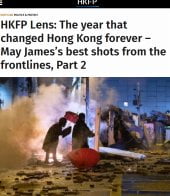
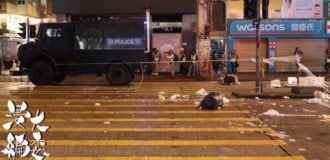
Another selection of HK Free Press photos from 2019.

‘The year that changed Hong Kong forever’ still seems to be a difficult concept for some establishment types to grasp. If you take the most militant pro-independence protester and the most hardline-Leninist Beijing official and sit them down at a table, the one thing they will both agree on is that Hong Kong will not go back to the way it was. Yet just yesterday I met another nice, mild-mannered member of our business ‘community’ who is in denial – not just hoping but clinging to the illusion that 2019 will somehow be unwound before long, so we go ‘back to normal’.

That means back to having Hong Kong run by witless bureaucrats focused on looking after their tycoon buddies. It means back to Beijing not just installing them in power, but ignoring whatever they do and how it effects the rest of the dissent-prone population. It means back to the population grumbling about it, but otherwise shrugging it off.

We are, most likely, in for increasing repression by Beijing – and deeper resentment and popular resistance in response. There’s an outside chance that the CCP will come to its senses and give Hong Kong more space and responsive governance. But there will be no ‘back to normal’ – that’s just a coping mechanism for those who can’t come to terms with the loss of their absurdly cozy power-structure. I told him he might try taking a bath.

More about what probably/possibly will happen next week. Meanwhile, I declare the weekend open with a handful of links.

A guy from the Spectator drops by and ponders the long-term stakes for Hong Kong. He is possibly exaggerating China’s future grip on international policymakers.

An update on protest-related arrests (almost 7,000) and charges.

The Jamestown Foundation on how China under Xi Jinping has moved away from

…tolerance of ethnocultural heterogeneity, and towards a virulent form of cultural nationalism that pathologizes dissent and diversity as an existential threat to the Party and the nation…

…which is arguably not exactly the same as ‘racial supremacist ideology’, unless perhaps it is, or something.

With that in mind, a magnificent rant about think-tank types who haven’t picked up on the nature of China’s regime since around 2012: it’s not about economics, it’s about a ‘cancerous mass that is evil and opposed to any concept of human freedom’.

For some positive energy, watch HKUST grads perform ‘Danzmocrazy’.

Posted in Blog | 12 Comments

New Year’s revolution

This letter from overseas dignitaries calling on Hong Kong authorities to curb police violence, launch an inquiry and introduce political reform didn’t have much effect on the cops’ tactics, judging from yesterday’s mayhem.

The cops’ New Year’s resolution seems to be to ramp up the use of undercovers dressed as protesters – complete with macho bandana-type head/face gear and concealable short-barreled shotguns – and to arrest people by the hundreds. Nearly seven months in, maybe this will finally work!

Still, the letter hit a raw nerve somewhere in officialdom late New Year’s Eve, as it prompted a particularly lengthy and whiny government response (or perhaps the spin-doctors on the night shift were annoyed at having their office drinks party ruined).

For an even greater moment in anti-protest discourse, try this article (originally in China Daily), which is currently circulating on the blue-ribbon web…

…the rioters themselves are more and more radicalized, now often resembling extremist Islamic groups in the Middle East. They are thoroughly brainwashed, they use comfort women, and they are consuming narcotics, including “ice”, amphetamines and certain so-called “combat drugs”, which have been already injected into places such as Syria and Yemen, by the West…   

And yes, thanks to Western funding and CIA control of Hong Kong’s protests, the movement over the holidays started to employ terrifying new technologically advanced and sophisticated weaponry. Behold – the police vehicles immobilized by plastic wrap.

Posted in Blog | 11 Comments

The year ends with wombats

After I was a bit snarky about a borderline-insane anti-protest column, someone at the SCMP wearily/patiently pointed out that they do carry a range of op-ed pieces. In the interests of fairness and seasonal goodwill, I pass on a couple from today.

Some iconoclastic common sense about how Hong Kong should make the drop in Mainland shoppers/tourists permanent and enjoy such benefits as lower rents and a more diversified economy.

And if that’s not subversive enough for you, here’s an erudite comparison of Xi Jinping’s regime to the late Qing dynasty. Ouch…

As we saw with Hong Kong Chief Executive Carrie Lam Cheng Yuet-ngor with the extradition bill and Empress Dowager Cixi with the Boxers, part of the problem in having eunuchs as advisers is that they do not advise but instead cloud one’s judgment, observations and reasoning.

I am pondering a grand Nostradamus-like prophecy for the new year (it will not be a good one for the local eunuchs, I suspect). In the meantime, I declare 2020 open with a selection of worthwhile reading and other material…

The BBC looks at Hong Kong’s emotions (don’t be put off) as 2019 draws to a close.

CNN does an elaborate multimedia look back at the uprising.

For your (10 mins) listening pleasure, RTHK’s wrap-up of a year of upheaval.

HK Free Press presents the best of photographer May James’s shots from the frontlines.

I couldn’t bring myself to look (must be full of CY Leung and God knows what), but if you can stand it – a review of the whole decade in Hong Kong.

More US media coverage of the HK Police: the LA Times, including an interview with a cop-turned-protester; and the NY Post on that hapless tear-gas-banana-art attempt at PR.

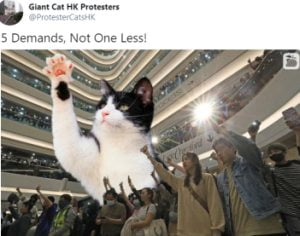
On the subject of culture: government-scrubbed slogans become a new (and quite vivid) transitory art form on Hong Kong’s streets; how (they said it could not be done!) the protests have turned kids on to Cantonese opera; and (does this count as culture?) Hong Kong Protester Cats…

The Committee to Protect Journalists report on China’s influence on Hong Kong and Taiwan media.

Minxin Pei on Xi Jinping’s bad year. Speaking of which, Nikkei Asian Review asks whether the Emperor-for-Life folded on trade.

Two quick and illuminating threads from experts: the supposed easing of China’s hukou system, and the trap awaiting countries that overdo current-account surpluses/capital-account deficits.

The Diplomat goes in-depth on how (and more to the point, why) Sweden incurs the Wrath of the Panda in no small way.

Strictly for hardcore enthusiasts of the CCP’s influence operations in Central Europe, details of the Czech Home Credit saga, featuring the phrase ‘weaponization of mediocrity’.

And on a completely different plane of existence, guaranteed to cure the toughest New Year’s Day hangover – why the Pre-Raphaelites were so into wombats.

Posted in Blog | 5 Comments

Happy holidays

For Hong Kong, it’s a holiday season in which ‘police and protesters roam shopping malls’ and the government complains that marauding masked rioters have ‘affected the festive mood’ and wrings its hands about the dreaded pro-independence flag menace.

A genteel SCMP columnist portrays this as Hong Kong’s worst Christmas since 1941 (actually, the Christmases of ’42, ’43 and ’44 were by all accounts not much fun). Like many, she is perplexed as to why – after over six months of unrest – the local administration is doing nothing.

It is sometimes hard to tell whether the Hong Kong government is failing dismally because of its peculiar innate incompetence, or because Beijing is imposing its own malicious stupidity upon it. The confusion arises because people mistake the Chinese Communist Party’s inability to comprehend Hong Kong for ancient inscrutable Oriental long-term strategic wisdom.

Long story short: Beijing has ordered its Hong Kong puppets to sit immobile and act dumb – which by happy coincidence they are good at – while China’s leaders try to come up with some ideas.

The best they can manage so far: order the Hong Kong Police to simply crush, arrest, tear-gas and pepper-spray the city into renewed harmony.

Thanks to a discontented member of the ranks, the Washington Post has obtained the cops’ official procedures on the use of force and found they are frequently breaking their own rules. Intro with link from one of the journalists…

Policing experts point out that everywhere in the world, a lack of accountability leads to radicalization. They were all really disturbed at how hard it is to identify HKPF officers at the protests, and how their face coverings seem to have morphed steadily since June.

From former PSNI officer Gary White: “If the police can get away with excessive and inappropriate use of force, and they are never held to account for it, what do you think is going to be the response from the people who are subject to that force by the police?”.

The predictable whiny petulant stroppy response from the administration prompts another WaPo journalist to say

The government’s “refutation” of our report issued today is essentially a copy-and-paste job of their “refutation” of HK Watch from yesterday. Unfortunately, they chose not to address any of the many incidents we catalogued and explain how they adhere to use of force guidelines.

Here’s the government’s refutation #1, and, indeed very similar, refutation #2. The police are meanwhile pleading with you not to believe ‘fake’ news, but to trust them instead.

Posted in Blog | 7 Comments

Season’s beatings…

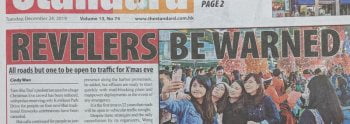
Shall we have a peaceful or a violent Christmas Eve in Tsimshatsui tonight? Inspired by their success in spreading holiday fun last Halloween, the Hong Kong Police predictably  choose the latter.

After six months of this, we can detect a pattern: when the police steer clear, public gatherings are – all else being equal – far more peaceful. So we must assume that the senior police management are deploying hyped-up armed riot cops on such occasions as a deliberate strategy to engineer physical confrontation. The question is, why? To bump up the number of arrests? To comply with Beijing officials’ demands for tough repression? To claim more overtime? To appease those of their front-line men who sadly seem to enjoy whacking passers-by?

Or, given their profession’s reputation for limited lateral-thinking abilities, do they dementedly believe that they are somehow preserving public order and serving the community’s interests?

(My money would be on the Beijing factor.)

I declare what could turn out to be a five-day Merry Christmas Weekend open with some quick links to interesting things…

Some thoughts on what the Hong Kong government could learn from other authorities’ PR response to a different train-wreck. One problem is that Hong Kong officials’ spinelessness and condescension is not only a colonial hangover, and not only a defensive instinct driven by their own incompetence and lack of legitimacy. It’s also pretty much required by Beijing.

An explanatory leaflet about the Spark Alliance arrests and freezing of funds.

If you need something depressing to curb excessive festive joy, Amnesty International on sexual violence against Hong Kong protests.

The naivety of government supporters who welcome the court decision that Au Nok-hin and Gary Fan were not duly elected.

And of course the Christmas version of the Glory to Hong Kong anthem. And for the uninitiated who don’t get Cantonese opera, an appreciation-with-video of that version.

And if you still don’t get Cantonese opera…

Posted in Blog | 4 Comments

Anything happen while I was away?

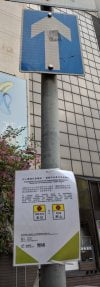
A mundane comparison between Taiwan and Hong Kong… The city of Taichung is making all bus rides free for the first 10km (not per day, but per ride). Only downside: your stored-value card might have a pink Hello Kitty on it. In Hong Kong, the Big Transport Dept Idea is the removal of unnecessary road signs, as seen on Ice House Street yesterday. In theory, it’s to improve the walking environment, but in fact to squeeze more pedestrians onto sidewalks – thus ensuring the all-important Alphards can still park illegally wherever they wish.

Five months after my last visit, I also find that Taiwan has largely successfully continued to resist Chinese Communist Party encroachment. How did Hong Kong do during my four days’ absence?

The Hong Kong Police arrest people for suspected (presumably as in ‘phony’) money-laundering offences and freeze HK$70 million in crowdfunded donations for protesters’ legal and other aid. HSBC becomes the city’s latest enemy-of-the-people company.

The government increases intimidation of teachers and civil servants who might support the protest movement.

Chinese security arrest a Hongkonger going to Macau on the Zhuhai Bridge. The government says it wasn’t its place to warn residents that this part of the white elephant is under Mainland jurisdiction. (Could it be that our top officials simply didn’t know about this either? Would this be more reassuring? Or less?)

Beijing spokesmen agitate for Hong Kong to introduce Article 23 National Security Laws. (Local shoe-shiners alleviate concerns by pointing out that the CCP can do it by other, rule-of-law means anyway.)

Chief Executive Carrie Lam meets with the pro-Beijing losers from the District Council elections, though she has had no time so far to see the winners. (The elected representatives of the people have better things to do, like ridding public parks of lewd Mainland-granny dancers.)

The courts find two pro-dem lawmakers to be unduly elected because (roughly) their predecessors were unduly disqualified. To solve this mess of its own devising, the government must now either leave pan-dems/voters under-represented in the Legislative Council, or hold by-elections – respectively potentially problematic and humiliating.

Government plans for a bland Review of Various Stuff in 2019 (as opposed to an independent inquiry into the police) run into trouble as no respected former judges are dumb enough to take part.

The cops find one or two more dead bodies in what they say are totally non-suspicious circumstances. They manage to turn a small pro-Uighur gathering into another guns-drawn/pepper-spray fest yesterday, complete with some arrests to round up the numbers for the ‘assembly line’.

What else did I miss?

In another of its exclusive deep-throat scoops, Reuters reports that it was Beijing, not Carrie Lam, that pushed for the extradition bill – as most of us assumed all along (especially after the SCMP’s special exclusive scoop that the lady who doesn’t know how to buy toilet paper thought it all up herself).

I’m sure there’s more. It was, after all, four whole days.

Posted in Blog | 2 Comments