Get ready for a Panda-tantrum of about – oh, 6 or 7 I guess – on the Richter Scale: concerted opposition to Hong Kong’s National Security law from every NGO you can think of, plus G7 foreign ministers.
The venerable Jerry Cohen expands on his post of yesterday in the Diplomat. He even mentions a sort-of bright side to Beijing’s plan to station its security agents in the city…
Some sophisticated defenders of this momentous change argue that it will improve upon the existing situation, where kidnappings or violent attacks by local thugs occasionally take place in clandestine cooperation with mainland secret police.
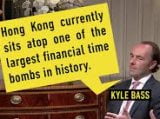
It all sounds like good news for hedge fund boss (and arguably wacko) Kyle Bass, who is shorting the Hong Kong Dollar in no uncertain terms. It is a 200-times leveraged bet in which investors will lose everything if the peg holds – but stand to make a 64-fold gain if the currency drops 40% against the USD in the next 18 months.
There are reasons to be skeptical. The HK Monetary Authority has in the past heaped scorn (without uttering his name) on Bass’s flawed understanding of the peg, notably his confusion about the amount of reserves at the HKMA’s disposal. It also rejects his claims that banks here are headed for a crisis, pointing to one of the world’s highest capital adequacy ratios.
Hong Kong authorities also say Beijing has pledged additional support for the currency if it really proves necessary. (Of course, you might wonder why – for the first time ever, I think – they feel a need to announce such a confidence-booster.)
Reasons to think Bass can succeed in creating a self-fulfilling prophecy are pretty thin. It is no secret that some ultra-rich local families discreetly moved cash out of the HKD last year – and many ordinary middle-class folk have done the same since Beijing announced the National Security law. But this is a drop in the bucket. As it happens, the HKMA is currently more occupied with excess inflows of funds.
The National Security law might kill Hong Kong as an autonomous and free society. But it doesn’t follow that it will break the peg (heck – it doesn’t even weaken housing prices much). A more likely way for Bass to win his bet would be through a Mainland, rather than purely Hong Kong, mega-crisis.
And that – if we see the National Security push as a symptom of panic in Beijing – points to a reason for the prudent among us to move cash out of HKD.
Struck by Carrie Lam’s incomprehensible blathering in its support, Jerome Cohen concludes that Hong Kong’s National Security law is being drafted in a rush. Maybe it will be delayed. Maybe it will be a mess. Maybe both!
One glimpse of detail emerges today, as Security Secretary John Lee suggests that the law could target local figures if they say the wrong thing when meeting overseas politicians. This sounds ridiculously banana-republic. Use some words – outside Hong Kong – and you’ll be fine; use others and you’re under arrest? What if you say the words to a Washington DC cab driver rather than a Congressman?
Curiously, Lee seems particularly miffed that government opponents have been able to get face-time with foreign politicians whom our own officials can’t get to see. If we pointed out that – unlike members of the Hong Kong administration – some of these activists have actually won elections, would that make him feel better?
The Bar Association head says that if Beijing exercises jurisdiction over national-security cases it’s tantamount to extradition – except the Mainland comes to you rather than vice-versa.
The Justice Secretary considers barring private prosecutions if they are based on improper motives – otherwise known as ‘holding the police to account’.
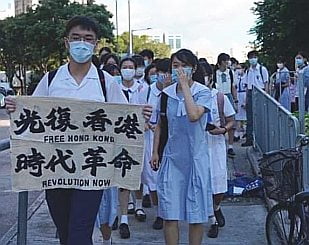
Over in the Creepiness Department, the Education Bureau is asking schools to report on how they will rectify deviant-thinking students’ attitudes and put them on the path to virtue and positive values.
And the hounding of Next Media’s Jimmy Lai continues with a police raid on a secretarial services company suspected of business-licence and other desperate-sounding infringements.
Meanwhile, Beijing goes on making friends and influencing people – with its troops getting into a deadly scrap with Indian soldiers up in the Himalayas. For an idea of the extreme harshness of this territory, read this in the (aptly named) War on the Rocks.
There are two explanations for the CCP’s ever-increasing obnoxiousness. One is that Xi Jinping is seriously unaware of external reality and believes the rest of the world is so preoccupied with Covid and riots that China right now can grab grab grab with zero future consequences. The other is that Xi knows something we don’t about China’s economic state or internal power-struggles, and feels he needs overseas conflicts as a distraction.
In today’s Vindication by Gwailo – China Daily manages to find a French wine maker who says of the National Security law for Hong Kong, mais c’est formidable!
So… one day Executive Council member Ronny Tong tells us the ‘whole weight of Common Law’ will ensure justice, and former judge Henry Litton says no Common Law court would convict you of subversion simply for holding a banner. The next day the Justice Secretary admits the National Security law won’t be compatible with Hong Kong’s Common Law system.
And now a Beijing official says the central authorities will have jurisdiction over rare cases involving ‘serious threats’. We don’t know what constitutes a ‘serious’ threat. Nor do we know whether ‘central jurisdiction’ means separate courts, transfer of suspects across the border, or what. But then we still don’t even know what the new law will say.
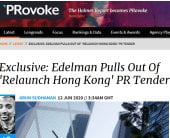
Amid this confusion, it’s no surprise that the Hong Kong government has suffered a tragic setback in its second desperate and forlorn attempt to lure PR agencies to help repair the city’s battered image. The prize catch – the venerable Edelman company – has dropped out of the bidding.
This call for pitches in March-April was more focused on a global business audience, and supposedly less daunting than the one last year (which expected PR firms to magic away the whole protests/police brutality mess). Officials probably saw the Covid pandemic as a window of opportunity – then Beijing dropped the National Security bomb and the challenge became more impossible than ever.
For a taste of how badly the government needs advice on communication, here’s a wretchedly bad video trying to convince you that the National Security law will be all fine and dandy.
You might ask why, when evil foreign forces are infiltrating our city and trying to topple the CCP, the government wants Western expertise. Surely, 20,000 years of civilization, Confucian wisdom and Xi Jinping Thought should ensure that Chinese PR skills are at least as good as a bunch of American hucksters. We could go further and ask why, when officials routinely denounce foreign comment on our ‘internal affairs’, the government deigns to give a damn what Westerners think anyway.
Patriotic Mainland academics lament Hong Kong’s failure to de-colonize its thinking, and the Western world is waking up to the CCP’s true nature and starting to disconnect from China. But Carrie Lam and her fellow puppets are stuck in a time-warp where Asia’s World City still exists and craves the approval of white businessmen.
Even Beijing’s own state media believe that the ultimate killer trump card in this battle of ideas is Vindication by Gwailo.
Where one audience is concerned, the propagandists are correct in thinking that whites have more credibility. Many older educated Hong Kong middle-class blue-ribbon types – Regina Ip fans and other products of the colonial-cringe era – pass these videos around on Facebook avidly. My theory is that it helps these anxiety-ridden identity-confused outcasts assure themselves that they are not turning into parochial Mainland hicks.
The quest for a PR agency with sub-zero integrity continues.
So much going on – including another setback in the Hong Kong government’s tantalizing efforts to hire a PR agency, and a US hedge fund’s audacious/wacko/worth-a-punt plan to topple the Hong Kong Dollar. But first, a wrap-up of the weekend’s Mainlandizing.
The Security Secretary announces that Hong Kong will have some sort of home-grown secret police. Members of the new national-security unit will have to pass loyalty tests, and confidentiality will be necessary because their targets could be ‘very smart people, maybe specialists’.
If that’s not unfathomable enough for you, the Justice Secretary tells us that it would be impractical for the National Security law to be totally compatible with the Common Law system. Her full (hastily translated) blog post is here.
Reassurances that the Civil Law system offers the same protections as Common Law (presumption of innocence, etc) would be fine if we were talking about legislation emanating from France or Germany. But this is Mainland ‘Civil Law’, with Leninist characteristics: the law serves the government by restraining the people, not vice-versa.
The lack of a sunset clause is hardly surprising: the CCP doesn’t relinquish power after grabbing it.
But is she implying a parallel court system? We don’t know.
Genial old pro-CCP think-tank guy Lau Siu-kai says Beijing will not allow pro-democrats to win a majority of seats in September’s LegCo election. ‘You can only vote if you choose the candidates we want.’ What, you may ask, is the point of having an election? It’s not as if LegCo has much power anyway – but to Beijing it’s as scary as a bunch of schoolgirls singing the wrong song.
Some perspective…
Jerome Cohen expects Beijing to use National Security laws to target Hongkongers who ‘support’ (which could mean anything) organizations banned on the Mainland. In The Wire China, Victor Shih foresees trouble for Hong Kong as a financial hub as the CCP finds it can’t stop itself from freezing funds and pressuring courts on ‘national security’ grounds (you can see this coming). And the Diplomatlooks at the impact on tech companies, privacy and cybersecurity.
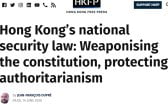
At HKFP, Jean-François Dupré sees the National Security law as primarily a way to absorb Hong Kong’s constitution into that of China…
By bringing issues of national security into Hong Kong’s constitutional arena, the regime is using the NSL as a Trojan Horse to bring the Basic Law closer in line with the Chinese constitution—especially in its embodiment of authoritarianism.
From China Digital Times, a translation of comments by a former Central Party School academic – no longer in China (no kidding) – calling for Xi Jinping to step down and censorship and political arrests to be reduced, as a start. The CCP, she says…
…is no longer a political party, and hasn’t been one for a long time. It is just a tool in the hands of a mafia boss.
Calvin Coolidge thought that “four-fifths of all our troubles would disappear, if we would only sit down and keep still.” If Beijing and the local puppets can manage that for a day or two, we will get on to the highly amusing PR agency fiasco and the supposed attack on the Hong Kong Dollar.
It seems teachers will soon have to attend ‘professional conduct’ and National Blah-Blah courses. And Secretary of Education Kelvin Yeung is now banning songs from schools. ‘Glory to Hong Kong’ is forbidden, while ditties from Les Mis might be OK, but maybe not – it depends (he didn’t say on what). The ever-popular tune ‘Love the Basic Law’ is fine. Update: ‘Glory to Hong Kong’ is a firing offence.
So much for the Hong Kong Police being sensible on June 4 (it did seem odd). Lee Cheuk-yan, Albert Ho, Richard Tsoi and Jimmy Lai are being charged with ‘inciting unlawful assembly’ for (presumably, allegedly) luring thousands into Victoria Park.
Also, RTHK’s deputy head is leaving the public broadcaster-turning-propaganda organ, and a civil service union organizer gets demoted.
Oh, and the National Anthem law takes effect today.
Japan and Taiwan have both indicated a desire to attract Hong Kong financial professionals to their shores. I won’t wish them luck, as an absence of international bankers and fund managers is one of the two countries’ many charms. Singapore is maintaining a blissful and smug silence.
I declare the weekend open with a roundup of reading and viewing excitement…
HKPF’s expert explains the HK cops’ new space-age pepper-spray handgun. Keep deploying more sophisticated and expensive sub-lethal weapons, and Hong Kong will be returned to harmony.
Clifford Stott talks to the FCC about how he and the other overseas ornaments pulled out of the Independent Police Complaints Council’s whitewash on the police…
We were put in a difficult position. We were in the end manipulated and put in an awkward position … There is no way I could have stood by that report.
The FCC will post the whole video sometime, and Stott will soon release his own work on Hong Kong.
A good synopsis of Johannes Chan’s analysis (with link to original) of how the National Security law breaks China’s constitution and or the Basic Law, based on BL Articles 18, 19 and 23. This is basically an elegant way of showing that the CCP isn’t bound by laws.
For your audio-visual pleasure, Regina Ip gets quite agitated in an interview with DW’s Tim Sebastian. Look how much I am wetting myself on TV, now will you let me be Chief Executive?
The pro-Beijing Hong Kong Coalition launches a platform with suggestions on where to spend your HK$10,000 handout. Or maybe – if the businesses are all shoe-shining buddies of Tung Chee-hwa – where not to spend it. So quite useful!
An interview with Kong Tsung-gan on the protest movement, coronavirus, yellow economy, police, prisoners and the future – part one and part two.
In the Guardian, a long history (starting in post-war years) of the Hong Kong protests.
Lowy Interpreter sees Beijing’s policy on Hong Kong as self-defeating…
Not only does such a manoeuvre signal Xi’s willingness to place the CCP’s immediate political needs ahead of its global aspirations, but it also puts the inherent contradictions of the party’s long-term strategy for absorbing Hong Kong on full display.
Nikkei Asian Review looks at China’s imperial overstretch, which seems to be paralleling the country’s rapid economic development in its speediness – never has a major power become so obnoxious so quickly…
Can Xi make China, without any allies, the world’s leading power by relying on an open disregard of international rules and on bullying? Leadership demands more than brute might…
…with the pandemic and the move to strip Hong Kong of its autonomy, Tibet-style, Xi is courting an international backlash, underlined by a spate of actions from the U.S., EU, U.K., India and Australia.
So keen are China’s leaders to gain the respect they feel their country deserves that they have become highly sensitive to criticism and quick to threaten economic coercion when countries dare to defy them.
The Australians, finding their farmers being threatened and suspecting they don’t need China as much as they’re told, coin an exquisite phrase for Beijing’s ambassadors – ‘wolf wankers’.
Christopher Balding sets the limp, wet Panda-huggers straight with a no-nonsense look at what the CCP’s China is and wants. It’s amazing that even in mid-2020 after the Wuhan virus cover-ups, the wolf-warrior tantrums and bullying, and the Hong Kong clampdown, there are people out there (and not just grasping investment banks and German and other Euro-weenies) who still think they can do lovey-dovey cooperation and partnership. You almost dread a Biden win.
As if 2020 hasn’t brought enough – some bad news from the illustrious David Webb.
An RTHK ‘advisor’ (dentist-cum-government stooge) says the public broadcaster must provide positive coverage of national-security and national-anthem laws in order to educate the public and nurture their sense of national identity. Obviously ordered by Beijing officials who are too dumb to realize that (in Hong Kong at least) such propaganda will increase alienation and resistance. So carry on!
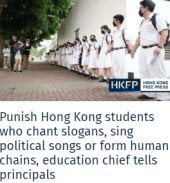
The Education Secretary tells schools to ban (the wrong sort of) politics and ‘punish’ kids who take part in banner-waving, slogan-shouting, or the dreaded ‘referendum’ on a strike. Again, clearly a Beijing idea. What better way to make kids see protests as even cooler? (I read somewhere the Education Secretary educates his offspring in Australia.)
As if in anticipation of these measures not working – indeed backfiring – the HK Police are already forming a dedicated unit to do ‘national-security’ work. Presumably, this group (the ‘Red Berets’) will house/liaise with/take orders from the Ministries of Public and State Security.
The SCMP has a graphic representing the 9,000 people who have been arrested in connection with protests since June 9 last year – with a whole 17 jailed so far. (Can’t find it on their website, but these graphics are good too.)
Ever since around last July-August, the police have assumed they can arrest protests out of existence. At first they were telling officials that if they could detain one or two thousand ‘hardcore’ it would all be over – and they just carried on upping the figure. More recently, they’ve moved on to mass/arbitrary arrests. One likely reason is to gather intelligence, notably by accessing arrestees’ phones, for a Mainland-style database of dissidents, sympathizers, etc. Which will come under your friendly local Red Berets.
The SCMP is also running a fairly putrid series of puff-pieces on the heroic and under-appreciated cops (here and here if you really want). Lots of oh-so candid ‘caring’ sentiments and tear-jerking tales of hardship. The smell of shallow, hackneyed, money-grabbing PR consultant is overwhelming.
The new HK Police National-Security Unit in training yesterday
An amusing conspiracy theory: the US and Beijing will do a deal on a watered-down national-security law behind closed doors. If you want some circumstantial evidence, the draft law is mysteriously not on the agenda for the imminent NPC Standing Committee meeting (but nor was it, at least until the last minute, for the big NPC gathering two weeks ago).
You be the judge. On the one hand, there have been signs that Beijing is surprised at the negative reaction to the law from overseas and business. On the other, Zhang Xiaoming’s webinar made it clear that the CCP sees Hong Kong as a mortal threat. Clue: Communist dictatorships have not traditionally involved the US in drafting their national security legislation.
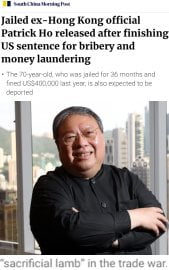
Would Brian Leung be nuts to come back to Hong Kong? In a word, yes. No point in offering yourself up for a multi-year sentence. What about Patrick Ho – now released from prison in the US? He is, I think we can all agree, excellent ‘heavyweight’ material and would look great wearing a Gold Bauhinia Medal and serving as Deputy Sub-Assistant Convener of the CPPCC.
Some things you might have missed in HKFP…
John Burns points out that the CCP’s strategy for Hong Kong is kept secret even from the Hong Kong government. In the absence of a Party-controlled (-trusted, and even -staffed) administration, more direct rule from Beijing looks like the only way.
A useful refresher from Chris Maden on the difference between rule of law and ‘rule by law’…
…the Annex III laws are, for all practical purposes, a constitutional amendment that prioritises the state’s paranoia over the freedoms of speech, the press, assembly and travel
And CUHK’s Denis Edwards on the likely incompatibility of the national-security law with the Hong Kong legal system…
…in a case governed by the new law, is it obvious that the ordinary Hong Kong laws of evidence will apply? What if, in the Mainland’s view, local laws result in obstructing the full effectiveness of the new law?
Hong Kong and Macau Affairs Office Deputy [since February demotion] Director Zhang Xiaoming delivers a webinar-speech explaining Beijing’s reasons for the Grand Mainlandization.
(Chinese here; slightly wonky auto-translated version here.)
His remarks ‘avoided wolf-howls’ and were, by Beijing officials’ standards, quite candid. As commentators note, he broke with the traditional analysis and said Hong Kong’s problem was ‘political’ rather than ‘economic’. This might sound heartening to those who insist that blaming inequality and housing is missing the point and the root cause is the city’s underlying rotten and unrepresentative political structure. But that’s not what the CCP means by ‘political’.
Zhang’s comments reveal Beijing’s deep frustration with Hong Kong’s free speech, free press, liberal education, civil (and cosmopolitan) society, impartial civil service and rule of law and independent judiciary. So long as these institutions are not under CCP control, they are a challenge to national sovereignty and security. Added to that is alarm over the perceived role of the US and other foreign forces in infiltrating the city and instigating subversion. National-security laws will be an anti-political virus software.
Among Zhang’s more interesting thoughts is a righteous (his word) rejection of the idea that CY Leung’s contrived January 2015 freak-out over ‘Hong Kong independence’ was anything other than well-founded. Localists’ attempts to take part in 2016 LegCo elections were part an attempt by pro-independence forces to seize power, and such elements are still plotting ‘terrorist’ activities. Hence the disqualifications of candidates and expulsion of FT correspondent Victor Mallet.
It’s clear that Beijing’s officials are also mightily miffed that Hong Kong simply isn’t into the ‘China Dream’ or indeed the China anything. The media here dwell on the negatives about the Mainland (and we thought they were mostly shoe-shining), and, Zhang complains, we have ‘boycotted’ the Greater Bay Area visionary hub-zone thing (well spotted!)
Reading between the lines, I would guess that one of the biggest impacts on the coming rectification campaign will be on schools and the shaping of young minds. Government opponents, civil servants, anti-China forces and the media are all in for serious treatment – but schools will be a big one. These guys are serious about long-term re-engineering of people’s thinking.
Also some whiny semi-tantrum foot-stamping about how China has due process, presumption of innocence, proportionality of punishment and other legal principles and protections just like real grown-up civilized countries.
Zhang also stressed Hong Kong’s importance as a financial centre. Carrie Lam is hinting at Beijing’s support in this area – so presumably someone is worried about US sanctions.
Bottom line: if you thought they were just play-acting, you’re wrong – they really are paranoid psychos.
1) Hong Kong’s civil servants are told that they work for China too, to which they reply ‘news to us’. Their top official also broadly reminds them that they are servants of the state not the public. Loyalty tests by year-end?
2) Not that she knows any more than the rest of us, but Regina Ip says there will be no juries for national-security court cases, despite saying otherwise when Security Secretary in 2003. It would be pretty amazing if the Chinese Communist Party allowed suspected subversives to be tried by a random selection of fellow citizens. Will the evidence, or even the trials themselves, be public?
3) Students and workers plan a ‘referendum’ on a strike over the national-security law. Probably nothing much will happen, and the government could easily ignore it. But instead we get a blast of extreme hyper-sensitive official phobia about any mention of the word ‘referendum’, complete with whining about innocent kiddies. This isn’t the first time. Worth remembering, if only for civil-disobedience mischief-making: announce a ‘referendum’, and watch the government utterly wet itself.
4) The HSBC kowtow continues with the bank reportedly pleading Beijing’s case on Huawei in the UK. (Ever-charming on the Huawei issue, China’s diplomats in the UK also threaten to blackmail the country using Beijing’s grip on yet-to-be-built energy and transport infrastructure. The prospect of not having CCP-run power stations and rail in return for not having CCP telecoms sounds like a win-win.)
Your Mainlandization du jour – as expected – was the passing of the National Anthem (Compulsory Adoration (Sincere)) Bill. Seems it takes effect next Friday. I look forward to seeing mischievous versions of the dirge on YouTube before long.
Meanwhile, the wonders of our era continue. As if the US doesn’t have enough peculiar political demographics, vast hordes of redoubtable K-pop fans support Black Lives Matter by swamping police tip-off services and racist websites with video clips of (I guess) boy bands. Just when you were despairing about kids today and their musical tastes.
And in Hong Kong, the government’s attempt to ban the June 4 vigil flops nicely, prompting impromptu gatherings not only in Victoria Park but a dozen other locations, plus solemn memorials in churches.
For an extra bonus, the annual event becomes newly relevant to youth. In the outdoor gatherings, the sub-theme of the evening wasn’t the traditional ‘democratize China’ but ‘Hong Kong independence’. CY Leung is credited with inventing the concept of a HK Independence movement; the CCP is responsible for making it a reality. This is a classic asymmetric struggle: one side has all the guns; the other has all the brain cells.
Perhaps with a few exceptions. Weirdly, apart from in Mongkok, the police stood back and let last night proceed in peace. What accounted for this uncharacteristic fit of common sense on the part of the cops? It’s hard to imagine their advisors in the Liaison Office caring about how bad it would look to tear-gas a bunch of people holding candles.
I declare the weekend open with another selection of suitably depressing links – many trying to work out what Beijing’s new national-security regime will mean for Hong Kong.
In HKFP, Patrick Poon explains how ‘subversion of state power’ could work in practice, and Kenneth Ka-lok Chan fears the worst for academic freedom.
Isobel Hilton in the Guardian is in little doubt that the Chinese leadership…
…has now effectively torn up the treaty it signed with Margaret Thatcher’s government and condemned Hong Kong to further unrest and decline. If Beijing’s desired outcome was stability and security, it has disastrously mishandled it. Few doubt that Beijing’s security law will criminalise dissent, undermine the rule of law and target prominent activists
Simon Cartledge in LRB discusses growing repression in Hong Kong…
In January, China appointed a new hardline head of its Hong Kong Liaison Office. I wondered if the aim was to find out whether it would be possible to apply the coercive techniques used in Xinjiang to Hong Kong.
Or was it so the guy could spend his pre-retirement days feasting on dimsum? Find out here.
On a related subject: why are the HK Police so touchy about the 8-31 Prince Edward memorials?
Several Hong Kong journalists imagine how National Security laws will affect their work covering the city.
Kong Tsung-gan introduces his book, Liberate Hong Kong: Stories From The Freedom Struggle.
Before they get shut down – or the HK/CCP secret police start monitoring your online transactions (if they’re not already) – some causes to donate to.
Some people I follow on Twitter are beside themselves with rage to learn that Apple Daily’s Jimmy Lai does not share the entire spectrum of their political beliefs, and is a Donald Trump fan. Beijing’s decision to suppress Hong Kong is part of a much bigger struggle in the world and perhaps the start of a new phase of history. For those of us who wished they had been at a crucial place at a crucial date – your wish has come true. See it as a privilege to be alive and in the thick of it to witness such times…
Brian Fong in the Diplomatasks why Xi Jinping is making Hong Kong ground zero in the new Cold War? (He doesn’t actually say ‘damned if I know, the guy’s a total effing nut’ but there’s a hint of it.)
Hong Kong could be the flashpoint for a possible financial war … At the very least, there could be close scrutiny over all capital transactions between Hong Kong and the US, spanning both foreign direct investment and portfolio capital affecting stocks, bonds and other financial products.
And other things, including threats to the currency peg, which sound a bit unlikely. But then we get to the ‘Yum – yes please’ part…
The United States could also sanction individuals deemed to be implementing the National Security Law, for example, by freezing their assets, and financial institutions thought to be associated or complicit with them.
Drooling at the thought of how this would seriously wipe some smirks off certain pro-establishment faces.
Following HSBC’s forced kowtow, a thread on the CCP’s calculated use of economic coercion.
Christopher Balding with an important reminder: the conflict with China is not caused by or a reaction to Donald Trump, and is not the result of ‘poor communication/understanding’.
…there are no compelling reasons for thinking the tragedy that befell northern Italy under the coronavirus pandemic had anything to do with latent collective memories of Zeus or Kronos.
China Media Project examines how Chinese official media are trying to cover the US protests without seeming to endorse Hong Kong’s own uprising.
From National Interest, US conservative think-tanky stuff on a potentially interesting tweak to the cross-straits balance of power.
A New Bloominterview with James Griffiths, author of Great Firewall of China – and maybe an idea of the censorship and surveillance that might be coming online in Hong Kong.