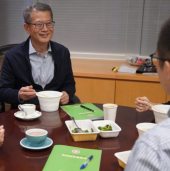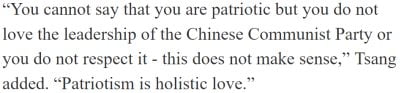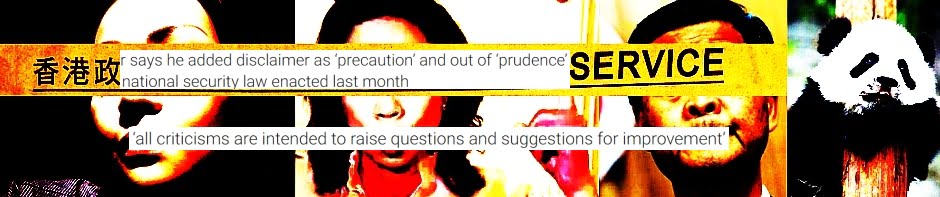
An interesting (by which we mean utterly mendacious) analysis from wily pro-Beijing academic and think-tank type Lau Siu-kai. Under Hong Kong’s old election arrangements, he says, the middle and upper classes elected the Chief Executive, while the middle and lower classes elected the Legislative Council – and that’s why we have inequality. Under the new structure, big business (especially property developers) will have less influence, and therefore the city’s people can have more affordable housing.
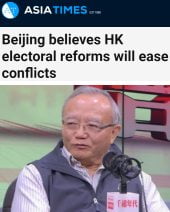
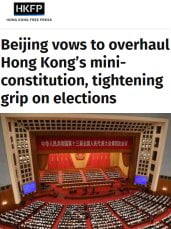
Obviously, this BS is an attempt to sugar-coat the dismantling of Hong Kong’s semi-democratic features. It also cunningly shifts the blame for past misgovernance from Beijing – which has always chosen the Chief Executive – to the tycoons who have served as rubber stamps in the Election Committee that pretends to elect the CE.
While deliberately overpriced housing has reaped huge profits for the property tycoons, the responsibility for it (and other results of poor governance) must lie with Beijing. The reason is simple: Beijing has chosen and appointed all post-1997 Hong Kong governments, and the CCP does not share power with others – including developers. If Beijing had wanted to change the policies that create overpriced housing, it could have done it with a phone call or kick up the backside anytime in the last 20 years (or, of course, have allowed representative government).
Indeed, unaffordable housing in Hong Kong looks very much in line with Beijing’s preferences. Well before the handover, Beijing insisted that the colonial administration impose tight limits on land supply, and the continuation of this policy post-1997 resulted in the accumulation of the vast fiscal reserves now earmarked for pointless infrastructure projects that benefit Mainland interests. At the same time, Beijing increased the flow of Mainland immigrants into Hong Kong – when there was clearly insufficient housing for them – presumably to dilute or squeeze out the local population.
Not that the tycoons deserve any sympathy, but portraying the election ‘improvements’ as a way to relieve Hong Kong of the property hegemony is clever, not to say audacious, spin. These guys – the astroturfing Bauhinia Party – are clearly in on this.
An array of links to last for a day or two, fingers crossed…
Why pan-dem and pro-Beijing Hong Kong are both going off Facebook.
An interview with Tiffany Sia, author of Too Salty Too Wet – a ‘wet ontology’ of a city in perpetual crisis. (Warning: contains comments like “I’m interested in expanding a fractured notion of place for communities”.)
ZolimaCityMag on Hong Kong’s iconic (ie, they’re all over the place) plastic stools. And an icon from 2019 – the Stonehenge-style anti-police brisk in the road – wins a design award.
Xi Jinping gets to work on China’s Mongolians…
He said Inner Mongolians should “learn by heart that the Han ethnicity cannot be separate from ethnic minorities and that ethnic minorities cannot be separated from the Han ethnicity.”
In Politico, journalist Michael Schuman gives up trying to admire the CCP’s China…
…developments over the past three years are what made me truly hawkish. I changed because it became undeniable that China was changing.
George Magnus asks how much of a challenge China presents to the West, and Foreign Affairs on why China isn’t as big and tough as it thinks it is.
The Diplomat on the great enigma: What is Belt and Road?
…the BRI was first proposed as a grand and extensive policy concept or even a slogan, and was filled in with concrete content afterwards.
Back to War on the Rocks for another view saying the West should take it seriously. Meanwhile, Infrastructure Ideas notes that China’s overseas loans have plummeted in recent years.
For those of us who like reading reference books start to finish: the Decoding China Dictionary of CCP-speak – also useful nowadays in deciphering Hong Kong government press releases.
Kevin Carrico in Apple Daily does a deep probe into those anal swabs. We have ways of making you kowtow.
All you need to know about Szechuan peppercorns – including why the US essentially banned imports of them for many years.