
Second thoughts

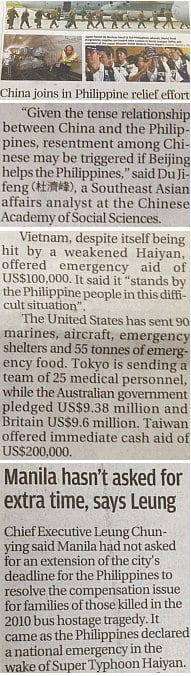
Beijing indulges in a bit of unseemly backtracking. China’s government has second – and you can’t help thinking cynical, clumsy, let’s-do-soft-power – thoughts about snubbing the Philippines with a miserly contribution towards disaster-relief, and stumps up some more cash. Global Times quotes a Mainland academic growling that the US and Japan may have hidden intentions behind their humanitarian aid. Obviously, it’s all the fault of slick do-gooder foreigners that China ends up looking bad and that Filipinos have a highly developed sense of who owes whom a favour. On top of that, the Communist Party’s Third Plenum communique being so vague and vacuous about what it was being ‘decisive’ about that it caused a stock market slide, leaders are now promising the ‘full’ version, crammed with lots of exciting detail about what will happen now everyone’s adequately felt the stones in the river.

Perhaps Hong Kong could use some of this promised Third Plenum-style reform and opening-up. First, our policymakers deny a licence to a budding TV broadcaster in such a way as to protect the interests of the city’s monopolistic property tycoons’ families. Now, our precious small stockbrokers want the government to authorize an official cartel so they can pad out their fees at investors’ expense, rather than accept the fact that the Almighty put them on this Earth to be taxi drivers on account of the appalling things they did in their previous life. These are the same grubby intermediaries who for years demanded that the stock exchange shut down for hours every day so they could shovel vast piles of food into their mouths and then snooze at their desks, rather than survive off two bites of a cold sandwich like real men in real financial centres do.
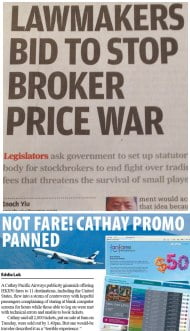
On the subject of people who deserve little sympathy, Cathay Pacific’s ‘Fanfare’ promotion predictably leads to wailing and gnashing of teeth among hordes of gullible penny-pinchers. Some folk actually believed that if they went on-line at the promised time, they could pick up a HK$50 flight to New York, among other too-good-to-be-true offers. Needless to say, while a handful may have, the vast majority of these poor guileless wretches floundered away for hours trying to get through to an overloaded, frozen website.

Cathay’s spokeswoman blathers away about an ‘intermittent technical error’. This is, of course, totally the wrong response to the inevitable howls of anguish from bitter, unrequited graspers of improbable bargains. The correct press statement would read:

Please be informed that, obviously, only an idiot would seriously imagine that, as a profit-making enterprise, we would give our product away to anything more than a token, headline-grabbing number of applicants. Our main aim with this promotion was in fact to entice large numbers of the most dim-witted members of the community and occupy them on their PCs for several hours, so the rest of society could get a bit of peace. We consider this meaningful project an example of good corporate citizenship, in addition to which, we take pleasure in declaring the weekend open. Thank you for your attention.
Posted in Blog | 27 Comments

Former top judge says interesting things

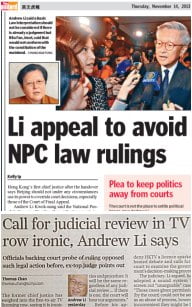
Former Chief Justice Andrew Li neatly lined up and picked off pretend- and real targets yesterday in a speech to assorted people in suits who probably didn’t expect to hear anything interesting. He warned the pro-democrats of the Occupy Central civil disobedience campaign that an unlawful assembly is, well, unlawful. This statement of the obvious is bound to meet with the approval of Beijing’s officials and the broad front of business and patriotic groups they have herded into a state of contrived apoplexy over the idea of people sitting in the street demanding universal suffrage. Just in case any pro-democracy activists take his comments the wrong way and feel hurt, Li reminded his audience that the most ‘effective’ (why didn’t he just say ‘admirable’, ‘thrilling’, or ‘cool’?) political demonstration in Hong Kong was the law-abiding 2003 one. The one that essentially overthrew then-Chief Executive Tung Chee-hwa.

Li was not there to tell Beijing what it wants to hear. His main point was that the Communist procedure known as interpretation, under which the Chinese government can summarily change the meaning of even the most plainly worded and unambiguous clause of the Basic Law, makes a mockery of the concept of an independent judiciary. It’s especially bad, he noted, if Beijing uses the mechanism to overturn decisions that a Hong Kong court has already made (rather than pre-empt them). To make his comments more inflammatory, he added that he sees Hong Kong’s Basic Law as giving the city separation of executive, legislative and judicial powers, with checks and balances (and, those of us of anglospheric heritage will infer, Magna Carta, Shakespeare, apple pie, red-white-and-blue, from sea to shining sea, rah rah rah). This is the exact opposite of what Communist Party ideology and scowling Chinese officials insist; to them, and to any Leninist functionaries, separation of powers is incompatible with the one-party state and thus dictatorship of the proletariat, or whatever-it-is-these-days with Chinese characteristics.

Who is right? Seen from the ground here in the Big Lychee, Hong Kong does indeed have separation of powers: the administration has to beg lawmakers for funding and grovel, often nauseatingly, to pass bills; the courts can and do push the other two branches around on grounds of law. Seen from Beijing, however, this alien, colonial, Western, bourgeois contrivance is safely encapsulated within the one-party system: the executive is chosen (via rigged ‘election’) and appointed by the central government; the rigged functional constituency system guarantees Beijing a veto in the Legislative Council. And, yes, the courts are subject to ‘interpretation’. Morally, Andrew Li may be right, but China’s globally recognized national sovereignty says Beijing is right.

The former Chief Justice hadn’t finished. Rather wittily, he said he finds it ironic (as in ‘hypocritical’, perhaps) that pro-Beijing/pro-establishment politicians who  whine about activists, radicals and smart-asses making them look foolish through judicial reviews of executive action are now demanding that everyone shut up about the HKTV licensing mega-screw-up because it might be subject to… an oh-so-important-and-venerable judicial review.

So: a playful pretend-slap-down for pro-democrat subversives in league with Taiwan splittists; a blunt contradiction of what Beijing insists is incontrovertible and fundamental constitutional truth; and an amusing kick up the backside for a hapless government already slipping on every banana skin it can find. Who says an ex-judge’s speech has to be boring?

Posted in Blog | 15 Comments

China Daily swallows Worst Excuse Ever – and more

As if it suddenly found itself looking and feeling a bit stupid in the midst of an inappropriate rant about the 2010 Manila bus shootings, Hong Kong feigns a return to some sort of normalcy. The government, among others, dutifully prepares to release disaster relief funds for the Philippines. Current and former officials gathering at what sounds like an almost-parodic bore-fest drone on about Pearl River Delta free-trade zone-hubs, while landlord Allan Zeman reveals that “Beijing has lost faith in Hong Kong…” (and there we all were thinking it was the other way round). Across town, property-land visionary-wacko Franklin Lam claims Hong Kong needs 200,000 workers, and should look to Macau or Singapore as models – though imported labour recently became the first ever issue to provoke the Lion City’s usually docile people into open opposition to their authoritarian leadership. An elegant and pithy antidote to this raving ‘GDP figures over quality of life’ mentality comes from Alice Poon. (If only Franklin would read it. If he had a buddy called Franklin Lim, they could do a double-act called F.Lim-F.Lam.)

China Daily gives space to an expert in the Filipino language (or at least witty prankster), who clarifies everything: Manila can’t say sorry because they don’t have a word for it. The best they can manage is something similar to the Cantonese m’hou yi si, or simply a flippant ‘whatever, my bad’. So that’s sorted that out. (I never realized China Daily was so gullible.) One thing I do know about Philippine languages is that they have three words for ‘we’ or ‘us’: one means ‘everyone here’; one means ‘you and me (but not him/them)’; and another means ‘me and him/them (but not you)’. Well, I find it interesting.

Have you ever seen a load of men in suits crossing a river by feeling the stones while simultaneously killing chickens to scare monkeys? It’s less interesting than it sounds, even when they give it the scintillating title of the Third Plenum of the Chinese Communist Party’s 18th Central Committee. Experience strongly suggests that there is little correlation between official post-Plenum communiques and what eventually happens, but people have to write about something, don’t they? Maybe China is about to ‘unleash market forces’, as a gushing Financial Times believes, or maybe something else. How easy is it to peel princelings’ fingers from state-owned monopolies or get city slickers to share their municipal goodies with migrant peasants?

The South China Morning Post distills the gathering’s recommendations down to their purest essence. For example, ‘Build a sound, scientific and effective institutional system in all sectors by 2020’; sounds good – so much better than an unsound, unscientific and ineffective institutional system in all (or maybe just some?) sectors. Then there’s ‘Achieve “decisive accomplishments” in major fields’. Most analysts were expecting ‘Accomplish “decisive achievements” in major fields’. This is a major surprise.

Meanwhile, Christmas trees have already gone up in Chater House, the core of the core of Core Central…


Maybe they’ve been there for months and I didn’t notice. And far away from all that, nestled in the serene calm of Tai Tam Bay…


Yes, it’s an old Star Ferry. Renovated as a floating home, and providing – I can only imagine – some serious quantities of living space. Dashing over to 7-Eleven is a problem, but there’s a nice barbeque spot up on top (you could build a grill into the funnel). Do they say ‘upstairs’ and ‘downstairs’, or ‘first-class’ and ‘second-class’? Spies sailing past report that it houses a family, complete with a helper wielding a vacuum cleaner.

Which brings us to the slightly bedraggled and traumatized domestic helper who turned up yesterday after managing to get a flight out of Cebu. Eagerness to resume household duties was her third priority. Number-one was simply getting away to somewhere with guaranteed food, water and shelter, and a close number-two was a humble request for help. In brief: the storm became more and more intense, it was pitch black, the power was out, the ground started heaving, and then the entire roof curled up and vanished, ultimately leaving an intact, brick house (rare in the area) with a swampy interior of soaked clothing and wrecked possessions, including my old PC, which served as the village Internet cafe. Every coconut, mango and avocado tree – her retirement plan – flattened. No family hurt, but several neighbours dead. Some resentment that Samar and Leyte were getting more aid (Cebu escaped relatively lightly). I’m stumping up for a new roof – worth every penny for not having to personally go through anything so petrifying.

Posted in Blog | 14 Comments

Where are Confucius’ teachings on decorum when you need them?

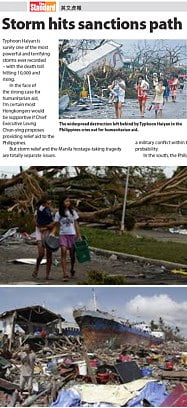
The death toll from the typhoon in the Philippines is the same as it was yesterday – namely, no-one has a clue. Given the aerial shots of afflicted regions, even a well-governed developed country would have trouble knowing where to start. Foreign aid is starting to come in, led by the US Marines, Japanese medics, US$9m each from Australia and the UK, US$200,000 from Taiwan and even US$100,000 from storm-damaged Vietnam, and help from Citibank (link includes details for donors).  

The South China Morning Post tries to put a gloss on China’s contribution, which at US$100,000, looks like a calculated and churlish snub towards Southeast Asia’s most reluctant kowtower to the Middle Kingdom. There is something a bit disturbing about the Chinese leadership’s ability, and indeed apparent eagerness, to pass up an opportunity to display magnanimity and good grace. Those of us with long-enough memories might recall the time in 1986 when Hong Kong’s then-governor Edward Youde died on a duty visit to Beijing. A photo subsequently appeared in the press of an unkempt, cigarette-puffing workman shoving a rough wood coffin to be loaded onto a plane; if the idea was to repel the Hong Kong public, it worked. As with its miserly donation to the Philippines today, it undermined China’s overall interests, and showed a bizarre lack of awareness, or care, about national image. Maybe Chinese officials get some sort of quick, pleasurable thrill from it and just can’t stop themselves.

In a sadly similar vein, Hong Kong Chief Executive CY Leung announces that the disaster befalling the Philippines won’t change his government’s one-month deadline for the imposition of ‘sanctions’, unless Manila gives satisfaction over the 2010 bus hijacking. Even Labour Party legislator Fernando Cheung, normally a hand-wringing humanitarian preaching justice for the poor, is so wrapped up in the wretched bus thing that he seems oblivious to what he is saying. It is as if these people have lost any sense of decency or even practicality. Or simple awareness of how it must look to any outsider; fortunately, the world’s press seems to have more pressing stories than ‘HK takes callousness and insularity to new heights’.

To make sense of it, we need an explanation. Obviously, a lot of Hong Kong politicians have invested a lot of effort into ramping up the bus tragedy in recent weeks. To CY, it has offered a chance to distract attention from HKTV’s licence-refusal and his other woes; in his desperation, he might even have hoped it would win him a few extra shreds of approval rating. For the pro-democrats, it has been a profile-raiser and something else to criticize the administration for. For the patriotic pro-Beijing camp, it has been an opportunity to pander to populist and racist instincts (as it has for everyone), and a welcome occasion on which the Hong Kong public might align itself with Mainland-style nationalism.

As it has been, no doubt, for CY – presumably second-guessing or just taking guidance from Beijing’s local Liaison Office. The recent resurgence of the bus tragedy has suited Chinese foreign and Hong Kong policy nicely. It has been an additional means of bullying Manila for its uppity attitude over maritime boundaries and closeness to the US. It has also served as a great opportunity to get Hongkongers to identify themselves as victimized by foreigners. Generations of Mainlanders have been taught all (if not more) about their ancestors’ persecution and exploitation at the hands of foreigners, and how the Communists rescued the people from this humiliation. In Hong Kong, by contrast, the narrative has been of oppression at the hands of the Communists, and escape to refuge in the colony of a relatively benign foreign power. Filipinos’ victimhood at the hands of natural disaster is an intrusion into this struggle of communal mythologies.


Posted in Blog | 25 Comments

HK’s plans to punish Philippines disrupted

Adjusted for geographical scale, the Typhoon Haiyan death toll in the Philippines is reaching Indian Ocean Tsunami proportions, with reports of 10,000 dead, or 10,000 dead in one city, and bodies hanging from trees. In Hong Kong, Democratic Party legislator James To seems to suddenly drop his crusade to ‘help’ the families of the Manila bus shootings victims. Instead, he will be spending today ‘helping’ small investors who lost money after the 2008 collapse of Citic Pacific’s share price after the princeling-conglomerate’s disastrous foray into the Australian dollar through the insane semi-suicidal investment instrument known as an accumulator – or, ‘I kill you later’, as wits dubbed it. It is a long-running saga. James To’s part in it seems to be bogged down in complaints about the system for handling complaints about corporate governance, but the issue still has its uses.

Others in Hong Kong are less squeamish. The Standard’s ‘Mary Ma’ editorial defiantly declares that the thousands of bodies etc in Tacloban City are a separate issue from the Big Lychee’s promises of vengeance for the bus tragedy. It also accepts, however, that we have an awkward contradiction on our hands. Threatening the Philippines with visa controls and other silliness at a time like this looks more obtuse and self-centred than ever.

Hong Kong has its own, little-known foreign-aid programme in the form of a disaster relief fund with a rubber-stamp advisory body stacked with pro-Beijing figures. Typhoon Haiyan is exactly what this fund was designed for. If the city pointedly abstains from donating official money on this occasion, it looks too callous and downright narcissistic for words. If the fund writes out a cheque (as it presumably will), it leaves the mouth-frothing xenophobes demanding collective punishment of Filipinos looking ridiculous, or at least – like James To – scrabbling for something else to do.

Seeking someone to blame for this logical (I don’t think we can say ‘moral’) quandary, ‘Mary Ma’ goes a bit off-message. The last Chief Executive, Donald Tsang, treated the Filipinos with kid gloves out of deference to Beijing’s policy at the time, which was to try to charm Southeast Asian barbarians into accepting China’s claims to own the whole South China Sea. His successor, CY Leung, is acting tough in accordance with Beijing’s own shift in stance to frighten the tributary states into submission. So, not only must the families of the Manila bus shooting victims be used as tools by the likes of James To, their cause is being picked up, cast aside or waved around, as the paranoid and insecure needs of China’s foreign policy demand.

We now wait to hear from our self-appointed chief scourge of the Filipinos, lawmaker Regina Ip. Maybe she will demand ‘no visas for people whose bodies are hanging from trees’, or organize an emergency air-drop of dead dogs for Leyte. Or perhaps she will realize the typhoon’s impact on rank opportunism and keep her head down.

On a personal note, I too am pondering the typhoon’s far-reaching effects. My domestic helper’s daughter recently had a few weeks off from her strict convent boarding school after the institution suffered slight damage in an earthquake. So my helper went down there so they could spend a week together. They are somewhere south of and, I think, inland from Bogo City, Cebu, where one report says 70-80% of homes’ roofs were blown off. Best-case scenario is that I have to wash my own dishes for a few days longer than planned.

Posted in Blog | 29 Comments

Desperate rabbits, breast enhancement, Lifshitz… it must be the weekend

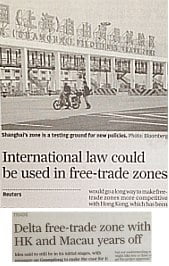
Hopes that we could go a week without free-trade hub-zone hype-mania are dashed by the appearance of a couple of stories from Shanghai and Guangdong. Or then again, maybe not: both articles reflect glimmers of reality.

First, China’s Shanghai and other free-trade zones – which, inevitably, “could challenge Hong Kong” – could use ‘international law’. This is specifically about offshore use of the Yuan, but has wider ramifications. (Note to lazy journalists who lapse into cliché: in a genuine free-trade zone, Hong Kong firms would be allowed to enter the market and compete against local players. The former would probably benefit while the latter might suffer, which is why it won’t happen anytime soon.)

Whoever is mulling this idea is probably thinking of Dubai, which has established a special financial district using English instead of local commercial law (the UAE still has debtors’ prisons), complete with British judges flying in to sit on special courts. Such a symbolic cession of sovereignty might be OK with the Al Maktoum family, but it’s hard to imagine the Chinese Communist Party sacrificing both grip and face in any such way. The wider ramifications here apply to the whole Chinese economy: when the lack of rule of law becomes a barrier to progress, do the interests of the Party’s power or the economy’s development come first?

Second, Guangdong authorities are getting real about hopes for their own free-trade mega-blah-blah zone-hub. Again, remember what this ‘free-trade’ concept would mean: anyone in Hong Kong could transport and sell goods and services into the Pearl River Delta without paying duty or import taxes, whence they would leak out into the protected market of 1.3 billion consumers, unless they built a big wall around Shenzhen, Guangzhou and Zhuhai. The giant sucking sound, as every bottle of Yakult in the solar system is hoovered up into the hinterland would be deafening.

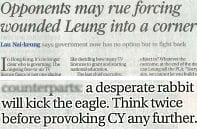
At least Mainland civic leaders think big. Back in the Big Lychee, the government seems to be in full retreat from ideas and action. Patriotic mouth-frother Lau Nai-keung, incensed that even off-the-record Executive Council members are distancing themselves (not to say blabbing), issues a stern warning that Chief Executive CY Leung will fight back when cornered. “A desperate rabbit will kick the eagle.” It won’t be pretty.

On a lighter note, exciting consumer news…

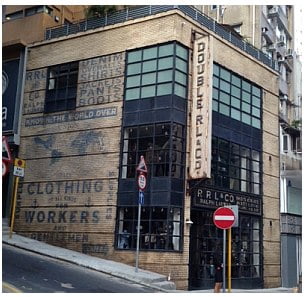
This odd-looking, faded, 100-year-old warehouse has suddenly appeared at the top of Lyndhurst Terrace, several hundred yards west of Central’s current designer-label-crap hub…


Apparently it is the flagship-whatever-blah-blah of Ralph Lauren, a chain selling the usual ugly, overpriced tat, founded by – amazingly – one Ralph Lauren, who (honest) was born Ralph Lifshitz. I’d have changed it too. But what will Mainlanders, the target market, make of the retro-exterior? Will it resonate as iconic-trendy, or will it just say ‘condemned building’, ‘dirty’, or ‘outdated’?

Then we have the brochure I found in my mailbox yesterday…

Essentially, if you are female and are sadly cursed with the off-putting, simpering, educationally sub-normal look displayed by the young lady in the photo, you can have a Yakult-extract called pueraria rubbed into your breasts; it will make them big and firm, and divert guys’ attention from your face. I suppose the good news is that they’re not chopping away with knives, but you have to wonder: if someone falls for this stuff, what else will they be willing to believe?

And finally, for those with a sweet tooth, the latest sugary, chocolate thing from Japan… 

But is it halal?

We declare the weekend open with a noteworthy cartoon-comparison of Taiwan and Hong Kong.

Posted in Blog | 10 Comments

Tamar leveled by rampage of angry militant senile

You know your protest against the Hong Kong government is complete when a bunch of cantankerous elderly folk waving Chinese flags are bussed in to oppose you. The pro-HKTV demonstrators outside the Legislative Council were thus honoured yesterday, as lawmakers debated using special powers and privileges to force the administration to reveal why the Executive Council rejected the upstart broadcaster’s application for a licence.

The South China Morning Post reports one senior citizen’s considered analysis: “Exco owes the public no further explanation. Their decision must be correct.” An interview with the old guy would have been fascinating. Maybe he took his free lunchbox and just chanted what he was told to; maybe he really holds blind hatred for the activists, radicals and dissenters. Either way, there is something a bit chilling about it, probably because it echoes episodes in my current read, Frank Dikotter’s Tragedy of Liberation, about the Communist persecution, starvation and killing of supposed landlords and capitalists in 1950s China (a Jasper Becker review is here).

(Maybe the aging flag-waver genuinely believes Exco has collective genius. No – he can’t be that demented.)

The appearance of mouth-frothing, geriatric, even – God help us – Chiuchow, patriots confirms that the HKTV saga has become another official, permanent divide between the rulers and the ruled, alongside Article 23 and National Education. Even legislator Lam Tai-fai (nominally independent but actually of the Liberal Party/textiles ilk) called the government suicidal as he announced his support, presumably under pressure (more shades, at a pinch, of the 1950s; he’ll denounce his parents next). He and other functional constituency representatives must know that they could be helping to dig their own graves too, siding with the administration on this issue, at this time.

So expect one angry crowd, plus perhaps a gaggle of the aggressive aged, when (assuming) Legco votes against the Powers and Privileges Motion. And then we still have a judicial review to go.

At this point, you would expect the Global Times – if it took any interest at all – to accuse the pro-HKTV protest movement of being part of a CIA and Taiwanese plot to usurp power in Hong Kong, and use the city as a base for a US-led alliance with militaristic Japanese hegemonists and regional monkey-republics planning to sink the glorious motherland’s fleet of half-completed aircraft carriers and deny the country its peaceful rise to Big Boss of Asia and thwart its rightful historic claims of sovereignty over the moon.

But no. A thoughtful-sounding Mainlander doing a PhD in economics at Chinese University turns up instead. The problem, he says, is a government “drafting policy on the basis of corporate needs.” He fears a backlash in the form of a demagogue candidate in a democratic election in 2017, which is possibly a bit alarmist. But his basic theme, that crony capitalism could damage the relationship between Hong Kong and the Mainland, is astute, and its appearance in a (admittedly wacky) subsidiary of the ideologically forceful People’s Daily at least mildly interesting.

Posted in Blog | 8 Comments

Ricky for 2017!

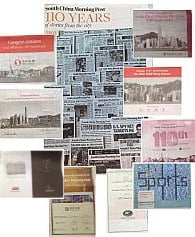
The South China Morning Post celebrates its 110th anniversary today with a special supplement looking back on 1.1 centuries’ of Hong Kong history. It includes the editorial from the first edition to appear after the end of the Japanese occupation, a look back at the never-ending wrangling over democracy and similar interesting stuff. And, page after page, the pull-out unwittingly carries an alternative, parallel account of how the city came to be where it is today – in the form of the face-giving advertisements from big companies congratulating the paper on this noteworthy occasion. Of the 14, nine are from developers and landlords.

Meanwhile, the government produces its sorry and sad apologia about the ongoing HKTV licensing saga. It attempts to justify the Executive Council’s decision by amplifying its previously announced reasoning with more detail – detail that somehow manages not to add anything of interest. It also states that there is no need for the Legislative Council to invoke the Powers and Privileges Ordinance to force the government to reveal all, as this “will politicize the matter but offer no help in resolving it.” Unlike everyone just shutting up and forgetting the whole thing.

The first two Chief Executives – tycoon Tung and bureaucrat Tsang – both oversaw pretty blatant acts of official collusion with the family-run cartels. To take just a few examples, we saw curbs on land and housing supply to protect and push up developers’ profits, the granting of free or cut-rate development rights (Cyberport, Grand Promenade, at least one Urban Renewal Authority project) and, until recently, tolerance of consumer rip-offs like lying about apartment sizes. CY Leung had at least a partial claim to be different, but now, in the public eye, he has blown it. However technically or turgidly you put it, HKTV’s bid for a licence was rejected because, in effect, owner Ricky Wong doesn’t come from one of the half-dozen or so families for whom Hong Kong is run.

Yet CY will probably get through it. He has the robotic support of the Communist loyalists. The tycoons will grudgingly back him out of expedience, as will the broader pro-establishment business community whose retail, engineering and other interests gobble up the crumbs that fall out of the trough. Even the pro-democrats will fail to make the most of the collusion angle, and not just through incompetence; many of the Democratic and Civic Parties’ leaders’ legal practices – like the newspapers – depend to some degree on the big conglomerates for business. Our political system leaves the likes of Ricky Wong unrepresented. Given the lameness of our current politicians, and the constant whining about the shortage of talent in public affairs, could there be an opening for him somewhere?

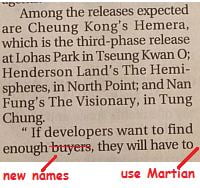
At what point will the government, if it is to serve tycoons above all, step in to prevent property prices from falling too much? The SCMP notes that apartments are getting that teeny bit less unaffordable, and specifically mentions three projects that, it happens, are noteworthy for the ineptness of their names. The problem is: they are running out of wacky things to call ugly high-rises. What is a hemera? It sounds like some sort of painful, bloody rupture in the abdomen. The homes, by the way, are not to be sniffed at: they’re near a huge landfill. As for The Hemispheres, the two in my brain produce different word-associations: ‘Christopher Columbus’, discoverer of a new one, and ‘boobs’ (or your favourite equivalent – word-associations are actually picture-associations, for me at least). This Henderson Land project is predictably promoted by the Standard, which raves at how the generous discounts will bring a 284-square-foot apartment to below HK$6 million. Small, crumb-eating loser-developer Nan Fung’s ‘Visionary’ might be better value, being in Tung Chung, a place so fun, exciting and convenient to live in that public housing units lie empty.

(Hemera is, of course, as we all know, the goddess of daytime – the period in our 24-hour cycle during which the project’s residents will be at work, paying off the mortgage and thus Li Ka-shing.)

Posted in Blog | 10 Comments

Shanghai, and tycoons, get desperate

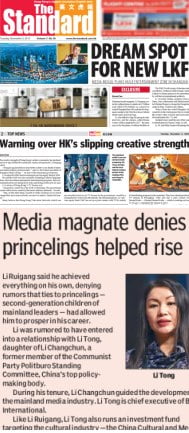
If you’re a free newspaper, you can prostitute yourself all you like. The Standard today carries no fewer than three stories glorifying one Li Ruigang, Mainland TV and radio tycoon, for reasons that are not clear but presumably go beyond everyday shoe-shining into, perhaps, the owner Charles Ho’s hopes of cementing some sort of cross-border media deal. Li plans a Shanghai version of Lan Kwai Fong (can’t anyone think up anything original any more?), knows much and cares deeply about Hong Kong’s declining creativity (I’m not making this up) and absolutely did NOT NOT NOT rise up in the state-run world of Mainland media thanks to a relationship with the gorgeous pouting daughter of a Politburo member (I think we can safely read between the gaping, laboured lines). Wanting a Lan Kwai Fong: pitiful or what?

Back on planet Earth – well, not really, but a bit closer – Hong Kong Chief Executive CY Leung continues his barely believable ‘shooting self in foot after self-immolating and leaping from window’ act. After a generous two-week excuse-inventing interval, the government is coming up with an official super-credible reason why entrepreneur-led HKTV didn’t get a TV broadcasting licence while stations run by members of dynastic cartel-running conglomerates did: HKTV lacked a big parent company, deemed necessary for financial sustainability in a competitive market. If that sounds like a fancy way of saying “Your daddy isn’t a tycoon, so there,” that’s unfortunate, but it’s the best we could do in two weeks.

The government is trying desperately to beat tomorrow’s Legislative Council powers-and-privileges motion that would force it to produce all the papers behind the licensing decision. It will probably succeed, thanks to the in-built veto power of the mainly pro-Beijing Functional Constituencies. Apart from a token few allotted to the pro-democracy camp, the FCs are divided between Communist loyalists, who will follow orders, and (mostly cartel-related) ‘business’ interests. The latter detest CY but also hate competition for cozy market-rigging cliques, and so may initially feel torn. But they will also, no doubt, ultimately follow orders.

Hopes of solving the root cause of this mess – a dysfunctional political system – lie with constitutional reform, which is possibly coming soon, or at least soonish, after much foot-dragging for over 20 years. It will all be decided by Beijing, which has to choose whether to depend less on buying the loyalty of business and other vested interests with crony government, and instead to trust the wider population to elect leaders who are competent but won’t challenge the Communist Party.

One constantly repeated falsehood is that things can only change if the bulk of the Hong Kong community can agree on a way forward. The theory is that both pro-democrats and the pro-tycoon FCs have a veto over any reform bill in LegCo. The South China Morning Post yesterday did its bit to perpetuate this myth in an editorial on the need for compromise:

Hong Kong failed when the first chance for political reform under Chinese rule arose eight years ago. Despite strong public desire for change, the government and lawmakers could not agree on the way forward when handling the reform in 2005.

The truth is that no way forward was on the table; Beijing offered a 2007 package of purely symbolic change.

…the city cannot afford to miss the coming opportunity. Standing still is not an option … crafting an electoral package acceptable to the key stakeholders will not be easy … the language of political conciliation is needed … dialogue and co-operation [are] essential … That means putting aside differences and seeking common ground on the way ahead … Hong Kong cannot afford to march on the spot on the road towards democracy. We need to work harder to come up with a road map and turn it into reality. Compromise is essential.

This is all a code for ‘we must con people into thinking the FCs can and have to stay in some form’. When saying we need a package “acceptable to the key stakeholders,” the (tycoon-owned) SCMP is suggesting that the FCs would use their veto against a package eliminating or seriously reducing their privileges. Constitutionally, they could. But any such package will come from Beijing. If (by some chance) Beijing orders to FCs to vote themselves out of existence, they will obey. The dynamics give the pro-dems, on the other hand, a genuine veto (which, typically, they are neglecting because it’s more fun to rant about how the Chief Executive candidates must be nominated by a ‘committee’ comprising the whole electorate.)

So remember: when you hear hand-wringing pleas for ‘compromise’ on things like the FCs, you are probably listening to tycoons begging to retain the upper hand.


Posted in Blog | 9 Comments

Developers jack up price cuts

Kiasu-Victim-of-the-Month Award goes to 30-year-old banker Foster Lee, who, after watching property prices rise for four years, has chosen this time to buy an apartment in West Kowloon (presumably The Austin, at around HK$19,000 a square foot). “You see that people who earn less than you have caught up with you because they bought then,” he told Reuters. It is classic ‘afraid to lose’ thinking – and of course investor psychology at its most emotional and thus illogical.

He adds: “It’s like a girl you liked got married.” Except it’s not. He didn’t lose anything to anyone by not buying earlier; it’s just that other people got something he didn’t get. But that’s how kiasu works: others’ gains seem to be pretty much at your expense. (In Singapore and Malaysia, where the study of this attitude is highly developed, it is common for people to note the licence-plate numbers of vehicles involved in accidents, to use the digits in the lottery. The idea is that now those numbers have delivered misfortune to another person, they will be luckier for you.)

‘Developers jack up prices’, screeches the Standard. Like many media moguls, owner Charles Ho shoe-shines the property tycoons and cartels, mainly out of caste loyalty, but also because his newspapers benefit from the big conglomerates’ advertising. The paper’s intention is to make you want to rush out and buy real estate now. Under the circumstances of a liquidity/supply-generated bubble with relatively little obvious upside to prices, you might think ‘Developers reduce prices’ would be a bigger lure, but as Foster shows us, it’s not. Weirdly, It would also be more accurate.

The real-estate companies are indeed slashing their prices, to the extent that their latest developments (which of course are nowhere near completion yet) undercut similar second-hand units in the same neighbourhoods. They are using rebates and offers to pay stamp duty in order to minimize the reduction on the price tag, but the bottom line is the buyer pays less and they make less.

The inevitable consequence is that the asking prices for second-hand places have to come down. The sellers, who we can be sure have some kiasu hang-ups of their own, will show intense reluctance to discount; a typical Hong Kong property owner or landlord would rather have six months’ of all-day root canal treatment than cut the price. When it starts, however, there is a chance they will all rush and panic-sell. That’s when the fun starts, and people throw themselves from windows, and the government will suddenly start worrying about having a stable and ‘healthy’ market (understandably, given that it includes people like Labour Secretary Matthew Cheung, who owns eight properties on Hong Kong Island.)

Maybe. There is a theory that Hong Kong has considerable pent-up demand, and a relatively mild correction – say, 25% – will clear the market. Another theory is that whatever happens, the US Dollar is going to shrivel away into nothing and the currency peg will condemn us to pushing cash around in wheelbarrows, and homes will be costing a billion bucks per square inch. Which should make Foster happy.


Posted in Blog | 9 Comments