Mind your tone of voice

Samuel Bickett introduces his testimony to the Congressional-Executive Commission on China…

With the majority of foreign attention focused on the National Security Law, my number one priority was to draw attention to abuses taking place outside of NSL cases due to rampant, open misconduct in court by judges, magistrates, prosecutors and police officers. After all, the vast majority of political prisoners in Hong Kong are charged under common law crimes like unlawful assembly, riot, and “weapons” possession (usually laser pointers)—not the NSL. Since these laws were not designed to be used in this way, it has required a great deal of manipulation and outright misconduct by civil servants to ensure convictions…

The agenda of the hearings links to testimony from other witnesses – Patrick Poon, Fermi Wong and Ching Cheong, and to a video of the session.

The Commission’s research note names Justice Dept personnel and outlines possible sanctions against them.

The Hong Kong government’s response is predictably over-sensitive and over-wrought, saying the US…

…once again, manifests its hegemonism by disseminating slanders and attempting to intimidate the prosecutors of the HKSAR Government.

…The spokesperson rebuked that it is most despicable for the so-called “staff research report” to name the Secretary for Justice, together with 15 prosecutors, of the HKSAR Government with a threat of imposing the so-called “sanction” on them. This is clearly trampling on legal justice and attempting to threaten by way of hegemonism [you’ve said that already] the HKSAR Government officials who have been discharging their due prosecution role dutifully with justice upheld. Such gross interference in Hong Kong matters constitutes a serious violation of fundamental principles of international law.

The spokesperson said, “The attempt of the United States Congressional-Executive Commission on China to repeat a lie numerous times as if it were a truth simply reflects its ill intent and amounts to nothing more than an indecent act”.

Phew. Samuel Bickett points out

It hits a nerve because of how effectively the sanctions would deter misconduct. They can control fallout w/ senior officials, but not lower ranks.

Not sure if it would deter misconduct so much as deter being a Justice Dept employee. No mention of the even bigger step of putting sanctions on judges.

Justice Secretary Paul Lam defends the ‘incitement of hatred/enmity stuff in a Sing Tao interview…’

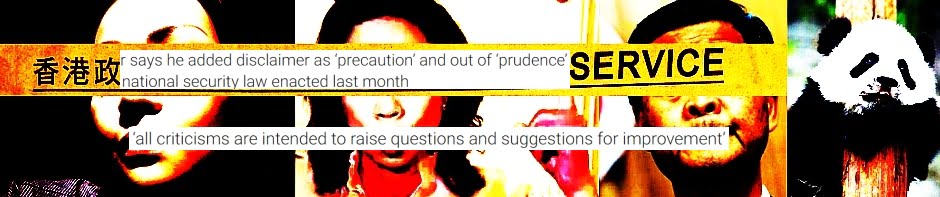
As for any confusion arising from terms such as “hatred-triggering,” “dissatisfaction” and “enmity,” Lam said they should not be considered without context and that various factors, from the background of a case to the accused person’s tone of voice, would be taken into account.

By ‘tone of voice’, does he mean the government reserves the right to read your mind and decide what you really meant? 

Meanwhile, a Hong Kong government delegation attended (by video link) a UN human rights committee’s meeting, answering – or not answering – questions on political, labour, academic and other freedoms. Asked if Hong Kong NGOs could be assured that they wouldn’t be persecuted for communicating with the UN, the delegates said – well, guess.

Sadly, all the government’s hard PR work is promptly undermined by more harsh sentences. Koo Sze-yiu goes international, in the BBC and AFP, among others. Soon to be joined by Grandma Wong, age 66, sentenced to eight months for – nothing, really.

The Chow Hang-tung case gets into legal technicalities. An explanation.

On a separate note, this just in from our Wimbledon correspondent: one Victor Gao says tennis player Peng Shuai is ‘too tall to have been sexually assaulted’.

Posted in Blog | 11 Comments

The week’s NatSec horrors… 

Koo Sze-yiu is convicted of ‘attempted sedition’ – painting slogans on a mock coffin ahead of a planned protest (it never took place) against the Olympics. He gets nine months in prison.

The principle magistrate ruled that the offence Koo committed amounted to endangering national security, saying that the phrases he painted on the prop coffin and fabric were not “pure criticism,” but had an ultimate purpose of changing or even overthrowing China’s constitutional position.

Koo has created such protest props for decades, is a veteran Diaoyu agitator, and is now 76 and has terminal cancer. 

A former district council member is jailed for 15 months for inciting others to take part in an illegal assembly back in 2020 (note how the Standard wedges the Koo story in at the bottom).

And former student union head Owen Au is arrested by the valiant sleuths of the ICAC – theoretically graft-busters – for sharing a Facebook post by Ted Hui calling for the casting of blank votes at last year’s (widely boycotted) LegCo election. 

Then there’s the ongoing trial of speech therapists for producing sheep cartoon books for kids. Which of these cases is the most pitiful? Could you rank them in order of sheer absurdity?

Next week’s headlines to include: ‘Man arrested for teaching parrot to say Heung Gong ga yau’, ‘Nine-year-old released after cartoon sheep book she was suspected of possessing is not found’, ‘Judge jails parrot after ruling it had ultimate purpose of changing or overthrowing China’s constitutional position’.

More weirdness – Chow Hang-tung tries to get a magistrate to lift reporting restrictions on her subversion case committal proceedings. Even a NatSec judge is skeptical about the prosecution’s/magistrate’s stance.

The government gets predictably whiny about the outgoing US consul-general’s comments on Hong Kong’s declining freedoms…

…a government spokesman said democracy in the SAR has taken “a quantum leap forward” since 1997, and the electoral system has been improved to make the Legislative Council and Election Committee more representative. 

The pan-democrats have been jailed or otherwise barred from running, and the assembly now comprises wall-to-wall Beijing supporters after only loyalists were permitted on the ballot and only 30% of voters turned out – and that’s ‘more representative’?

Not surprising that the government also has a credibility problem in trying to convince the public that its new health code will not be used for non-health surveillance or control purposes. The new system is described as a ‘balancing act’, although Singapore – with an identical public-health challenge – dispenses with any ‘balance’. 

In Macau, the ‘balance’ is such that police are now arresting people for jogging and cycling.

Posted in Blog | 12 Comments

Or you can withdraw from society and live a solitary existence

More on Hong Kong’s proposed Mainland-style Covid monitoring/control system

Reporters … questioned why [Health Secretary] Lo thought the health code system would work in Hong Kong when it was unsuccessful in preventing Omicron outbreaks in Macau or Shanghai.

Lo answered that the proposal was based on the city’s existing Covid-19 situation: “By reducing the chance of them getting into the community, we would be able to reduce the transmission from our current level,” he added.

Hey – it sounds better than ‘I have no idea’. Although…

…leading microbiologist Ho Pak-Leung from the University of Hong Kong said in a separate Monday morning programme on Commercial Radio that he expected the effectiveness of the new health code system at preventing Covid-19 infections to be limited given the virus’ transmissibility and the tendency for contact-tracing measures to lag behind the spread.

A Standard editorial says…

Under the new administration, color-coded Covid monitoring will undoubtedly go ahead.

This is despite concerns that the introduction of such a system could accelerate Hongkongers emigrating and discourage foreigners of high-potential from returning here, which would further isolate the city from the rest of the world.

The conspiracy theory – on the verge of becoming mainstream in Hong Kong – is that that’s the whole point. It continues…

But there are also concerns that, unless Hong Kong adopts a color-coded health monitor, the mainland will not agree to reopen the border for normal travel.

Until and unless there’s a major shift in Beijing towards mitigation rather than suppression of Covid, the border will only ever fully reopen if/when Hong Kong is as sealed-off from the outside world as the Mainland itself is.

…Privacy might have been a concern when the previous administration first launched the LeaveHomeSafe app.

But, having used the app day in and day out, people have become used to living in the so-called new normal.

It can be expected that they will also get used to the new color-coded health monitor – unless they are prepared to withdraw from society and live a solitary existence.

The column goes on to ask:

‘If someone is given a yellow or red code, many people around them are likely to be flagged too. How will the decision be made? Will they be able to use public transport?’ 

There are a lot more questions. Won’t the heightened surveillance mechanism further increase people’s incentives to keep quiet if they test positive or show Covid symptoms? Will the new features work when your device is offline (as the current LeaveHomeSafe does)? Will the authorities start demanding universal testing? Why shouldn’t a government that jails people for kids’ books about sheep use the ‘red’ code to place dissidents under semi-house arrest? Will this app ever be scrapped, or will it become a standard ‘public health precaution’ in operation permanently? Will it then be merged with facial-recognition systems? Or extended to control access to bank accounts and other facilities?

Also from the editorial…

When John Lee Ka-chiu was still chief secretary, he reportedly demanded that then-Innovation and Technology Secretary Alfred Sit Wing-hang strengthen the app to include extra functions – but to no avail.

Posted in Blog | 16 Comments

Covid craziness cont’d…

A noticeable recent trend in my email/WhatsApp messages: friends who have just started trips out of Hong Kong raving in disbelief about how amazing life is in the outside world. They had forgotten what normality is like. And indeed it does sound very strange.

Macau goes more or less Shanghai over Covid for a week. Much of the public transport shut down, most people told to stay at home – cops roaming streets – and everyone must take tests (and do a separate test before going to the test site). Even casinos (ie most of the economy) are closed. More here.

A few naive folk out there had this idea that when John Lee became Chief Executive, a less idiotic Covid policy would follow. In reality, someone, somewhere must be looking at Macau’s symbolic Mainland-emulating zero-infections performance and earnestly wanting Hong Kong to do something similar. And of course it goes beyond symbolism – cue proposal for a red/yellow/green code system linked to your real name/address enabling the government to monitor and control your movements. Not creepy or anything. Oh, and more frequent testing.

This week’s At Least It’s Not Covid Award goes to Häagen-Dazs ice cream – being withdrawn by Hong Kong health authorities for containing insecticide. (Strange but true: the product’s name has no meaning, but was invented by American marketing geniuses to sound vaguely exotic/Dutch/Scandinavian.) 

A couple of interesting threads… Activist Michael Mo looks back at the campaign against the third runway (or second, since the old ‘second’ one is now undergoing maintenance). And thoughts from a carpenter’s daughter on the closure of Hong Kong’s last sawmill.

Posted in Blog | 3 Comments

I caught Covid from a mango

Hong Kong’s pointless flight suspensions policy is scrapped, at least for a while. It’s a new balance: going from one balance between science and stupidity to another. Once the government officials’ kids are safely home from their boarding schools in the UK, maybe they’ll go back to suddenly suspending airlines. As an expert points out, the compulsory hotel quarantines – and the shortage of hotel rooms – are the main barriers to inbound travel. Earliest rooms are available: late August (HK$1,600 a night at the hitherto unheard-of Cordis* in Mongkok).

Authorities strike another new balance – between believing fruit and vegetables can carry Covid and not believing it. The balance seems tilted against Taiwanese produce.

Some weekend reading…

The Christian Science Monitor delivers its 25th anniversary elegy for Hong Kong a bit late – but it’s a fairly good one…

“Hong Kong has gone from being such a free city to such a tightly controlled system,” says Jeffrey Wasserstrom, author of “Vigil: Hong Kong on the Brink” and history professor at University of California, Irvine. “This is part of a larger story of forced assimilation, the energy that’s put particularly on the physical edges of the People’s Republic of China to sort of rein in forms of diversity.”

Signs of things to come: The FTU urges everyone to contrive patriotically anti-Japanese sentiment on the anniversary of the Marco Polo Bridge incident.

Transit Jam on the lack of transparency over Hong Kong’s HK$350 million plans for electric ferries

Hong Kong’s electric ferry strategy is based entirely on one 2017 consultancy report penned by mystery consultant Transus, a firm which has left no trace of its existence other than the ferry strategy report.

Joint (and brief) speeches by the bosses of MI5 and the FBI on the threat posed by China, starting with the UK service’s Ken McCallum …

The most game-changing challenge we face comes from the Chinese Communist Party. It’s covertly applying pressure across the globe. This might feel abstract.  But it’s real and it’s pressing. We need to talk about it. We need to act.

Pretty blunt – it’s not often Western officials even mention the CCP by name. Guardian report.

Long read for history fans – in Asia Pacific Journal, academic Geoffrey Gunn explains what Ho Chi Minh was doing in Hong Kong’s Victoria Prison in the early 1930s.

VOA report on how impoverished Laos owes China billions in infrastructure loan repayments, and it doesn’t have billions. (Little mention of what might have induced Lao officials to sign contracts for an inappropriate mega-project like high-speed rail in the first place.) 

*Just been reminded that had a staycation there two years ago.

Posted in Blog | 18 Comments

In Sheep Village today…

From HKFP, the latest on the trial of the five speech therapists accused of ‘…taking part in a conspiracy to print, publish, distribute or display three children’s picture books between June 4, 2020 and July 22 last year with seditious intention’.

On Wednesday, prosecutors read out a long list of exhibits in the case and handed several items to District Judge Kwok Wai-kin, including three handheld boards found in Yeung’s home which featured the union’s name, social media handles and contact details. They also submitted 18 miniature statues donning protest gear, marked with the union’s name, as well as six pieces of paper which could be arranged to read: “Glory to Hong Kong.”

…The prosecution then played an animated version of the first picture book about “guardians of the sheep village” and an audio recording of the second book about the “12 warriors of the sheep village.”

People in the public gallery giggled as the video and audio were played in the courtroom…

More bad press – and no doubt giggling – overseas for Asia’s world city, the only international financial hub that jails people for kids’ cartoons and pieces of paper that could be arranged.

Mindful of the reputational problem, Hong Kong authorities will launch a campaign to attract international talent in the next couple of years as well as (yet again) tell the city’s story better. But no sooner said than undermined: the government will continue its dynamic semi-zero-Covid approach of striking a balance between minimizing and maximizing inconvenience, or something.

To win local hearts and minds, teachers and social workers are being encouraged to attend Mainland-style sessions to study Xi Jinping’s recent ‘important speech’ on Hong Kong. Federation of Education Workers president Wong Kwan-yu…

…said Xi “risked his life [amid the pandemic] to come to Hong Kong to give a speech – we should pay attention to what he said as his remarks are very important to Hong Kong’s future”.

Posted in Blog | 3 Comments

NatSec horrors du jour

Reuters reports that the Vatican’s top man in Hong Kong warns Catholic missions that they face possible persecution in the city in future. The Church in Hong Kong has moved half a ton of documents out of the city and is considering new ownership structures for real estate in case Beijing clamps down on religious organizations deemed to be ‘colluding with foreign forces’. 

Upon prompting by the NatSec Police, the new-look vaguely patriotic Bar Association asks 35 barristers to explain why they were paid by the 612 Humanitarian Relief Fund when defending – officially pro-bono – people arrested during the 2019 protests. (The fees of several thousand bucks a day seem fairly modest.)

A preacher is denied bail for the third time while awaiting trial for ‘seditious’ comments at a courtroom protest and on YouTube. 

And six months in prison for a guy who posted messages on social media – which few seemed to pay attention to – ‘inciting others to knowingly take part in unauthorised assemblies and to cause obstruction of public places’.

Is there any expression of opinion that is not ‘incitement’? Any criticism that is not sedition? An SCMP editorial boldly suggests that the phrase ‘Hong Kong add oil’ should not be proscribed despite a prosecution witness in a sedition trial last year saying such phrases were…

…capable of inciting others to break the law depending on the circumstances of their use.

The trial of speech therapists’ for publishing a ‘seditious’ children’s cartoon book begins. According to InMediaHK (in Chinese), prosecutors say the work describes Hong Kong and China as ‘sheep village’ and ‘wolf village’ respectively, incites hatred against Mainlanders, attempts to alienate children and adults from China, and to undermine China’s sovereignty and territorial integrity and the stability of Hong Kong…

The prosecution also alleged that the picture book promoted separatism and portrayed China as a surveillance state ruled by a brutal dictator.

Assuming the materials don’t actually mention Hong Kong and China or governments by name – which as far as I have seen they don’t – prosecutors, or the public, can only infer these meanings. And you would only infer them if you thought there was some truth to the allegory, just as that’s the only way you would feel Animal Farm attacks Stalin.

(Standard story here. Thread on comparison with Xinjiang kids’ books here.)

On a brighter note, whiny (see quotes) entitled civil servants are upset that they won’t get an up-to 7.26% pay rise.

Posted in Blog | 5 Comments

Some mid-week weirdness

A slight dash of the surreal today. New CE John Lee releases his ‘campaign’ expenses statement (more here). Donors (Heung Yee Kuk, Chinese Chamber, etc) had to transfer cash, as Lee is under US sanctions and has no bank account, so office security cost more than rent. Doubly weirder, of course, is the fact that, with only one candidate and no real election taking place, there was no ‘campaign’ to fund in the first place. Triple weird: strict adherence to statutory declaration of election finances for a sham election for a notional leader overseeing a dismantling of rule of law.

Second oddity: developer New World starts to offer staff a four and a half day week. On an experimental basis, for summer – but nonetheless a pretty edgy gesture for one of Hong Kong’s family-dynasty mega-conglomerates, whose approaches to employee relations are traditionally more semi-feudal than touchy-feely Scandinavian. Some might attribute this enlightened move to the influence of younger hip third-generation tycoon-scions (New World’s Adrian Cheng is into artisanal blockchains, etc). Others might wonder if the old-style local rent-seeking plutocrats are nervous about the new CCP-run order in Hong Kong and feel a need to contribute some ‘positive energy’ to society. 

Speaking of CCP influence – a nice little rant on Hong Kong’s ongoing craziness about quarantines, hotel bookings and sudden government-ordered flight cancellations. But hey – the government now recognizes vaccination certification from Kosovo and Madagascar.

Other mid-week reading…

From ABC Oz, Louisa Lim in search of Tsang Tsou-choi – the King of Kowloon, whose work once seemed to be everywhere…

I started noticing a mysterious pattern whereby pieces [of] the King’s artwork that had previously been painted over seemed to be resurfacing. Back in 2019, the newspapers reported a piece had been discovered by the Peak Tram terminus.

When I visited, I could see the King’s characters peeking out from beneath strips of paint that someone had peeled off — a reminder they had been there all along.

Vice explains why Thai restaurants are so common around the world. The government in Bangkok subsidizes them (though the Hong Kong ones are no doubt organic and non-state-backed). South Korea and Peru are following similar ‘stomach soft power’ strategies.

And since we mentioned Madagascar: a look at stomach-churning conditions in the country’s main prison.

Posted in Blog | 5 Comments

Well, that was fun

All this, I mean. From Lam chun-tung at Initium, Hong Kong end-June 2022 in pictures. Special July 1 ’life imitating art’ – except cartoonist Zunzi failed to anticipate the weather. More anniversary art (not for the squeamish) here.

A rather damning graph from the FT showing how few young Hong Kong people identify as ‘Chinese’ rather than ‘Hongkonger’. The 18-29 cohort would have been replaced twice during the 20-year period, so over time it becomes a group purely born after 1997. And (if sampling is sound) more will have been Mainland-born or born to recent arrivals. Big turning point in 2005-10 was when Hong Kong started to be flooded with Mainland tourist-shoppers. Since that time, a ‘Chinese’ identity in Hong Kong has apparently become even less equated with anything cool, attractive or fun.

Another graph, from HKFP, showing how apartments of less than 40 sq m (430 sq ft) went from 5% of completions to over 40% after the handover.

Just a few of the elegies in the following links. Probably some paywalls…

The Economist on how China turned Hong Kong into a police state. It took time, and Beijing uses some of the same methods overseas…

In the more explicitly repressive context of Mr Xi’s rule, Hong Kong came to be seen ever less as an engine of growth and ever more as a site of subversion.

…When Li Ka-shing, Hong Kong’s wealthiest tycoon, called for restraint in 2019 from both the government and protesters, the party and its proxies labelled the 91-year-old billionaire the “king of cockroaches”. He got the message. From then on every Hong Kong tycoon voiced support for the government’s harsh response to the protesters. They all saw what happened to Jimmy Lai.

Video here with interviews. Outline here – ‘There is nowhere better to understand how the United Front really works than Hong Kong’.

The UK’s Daily Mail gives us the excitable tabloid version

…just as there seems minimal chance of raising the huge [Jumbo floating restaurant] 3,000ft from its resting place on the seabed, few citizens cling to much hope of salvaging that spirit of dynamism, openness and optimism it represented and which made Hong Kong so special.

Best read this before clicking the next one. Regina Ip tells the Guardian how sorry she feels for pro-democracy politicians, sort of…

Ip said she felt sad that former legislators like Claudia Mo, Alvin Yeung and Ka-ki Kwok had been arrested and wished “they had not gone so far to break the law”.

“It must be terrible to be in jail, and … they were professionals,” she said, but accused them of trying to achieve “regime change”.

…Ip said she believed that if the opposition had won power, “they could lock me in jail”.

She really thinks she’s that important?

Vice on Beijing’s re-engineering of Hong Kong.

Market Place on the business and professional exodus from Hong Kong.

The FT looks at views of local loyalists, including Tsang Yok-sing…

Tsang, a soft-spoken former teacher who got on well with his pro-democracy opponents when he served in the territory’s legislature, said that “Beijing did not make its moves out of the blue”. …But when asked what he felt about seeing so many of Hong Kong’s pro-democracy figures in jail, he struggled to respond. 

“How do you want me to answer your question? How do you want me to answer?” he said, before pausing to gather his thoughts. “Some of them, I think, committed serious mistakes and had to bear responsibility for their decisions. To be frank, though, we also did not see this coming.”

From the Tyee, a new generation of Hongkongers settles in Vancouver

Her father was furious when he discovered the real reason for her departure. “I still remember the phone call,” said Mary. “He said, ‘You’re not my daughter anymore…’”. 

HKFP counts 58 civil-society groups that have disbanded under the NatSec regime.

From China File, NatSec arrests in graphics.

Posted in Blog | 8 Comments

Happy Handover 25th Anniversary!!!

In case you missed it, some more background on the Standard/Sing Tao’s coverage of Kaisa’s special tiny apartment on sale by tender…

Would that be the same Mainland group … Kaisa whose executive director and vice chairwoman Kwok Hiu-ting, the daughter of Kwok Ying-shing (Chairman of Sing Tao News) and co-CEO of Sing Tao News, suddenly resigned from the day before the company defaulted on principal and interest payments on a US$400 million note “to devote more time in other business commitments”, three days after her two sisters, Kwok Ho Lai and Kwok Hiu Yan, resigned from the board of a Kaisa Group healthcare subsidiary “to devote more time in their personal commitments”?

(Deathly silence as no-one faints in amazement.)

While many media organizations were not invited to cover the July 1 inauguration in the first place, the authorities have turned down more reporters – even from fairly pro-government outlets – for ‘security reasons’. Because of quarantine/testing requirements, they can’t be replaced.

It could be that the NatSec people decided to get extra paranoid at the last minute about media organizations. Or it could be the SCMP, Ming Pao, HKET, TVB, Reuters and other journalists have been blacklisted as individuals because of previous work they had done. It seems even Ta Kung Pao and Government Information Service personnel were included, though cynics might say that’s for show, so the government can say its decision was ‘balanced’.

Not that the sleuth reporters will miss much breaking news in the Great Hall of the Wanchai tomorrow.

Some Handover 25th Anniversary Long Weekend links…

Bloomberg on growing business uncertainty in Hong Kong…

In private conversations with diplomats, [Carrie] Lam has said she doesn’t have the power to eliminate quarantine even though she personally wants to open up to international travel, according to a person familiar with the situation. In an interview with Bloomberg this month, Lam acknowledged that Hong Kong’s quarantine policy “weakens our position as an international city” without saying when or how it might change.

…At the time the security law was unveiled, Hong Kong officials said it was mainly targeted at a few activists and said the stability it brought would reassure the business community. Yet the pandemic has shown the erosion of autonomy in the wake of the protests has affected almost every aspect of policy making in the city.

Unflattering juxtapositions of photos of Hong Kong when the Queen visited and Hong Kong when Xi visits today: here, here and here.

The latest update from the HK Democracy Council…

Hong Kong now has one of fastest-growing populations of political prisoners in the world, rivaling Belarus, Burma, and Cuba…

An RFA interview with Chris Patten…

The fact that the independence movement has grown in Hong Kong is an indication of how badly China has behaved and how little people actually trust China today. It’s an extraordinary thing that so few people are actually proud of Hong Kong being part of China now. There’s a great sense of Hong Kong citizenship, and there’s a great sense that people are Hong Kongers but only a small number think of themselves as Chinese.

Phrase-Coining of the Week Award goes to George Magnus, commenting on an FT report on superior job opportunities enjoyed in China by graduates in Marxist theory: ‘Nothing to lose but their brains’. The story

“The purpose of the major is to train thought police to brainwash the entire population,” said Ming Xia, a political-science professor at the City University of New York. Chinese universities offering Marxism degrees inculcate students in the philosophy developed by Karl Marx as interpreted by Xi and his revolutionary idol, Mao Zedong. A curriculum for a three-year masters program in Marxism at a university in central Henan province includes a module on the “principle and methods of thought education” and 18 hours of study of Xi’s speeches on education.

It is a selective interpretation of Marx…

Xi’s government has cracked down on young people who apply Marxist analysis too critically to abuses of labour…

How a Chinese fantasy novelist inserted fictional Russian history into Wikipedia…

Over more than 10 years, the author wrote several million words of fake Russian history, creating 206 articles and contributing to hundreds more. She imagined richly detailed war stories and economic histories, and wove them into real events in language boring enough to fit seamlessly into the encyclopedia…

“Characters that don’t exist in the English-Russian Wiki appear in the Chinese Wiki, and these characters are mixed together with real historical figures so that there’s no telling the real from the fake. Even a lengthy Moscow-Tver war revolves around the non-existent Kashen silver mine.”

Posted in Blog | 24 Comments