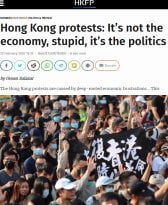
Is Hong Kong’s unrest driven by ‘economic’ or
‘political’ discontent in the city? Here’s a good
discussion of the arguments.
To the CCP, of course, everything is
political. Beijing’s preferred analysis is that the unrest is due to evil
foreign forces and an insufficiently patriotic education system. But Mainland
officials allow that material inequality plays a role and the government should
pay attention to ‘livelihood’ issues. The recent Budget, with a huge boost for
the police plus handouts to ordinary citizens, reflects this.
To the local business-bureaucracy establishment, it is comforting to blame factors like low incomes and housing. The government can in theory alleviate these problems without overly disrupting the overall cronyistic system. And tycoons are nervous that if Beijing sees the local power structure as part of the problem, it will further centralize control and sideline them from it.
Many international observers also assume
livelihood issues must be a key factor. After all, Hong Kong’s economic distortions,
and things like housing unaffordability, are in a league of their own in the
developed world. How could this not push the populace to protest?
To pan-dems, it is insulting to suggest that Hong Kong people just want money when the fight is for freedom, rights and universal suffrage (and, they could add, the backbone of the movement is largely middle-class).
Economic policy and politics largely overlap anyway. The real question is whether the Hong Kong public can be bought off with better material conditions, or will only structural reform resolve the reasons for the anger?
For an answer, we can trace the development
of Hong Kong’s broad-based discontent over the last couple of decades.
After 1997, Beijing installed local
administrations that hugely favoured tycoon interests, hence housing prices and
rents, low health-care funding, poor welfare, white-elephant infrastructure
projects and an unmanageable influx of Mainland ‘tourists’. This made people
increasingly angry, and bolstered support for the pro-dem camp and for
democracy.
Beijing interpreted this rising opposition as a challenge to the CCP’s right to rule, and so stepped up the Mainlandization that diminishes rule of law, freedoms and local identity. This goes back to Article 23 in 2003, but gathered pace with National Education and the 2014 political non-reform. All these proposed measures provoked a popular backlash based on values. We are now in a cycle of repression and resistance: the Umbrella Movement, disqualification of pan-dem politicians, the extradition bill, the 2019 Uprising, and now a semi-police-state type of clampdown, with intimidation, the arrest of Jimmy Lai, mass arrests, and the coming chop for RTHK.
To put it simply: what started as the Hong
Kong public’s discontent with a crony-serving local government has now become an
open conflict between Hong Kong and the CCP. If Beijing had ordered its appointed
mediocrities to fix housing and welfare 15 or 20 years ago, things might have
been different. But it’s too late now.