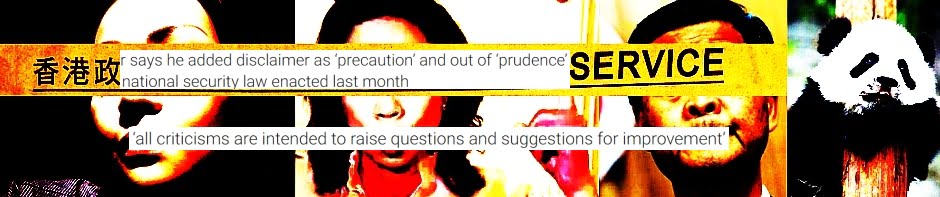
Bloomberg spots a recent shift in official wording of Hong Kong’s NatSec red lines: beforehand, you could be in trouble for doing things that ‘endanger national security’; now you’re in it for doing anything ‘contrary to the interests of national security’. The new phrasing first appeared in proposed changes to the film-censorship law, and then in charities tax guidelines.
Authorities may want to avoid arguing a specific film endangers national security, Kellogg said, as there’s a lower bar to censor movies that “merely run contrary” to its interests. That concept could also be applied to education, the arts and internet regulation, he said.
‘National security’ sounds rather abstract. Let’s say ‘Alice’. People were once forbidden to do anything that endangers Alice; now they can be jailed for doing anything contrary to the interests of Alice. That’s ‘lowering the bar’ enough to best keep out of her way.
RTHK3 host Hugh Chiverton disappears from the airwaves. An AP report on how Hong Kong’s new film censorship regime is cutting scenes from documentaries. And the China Human Rights Lawyers Concern Group becomes the latest civil society organization to disband before the cops come and round them up.

If you think Hong Kong’s NatSec clampdown has already become excessive, you’ll be interested to hear that there’s more to come: laws against ‘fake news’ and doxxing, plus the local National Security legislation required by Article 23 – which is apparently still needed to supplement the NatSec Law imposed by Beijing on July 1 2020. Get used to hearing the phrase ‘plugging loopholes’ a lot more in the coming months.
Bear in mind that Beijing’s local Office for Safeguarding National Security of the Central People’s Government in the Hong Kong Special Administrative Region, the HK Police NatSec Dept, plus other NatSec functions add up to a huge bureaucracy with thousands of staff and a budget of billions. They will need to continue finding new threats and arresting more subversives, if only to justify their own existence. To the extent that the plan is to impose genuine CCP-friendly Leninist-style governance, this must go on until Hong Kong becomes Mainland-without-the-capital-controls.
The Hong Kong Democracy Council announces its leadership line-up, including Alex Chow, Brian Leung and Nathan Law – sounding like a well-educated government in exile. It also has advisors, one of which is Stanford professor Larry Diamond, who supervised Regina Ip’s postgrad work. She’s quite proud of her Stanford connection, though I’m not sure the feeling is mutual.
Michael Pettis – one of the best observers on the subject – on what the Evergrande crisis means for China…
Moral hazard, in other words, underpinned the entire credit market.
That is why Chinese regulators have decided to have a showdown with creditors over Evergrande. By convincing lenders that they will no longer stand behind large Chinese borrowers, they are trying to transform the country’s financial system by making Chinese lenders more reluctant to fund nonproductive investment projects.
Also worth reading/listening to, Anne Stevenson-Yang – a video (skip over the slightly annoying interviewer) on her early days in China and, eventually, Evergrande. Her views on contemporary events start around 21.30. (Among her thoughts: the Chinese middle class see falls in property prices as an unacceptable and unjust outrage; and asset price inflation has been so great in China that the only way out ultimately is RMB devaluation.)
From a discussion on ‘China experts’ at Sinocism…
Basically, most people with a decent moral sense, solid intelligence, experience in China, and no monetary or status interest (i.e. not an ongoing businessperson, or else an academic with a prior reputation wedded to engagement or some postdoc theory of IR to uphold) tend to come down on the negative side of things, because any specific interaction with the current Xi regime leaves everyone with the same bad taste, and specific interactions can’t be papered over with the stupid Tu Zhuxi arguments about how Westerners just don’t understand Confucius.


