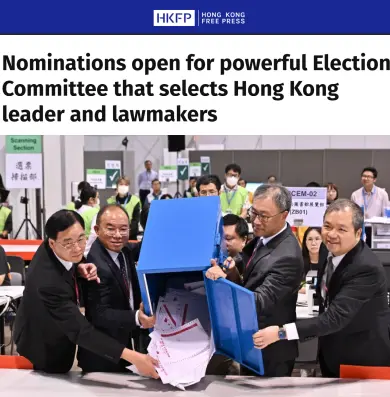
HKFP reports on the forthcoming election for Hong Kong’s Election Committee, which it describes as…
…the powerful electoral body that chooses both Hong Kong’s top leader and almost half of the territory’s lawmakers.
The nomination period for 982 seats on the 1,500-member Election Committee opened on Wednesday and will run until October 20.
If the number of approved nominees exceeds 982, a poll will be held on November 22, according to the government’s Electoral Affairs Commission.
The elected members will join hundreds of other appointed and ex officio members to make up the body. The body consists of five sectors, under which there are a total of 40 subsectors.
Is the body really ‘powerful’? Many of its members will be wealthy and/or well-connected and so obviously have some clout as individuals. And in theory, the committee is entrusted with the job of electing Hong Kong’s CE. But the supreme authority here is the CCP up in Beijing. It makes no secret of its Leninist tradition of top-down control and can hardly let 1,500 people – even pre-screened, etc – in Hong Kong choose whoever they want to occupy an important political role.
It has also never been a secret – by the time the Election Committee goes through the voting ritual – who the next CE will be. Indeed, in 2022 John Lee was the sole candidate.
Since no successor has been discussed in pro-government media by now – and the next CE will be ‘elected’ in the first half of 2027 – we can guess that John Lee will get a second term, barring a last-minute rug pull. The only time that happened was in 2012 when Henry Tang was tossed aside and CY Leung inserted just as Xi Jinping was taking over in Beijing. It could happen again (so far, no-one has ever served two full terms). But it won’t be decided by anyone in Hong Kong.
HKFP adds…
…the total cost of the [November Election Committee] election will be around HK$260 million.
Joel Chan calculates that 9,342 voters can take part (so that’s nearly HK$28,000 spent for each one). The majority are corporate rather than individual human voters.
A pro-Beijing Twitter account says…
Marking another vital practice of Hong Kong’s improved electoral regime, the election has witnessed enthusiastic participation across all sectors from the first day of nominations. Candidates come fully prepared, shifting from empty slogans to pragmatic policy platforms and in-depth governance insights, kicking off a benign and high-quality electoral competition centred on concrete proposals and actionable solutions.
Here’s a new one – a clampdown on ‘yellow economic circle’ marketing for insurance…
Hong Kong national security police have arrested an insurance agent and a woman for allegedly operating “seditious” social media pages to stoke hatred against authorities and boost policy sales.
…“The two arrestees include a man who is a licensed insurance agent, and they are suspected of operating various social media pages to publish content stoking hatred against the constitutional order of the city,” according to the Chinese-language statement.
“The arrested man also used this opportunity to sell insurance products for profit,” the statement added.
Did the SCMP help Chinese officials cover up Xi Jinping’s supposed health problems during the recent visit to the US? Domino Theory engages in some speculation.
Some weekend reading…
Desmond Shum on the differences between Western and Chinese analysts’ approaches…
Take China’s EV industry.
A Western analyst may naturally be drawn toward market share, European industrial decline, tariffs, supply-chain dependence and Chinese technological competitiveness.
A Chinese analyst studying exactly the same industry may give more attention to profitability, price wars, employment, supplier finances, government subsidies, excess capacity and whether the industry’s expansion is economically sustainable.
Both may be conducting macro analysis. Both may be looking at the same companies.
But the question determines the evidence sought, and the evidence sought can influence the conclusion reached.
A Chinese industry can therefore look extraordinarily formidable when viewed from the standpoint of its impact on European competitors while looking considerably less sustainable when viewed from the standpoint of returns on capital inside China.
Both can be true at the same time.
Bitter Winter asks: who owns ‘China’?
Calling Uyghur, Tibetan, and Mongolian homelands “China” does not turn their peoples into Han. Yet when an account of “China” tells only Han history, it makes those peoples strangers in the histories of their own lands.
China Books Review on how being born and raised in Shanghai influenced the work of J G Ballard.
No wonder we have disfunctional families, like that of the youngster struggling to carry 2 slabs of beer while being berated by her stepdad, when the organizations that are funded to look out for the vulnerable folk in the community are being assimilated into the NS juggernaut with considerable resources diverted from their intended focus.
Po Leung Kuk charity appoints 16 ‘national security tutors’ under gov’t scheme:
https://www.chinadailyasia.com/hk/article/640695