More is less?

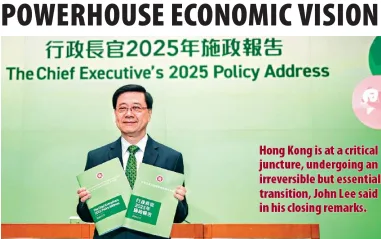
Chief Executive John Lee took just under three hours to deliver his policy address. He mentioned a few major initiatives – notably the ‘Northern Metropolis’ – that aren’t new. Some minor positive measures, including free high-tech prostheses for amputees, and less red tape for food outlets. Some banal obscurities, such as allowing dogs in restaurants. And a load of desperate (or optimistic) proposals to boost the economy, involving yachts, AI, gold, green (!) maritime fuel bunkering, Greater Bay Area intermodal something, streamlining license applications for Low Earth Orbit satellites, and encouraging tokenized assets, tokenized deposits, tokenized money market funds and tokenized bonds, with help from a supervisory sandbox. 

Hong Kong’s fundamental challenge is accepting and adapting to a world in which the Mainland’s post-Mao economic boom – the huge easy skim – is over. Which doesn’t bear thinking about. So frenetic micro-management it is. 

Joel Chan lists the hubs…

• “premier international hub” 

• global hub for AI development

• bond market hub

• RMB business hub

• gold reserve hub

• international logistics hub

• international aviation hub

• GBA transit hub

• top cargo hub

• international legal hub

• international education hub

• international hub for high-calibre talents

• Asia-Pacific hub for innovative low-altitude applications

• premium arts trading hub

• fashion design hub

• yacht hub in Asia

• international culinary hub

Wasn’t there also a reference to an ‘immersive, thematic travel hub’? Something to do with halal food? Or maybe I dreamt it.

Posted in Blog | 14 Comments

Getting my flu jab…

Just time for a link for history types – an Asia Times article by Francesco Sisci comparing the impact of geography on political, military and philosophical development in ancient China and Rome. (Also, some wacky nationalistic Chinese ranting in the comments section.)

Posted in Blog | 2 Comments

Can a car factory fix Hong Kong’s economy?

I think this was supposed to be kept under wraps before tomorrow’s policy address. Either way, this Bloomberg story is a sign of desperation among Hong Kong officials trying to reposition the city’s economy…

Hong Kong is in talks with several Chinese electric-vehicle makers to establish local EV manufacturing, according to people familiar with the matter, as the financial hub looks to advanced industries to diversify its ailing economy.

The city’s officials aim to develop an EV assembly base — a relatively complex process requiring advanced skills, the people said, asking not to be identified discussing private deliberations. They are weighing potential sites in Hong Kong’s New Territories that border mainland China, they added.

The talks have included state-owned automaker FAW Group, one of the people said.

Hong Kong has “been proactively facilitating the development of strategic industries, including advanced manufacturing” as part of its 2022 I&T development blueprint, the city’s Innovation, Technology and Industry Bureau said in response to a Bloomberg News query. FAW didn’t immediately respond to a request for comment.

Hong Kong is turning to new industries to spur growth after years of economic challenges fueled by political crackdowns, Covid isolation and a property slump, which have undermined the city’s status as a premier financial hub.

What ‘advanced skills’ would be needed, and does Hong Kong have them? And what competitive advantages does Hong Kong offer? As the story mentions, Hong Kong has high land and labour costs. While you can import workers, you can’t import sites suitable for large-scale manufacturing complexes. How can an EV plant possibly be viable unless the taxpayers subsidize it with cheap land? Then there’s existing overcapacity in the Mainland’s EV industry…

…with factories producing only half of their planned output — and a bruising price war that has forced a rare government intervention.

One possible reason for locating such operations offshore would be to avoid tariffs on Mainland-produced EVs. But surely it would make more sense to build the plants in Vietnam, Indonesia, Brazil or somewhere where costs are much lower and there’s a sizable and growing local market as well as export opportunities. 

Mega-events that fall flat, endless ‘hubs’, visas for supposed talent, an insatiable longing for millions more tourists, crypto, and now car assembly. Perhaps we should have some sympathy for the civil servants who are given a near-impossible mission: come up with ideas to rejuvenate the economy – but keep real-estate prices/land valuations high and (if you’re getting funny ideas about creative industries) put ‘national security’ above everything.


Transit Jam digs into the Missouri Synod Lutheran church’s complaint against HK International School and finds that they are demanding…

  • all other religious teachings … are dropped … no comparative religious studies;
  • festivals outside Christian festivals to be strictly prohibited;
  • an end to all acceptance and promotion of homosexuality, same-sex marriage and transgender-affirming care…

Whenever I think about Lutherans (about one minute once every five years), I have visions of trendy female Swedish pastors and that completely nuts architecture in Iceland – and forget who they are named after. It seems these guys (no women clergy) are pretty orthodox. Could be an interesting court case.


Ronny Tong’s think tank used to be called Path of Democracy, but has now renamed itself PoD Research Institute. Adjusting to the new order in Hong Kong. It still conducts a survey asking people if they are satisfied with the Legislative Council’s performance. The question might have made sense when the public elected representatives of their choosing to hold the government to account. But these days, LegCo members are, in effect, appointed by the government specifically to agree with it. It’s not a question of whether the public are satisfied with the legislature so much as whether they perceive one actually exists in any meaningful way. (For the record, the majority are dissatisfied.) 

Update from HKFP

[Tong] said the think tank did not intend to avoid “democracy” in its name, but added that the word could have a political connotation that may impact the credibility of its research.

By ‘did not’, we mean ‘obviously did’.

Posted in Blog | 11 Comments

At least it’s not a green hat

We ease ourselves gently into another week with a sneak preview of Wednesday’s policy address: the CE’s neckwear

For decades, policy addresses and their attendant ‘consultations’ have been heavy on ritual rather than substance, not to say quantity over quality. If there is anything worth looking for this year, it would be signs of seriousness – or desperation – about the economy. I’ve heard talk of at least one proposed measure that sounds borderline absurd. We’ll see.

Posted in Blog | 2 Comments

For example, we have the money and a need

A quaint way to put it: Hong Kong lacks the ‘necessary conditions’ to do the Lantau mega-reclamation…

The exorbitant [HK$580 billion] price tag for the reclamation has raised concerns, especially amid three consecutive years of government deficits.

It would total 1,000 hectares. Plans to use existing land in the New Territories will yield 30,000. 


For well over a century, non-profit, non-government schools and hospitals have been granted land by the Hong Kong government on the understanding that they would serve the public good. But some of the institutions involved have since morphed into exclusive enclaves of the rich.

According to an SCMP story (HKFP one here), the Lutheran Church – Missouri Synod cofounded the HK International School in Repulse Bay back in the 1960s. Nowadays, the school is debenture-hungry, charges around HK$250,000 a year in tuition and is sitting on a nest egg of HK$2.8 billion (unless that’s a typo). The church isn’t happy…

“The LCMS believes that HKIS today … has become a school for the rich and the privileged few, not an economically and socially inclusive school for all of Hong Kong as intended and agreed,” it said.

The church said the association had generated cumulative net operating surpluses of nearly HK$800 million over the past five years, with the amount in 2024 reaching almost HK$300 million.

“Personally, I find them grossly excessive. You look at the amount of their reserves, and if I were looking for money, I’d say: this is a great, nice job. But this is not a profit organisation. This is a charity. This is a non-profit. It’s not just for the rich,” [church official Christian] Preus said.

The church said the management had kept demanding more payments from parents, including regularly increasing school fees, selling priority access debentures, repeatedly seeking funding and donations even in cryptocurrency, and charging student training and competition fees, despite having substantial financial reserves.

It argued that the school should use the funds to reduce school fees and provide significantly more scholarships and financial aid.

It also revealed that the school had spent HK$1 billion to build a new “student activity centre”, which included two gymnasiums, four tennis courts, a fitness centre, an indoor golf simulator, a dance studio, indoor rock-climbing facilities and the institution’s third indoor swimming pool.

Third? Maybe the Greater Bay Area can hold the Olympics there.

Mark Simon adds

HKIS very hostile to special needs, and the addition of large numbers of mainland parents has not added anything in terms of the school seeking out any type of roll in the community for the disadvantage[d].

A modest proposal: in exchange for continuation of their leases, require these schools and hospitals to admit (say) a third of their students/patients from the general public, for fees matching what it would cost the public-sector institutions. Otherwise, start paying market rents.

(We could add cheap land allocated a century ago for essential electricity, gas, dockyard and other utilities, which (after the companies were acquired by property giants) were later converted into far more profitable housing rather than returned to the government. Then there are private clubs. And let’s not forget commercial/residential mega-developments on sites granted for places of worship. But this is a city where the main museum complex is expected to convert real estate into luxury homes.)


The EU’s annual report (‘so-called’) on Hong Kong. While it criticizes developments in human/civil rights and local autonomy, most of it is a surprisingly thorough account of other economic and social issues. If I were the government PR department, I’d cut and paste big chunks of this for the official year book. Still – government not a fan.

Posted in Blog | 9 Comments

Separation of powers in action, apparently

HKFP on LegCo’s rejection of a government bill to recognise same-sex partnerships…

…with just 14 out of 86 lawmakers voting in favour.

A total of 71 lawmakers voted against the bill on Wednesday, while one legislator, Doreen Kong, abstained.

It was the first time the opposition-free legislature voted down a government bill.

Lawmakers resumed the debate on the Registration of Same-sex Partnerships Bill, which sought to give limited rights to same-sex couples whose marriages or civil unions are registered overseas, on Wednesday, after a summer recess.

…Lawmaker Maggie Chan, who brought a sign to the meeting reading “Resolutely opposed to the Registration of Same-sex Partnerships Bill,” said the bill “rocks the foundation of the monogamous and heterosexual marriage system in Hong Kong.”

…The Court of Final Appeal gave the government two years to pass a framework for recognising same-sex partnerships. The deadline is October 27.

The Standard adds

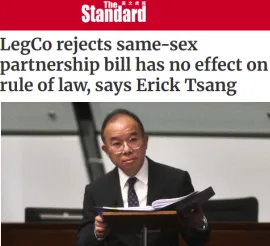
…Secretary for Constitutional and Mainland Affairs Erick Tsang Kwok-wai expressed disappointment regarding the result, emphasizing that the rejection does not represent any impact or influence on the rule of law, but serves as a demonstration of the sharing of responsibilities as well as mutual respect among executive authorities, the LegCo and the Judiciary.

…He noted that lawmakers are elected to represent public opinion, and the rejection of the bill indicated that there remain divergent opinions both within the Legislative Council and among the public. The issue of same-sex partnerships is highly controversial and needs additional time for further examination. He added that the government respects LegCo’s decision and will further discuss and study the issue with the Department of Justice.

Tsang added that the government has made every effort to gain support from both the public and lawmakers and has fulfilled its obligations within the timeframe set by the Court of Final Appeal. Although the result did not align with the government’s legislative proposal, Tsang said the process served as a positive example of how each branch of government fulfills its constitutional duties under the Basic Law. 

The CCP, in line with Leninist ideology, openly rejects separation of powers. Officially Hong Kong does have independent executive, legislative and judicial branches. But Beijing officials have always maintained that the city is ‘executive-led’, and in recent NatSec-era years have openly stressed that LegCo and the courts have a duty to support the (CCP-appointed) government – the all-patriots legislature being designed to have no opposition. It is hard to square talk of ‘sharing of responsibilities’ or ‘seeking public support’ with this.

If the authorities had demanded lawmakers’ support for the bill, they would have had it. Some might think the vote reflects Beijing’s disapproval of gay rights – or civil-society activism of any sort. For what it’s worth, the big pro-Beijing parties in LegCo seem to see gay rights as an unhealthy ‘Western’ thing. Ultimately, this looks like a way to put the (non-NatSec) courts in their place.


Many years ago, I looked at the Lantau reclamation proposal and declared it to have ‘not going to happen’ written all over it. For a while, it seemed then-Chief Executive Carrie Lam and her bureaucrat/engineering buddies were actually serious about spending half a trillion bucks or more on something we already have. More recently, the money has run out, and someone, somewhere noticed that the New Territories has lots of underused land. RTHK reports

Secretary for Development Bernadette Linn on Wednesday said the government does not have a timetable for the Kau Yi Chau project, and that the reclamation works off Lantau would not be carried out within this current term of government.

In a written reply to lawmaker Lo Wai-kwok, Linn said her bureau also thinks it is inappropriate to continue environmental impact assessment procedures without a timetable for the reclamation work.

Posted in Blog | 11 Comments

CSD not happy

Samuel Bickett’s NY Post piece (here)  on conditions in Hong Kong prison’s doesn’t go down well with the city’s Corrections boss, who says it is ‘completely false, baseless and malicious defamation’…

In his letter, Wong [Kwok-hing] stated the department is committed to ensuring a safe, humane and healthy custodial environment while providing appropriate rehabilitation programs to help offenders reform. He said allegations of widespread abuse, medical negligence or poor living conditions in correctional institutions were entirely unfounded.

Wong emphasized that Hong Kong has no so-called “political prisoners” and all persons in custody are treated equally without discrimination based on background, political views or nature of offenses. The department strictly adheres to fairness and professionalism in all operations, with any illegal acts by persons in custody or staff dealt with seriously and referred to law enforcement agencies for investigation.

…Wong explained that in recent years, some radical offenders convicted of serious crimes have entered correctional institutions, many influenced by extremist ideologies or misconceptions. To address their rehabilitation needs, the department launched the “PATH” program to help persons in custody understand Chinese history and culture, develop national identity, rebuild positive values and restart their lives. All persons in custody may participate voluntarily, and the department condemns any demonization of rehabilitation programs as “indoctrination.”

No angry government press release about the Committee for Freedom in HK Foundation report itself. But there is one on the European Commission’s ‘so-called’ annual report on Hong Kong, which apparently disputes every point in detail…

 “As regards the interim injunction relating to a song granted by the Court of Appeal, the HKSAR Government reiterates that the interim injunction covers four types of specified criminal acts in relation to the concerned song. The injunction pursues the legitimate aim of safeguarding national security and is necessary, reasonable, legitimate, proportionate and consistent with the requirements of the Hong Kong Bill of Rights. Internationally, many jurisdictions also have legal mechanisms in place to prohibit the dissemination of information that is illegal, offensive, incites violence, incites hatred or harms the public interest. For example, the EU’s Digital Services Act stipulates that upon the receipt of an order to act against a specific item(s) of illegal content, providers of intermediary services shall inform the authority of any effect given to the order without undue delay ; it also requires providers of hosting services to put mechanisms in place to combat illegal contents and respond to notices received in a timely manner, including removing and disabling access to the relevant content. The unreasonable criticisms made by the EU against the legitimate legal actions taken by the HKSAR Government shows clearly the double standards held.


An SCMP op-ed complains that the West deliberately ignores the Nanjing massacre…

[The reason] Chinese scholar Dai Jinhua has observed, lies in Western discourse itself.

To Western scholars, the Nanking massacre was just “not technically sophisticated”, she said. “It’s not special, not surprising, not worth writing about, while Auschwitz represents that kind of efficiency, order, modern technology that is truly terrifying. And Hiroshima and Nagasaki, where a single bomb destroyed hundreds of thousands of lives – that’s worth writing about.”

Every country focuses on its own World War II experiences. So, where Europe is concerned, the UK and US focus on D Day as the beginning of the end of Adolf Hitler, while overlooking the fact that 90% of the soldiers killed fighting the Germans were Soviets on the Eastern front. Similarly, people in Manila, Singapore, Borneo and Burma no doubt remember the Japanese massacres of civilians in those places, which many of us probably know little about. When did we last hear Chinese academics or politicians mention those Nanjing-type slaughters in Southeast Asia? If you don’t hear Southeast Asians mention them that much, it’s probably because they do not use those atrocities to stir up hatred of present-day Japan.

A Brookings Institute essay on Beijing’s World War II narrative…

Russia uses a generous interpretation of the Soviet role in defeating fascism to bolster the assertion that it is entitled to a say in NATO and European Union expansion.

…The PRC has jumped onto this “memory war” wagon with its increasing attention to the commemoration of the victory over Japan that occurred not merely in the Pacific Theater but also in the land war fought in China proper.

…The implications of … reinterpretations [of diplomatic history] are far-reaching. Recentering Cairo and Potsdam as legitimate international agreements bolsters the PRC’s justification for its sovereign control of Taiwan [and] a springboard for broader discussion in China of “international order.”

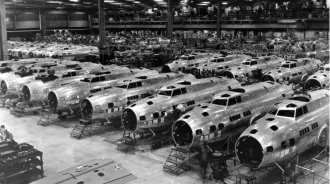
Modern-day officially sanctioned Chinese ‘discourse’ sidesteps the fact that the PRC did not even exist during World War II, and that China’s military effort was largely marshalled by the KMT-run ROC. And (as with the USSR and the UK), the ROC depended on one key contribution that probably did more than anything else to defeat Germany and Japan: the USA’s astounding industrial mobilization, which produced, among much else, 300,000 aircraft in a roughly three-year period. 

Posted in Blog | 12 Comments

Why not ‘serene, wholesome, hygienic, fragrant and evocative’?

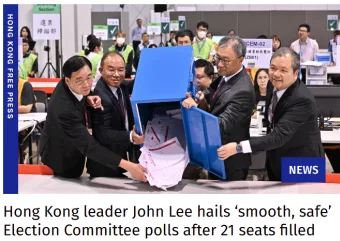
Chief Executive John Lee declares Sunday’s subsector by-elections for the Election Committee as ‘fair, just, honest, smooth, safe and orderly’, adding that the Committee is ‘broadly representative’ and showcases ‘balanced participation’.

Some stats. There were 3,534 voters – a 97.33% turnout. Between them, they picked 21 winners from a total of 28 (pre-screened) candidates on six subsector ballots. Another 72 candidates from other subsectors won by default because there were no competing candidates. The winners join a body of 1,500 people otherwise selected or appointed who will elect 40 (pre-screened) lawmakers and the next Chief Executive (probably from another ballot of just one candidate). The exercise cost HK$233 million. Officials explaining this figure in the HKFP report sound rather defensive, as if deep down they realize the weirdness and pointlessness of it all. (If there are surplus all-patriot types wanting these positions, just choose the ‘winners’ by lot, like Mark 6 numbers. Who would notice the difference?)

Asked Grok for 10 more adjectives similar to John Lee’s. It suggests: ‘great, excellent, superb, fantastic, wonderful, pleasant, delightful, admirable, impressive, positive’. AI has a long way to go. (Prompted it impeccably, by the way.)


China Media Project takes a look at the diminishing image of Wu Jing – star of the macho-patriotic Wolf Warrior movies…

…Wu is the face of the government’s ideal of a more assertive Chinese nation, one that is ready to stand tall in the world and fly its flag high — the same muscular nationalism on full display this week as state-of-the-art weaponry rolled through Beijing and soldiers goose-stepped to commemorate the 80th anniversary of World War II’s end.

…But last week, in the run-up to this week’s display of military might in Beijing, mocking videos of Wu that inexplicably went viral had state media pundits furiously scratching their heads. It was perhaps for some a jarring reminder that not everyone in China takes what Wu Jing represents as seriously as propagandists would like.

…An op-ed reposted by the Shanghai based online outlet Guancha (观察) noted Wu’s unpopularity among Chinese women, who perceive him as “oily and chauvinistic.” 

…Former Global Times editor-in-chief and public commentator Hu Xijin (胡锡进) speculated that the mocking of Wu might be at least in part about young people venting their frustration with poor job prospects and extraordinary life pressures, which according to Hu had “partially weakened the passion of the ‘Wolf Warrior’ spirit.’” 


A (probably paywalled) FT piece on Mainlanders moving to Tokyo is attracting attention…

There is a code at these dinners, which signals a desire to turn the conversation to the topic, according to another Run-ri, Zhang Jieping, a Tokyo-based journalist and entrepreneur who has founded a Chinese bookstore in the city. The way to do it is to ask one’s fellow diners: “How long do you plan to stay?”

“That signals that you want to talk about visas,” Zhang says. “The conversation is always about emigration. Of every three-hour dinner, two will be spent talking about other countries’ visa requirements, how to get out, how to marry a local, how to get an apartment, how to get your parents over there and how to get cash out. Every dinner, every lunch,” she says. “And everyone talks about Japan.”

In these conversations, there is a tacit admission that, for all its “lost” economic decades and flagging dynamism, Japan has got a great deal right. It ranks highly on global indices of peace, economic freedom and property rights. In politics, the nation has kept its poise as others have thrown tantrums, remained supple as others stiffened. It has reliable medical provision, free speech, safe streets, incredible service and astonishingly good food.

Beyond these practicalities, there is an almost ideological element to the movement, says Zhang. “The Chinese mindset for the past 30 years has been that leaving is always better. You leave the country for the town. You leave the town for the city. You leave the city for a big city. You leave the big city for the US. Now, you leave for Tokyo.”

…“very important, they want properties with a parking space big enough for an Alphard,” Guo says, referring to the imposing Toyota people carriers that have become the favourite Run-ri vehicles. A new Alphard would cost the equivalent of $130,000 in China and commands extraordinary status. In Japan, the same car costs the equivalent of $40,000. “They have seen celebrities in China being driven around in them. They want to buy all of that prestige but for a really low price in yen.”

…It works like this. The banks convert renminbi into yen via a complex network of laundering facilities that include dollar-generating Chinese import businesses in Africa. The customer then arranges for funds to be delivered to a representative of the bank at premises in China, and sets up an appointment to receive the yen at various locations in Japanese cities. Cash is couriered in huge quantities — one agent said that a North Face waterproof rucksack is currently the favoured receptacle — with the underground bankers taking as much as a 100 basis point margin on each transaction.

A lot of time, says Guo, is spent counting out cash on tables in anonymous upstairs offices. The transfer of a million dollars’ worth of renminbi into yen, say those who have used the services, takes about a day. “It has to be very discreet. A lot of the customers are the families of Chinese government officials,” says Guo.

Many of these upper-middle-class Chinese are taking advantage of business/investment visas that require an outlay of less than US$50,000. There are calls in Japan to raise the bar.

Posted in Blog | 3 Comments

Tapah wreaks morning in bed on city

‘Neither snow, nor rain, nor heat, nor gloom of night stays these courageous couriers from the swift completion of their appointed rounds’. Except in Hong Kong. Yet another day when the whole city shuts down because a passing cyclone is technically a ‘Number 8’, even though most districts experience only unremarkable wind and precipitation. 

Thankfully, the Election Committee Subsector By-elections went ahead smoothly yesterday. Full results were being posted live over at the government’s press releases. A couple of things stand out. Turnouts were all 90%-plus (perhaps electorates are so small that your absence will be noticed). And looking through the results (Tech and Innovation, for example), it seems that in most of these polls every candidate but one wins. Strange.


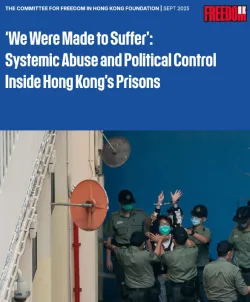
Someone isn’t going to like this – the Committee for Freedom in HK Foundation report on ‘systematic abuse and control in HK prisons’, which…

…reveals a prison system that has normalized abuse and neglect, suppressed dissent, and violated both international and local legal standards.

Hong Kong’s prisons have become a hidden front in the city’s broader assault on civil liberties, where unchecked power and secrecy prevent accountability. 

…. Compulsory political indoctrination through “Project PATH.” The Correctional Services Department (CSD)—with direction from the Beijing controlled Committee for Safeguarding National Security—uses political “rehabilitation” programs to indoctrinate prisoners with Chinese Communist Party (CCP) views and dissuade them from pro-democracy advocacy … Assaults by CSD staff. Prisoners described specific locations in the prison system where CSD staff regularly take prisoners to beat or pepper spray them … Solitary confinement as a routine form of punishment and control … Chronic medical neglect. Former inmates report widespread difficulties obtaining proper medical care, including untreated seizures, broken bones, and full-body rashes. We document the case of a prisoner who died due to official neglect after showing severe signs of psychological distress … Weaponized psychiatric detention … Squalid infrastructure and hygiene…

Co-author (and former guest at Lai Chi Kok) Samuel Bickett also does an op-ed in the NY Post

Arrested in 2019 — purportedly for stepping in to stop two men beating a teen in a metro station — and convicted in 2021 in an absurd show trial, I found myself jailed for what appeared to be retaliation against the United States for its actions against Hong Kong officials.

After two months, I was released but barred from leaving the city, after which I remained outspoken in my criticism of Hong Kong’s government and its abuses.

A few months later, an appeals court put me back in prison, which is where I found myself that evening in February 2022, witnessing the bloody beating of an inmate.

Posted in Blog | 5 Comments

Some ‘not guilty’ verdicts

A jury acquits seven people of conspiracy to commit bombing, while three are found guilty of a lesser charge of conspiracy to case explosion…

…three bomb plots involved planting explosives at a site near the Lo Wu border crossing point; Caritas Medical Centre, a public hospital in Sham Shui Po; and a car park in Tseung Kwan O, where a memorial was planned for a student who fell to his death amid a police-protesters clash in November 2019.

If convicted, the defendants would have faced up to life imprisonment.

Some echoes of the ‘Dragon Slayers’ case: also a bomb plot, also dating from late 2019, also tried under the UN model anti-terrorism law, and all but one of the seven defendants were found not guilty last year. Nowadays, the suspects would be charged under the local NatSec law, and tried without a jury by NatSec judges who hardly ever deliver ‘not guilty’ verdicts.


Another ‘not guilty’ decision, in the case of an LSD member charged with displaying an unauthorized poster at a street booth in 2022…

The poster featured pictures of the party’s detained members Leung Kwok-hung, better known as “Long Hair”; Jimmy Sham; and Figo Chan, alongside a Chinese phrase meaning “helping the needy, proceed without hesitation.”

Magistrate Kestrel Lam ruled that Yu was not guilty, saying the poster was small in size – measuring 1 metre by 2.5 metres – and was not especially eye-catching in the colourful streetscape of bustling Causeway Bay, according to The Witness.

The poster was only displayed for around 40 minutes and did not obstruct pedestrians walking past, he added.


Some weekend reading…

More on the symbolism of this week’s huge military parade in Beijing from China Media Project

…in the days ahead of this week’s parade of high-tech weaponry, ideological moves of equal or greater importance have prepared the way for the CCP’s new historical consensus. This view rewrites the history of global war and peace to firm up the narrative of China’s centrality. It was the CCP, the story goes, that decisively won the war for Asia and for the world.

…As the soldiers, tanks, missiles and drones goose-stepped and rolled along Chang’an Avenue on Wednesday, and Vladimir Putin had his smiling moment with Xi Jinping, some might have felt a sense of America sliding out of contemporary relevance. But behind the physical demonstrations of military might and the cementing of partnerships, there was an insistent narrative effort on all fronts to re-position China — and by extension, the CCP — at the center of the global historical narrative. For the leadership’s vision of a “new type of international relations,” nudging American leadership out of contemporary geopolitics is only half the battle; ensuring that it slips out of the history books may be equally important.


George Magnus summarizes China’s mercantilism in a tweet

1) the brazen pursuit of economic policies that result in huge [balance of payment] surpluses 2) Reserve asset accumulation fetish 3) Currency undervaluation and 4) … industrial policies that are unprecedented in scope and reach. All symbols of or leading to national greatness 

In Engelsberg Ideas, he writes an in-depth essay on the subject…

China was happy to take the outstretched arm of the US and others to join the World Trade Organisation in 2001, and benefitted enormously. The WTO, however, was not adequately equipped or empowered to deal with or discipline China, whose trade and industrial policy idiosyncrasies were tolerated for far too long. The long march, as we might say, of industrial policies embraced from the mid-2000s onwards included an array of initiatives spanning a special status for state enterprises, subsidies, direct grants and lending, below-market borrowing, state-directed credit, and technology transfer and procurement policies, all of which sustained China’s status as a ‘non-market economy’, notwithstanding understandings that these policies would not persist.

…Just over 80 years ago, a generation that had suffered the consequences of a fractured global economic and political order in the 1930s and then the Second World War, set up important institutions at Bretton Woods in 1944 so as to prevent the kind of commercial conflict that has now once again erupted. Yet, how is such a pinnacle of international collaboration to re-occur, when the world’s two major powers are adversaries? China wants to game the system, and the US has – for now at least – decided to replace the commitment to rules and alliances with transactional relations based on favour and patronage.


We are up to our ears in ‘reverse Nixon’ articles at the moment. The basic idea is that Trump is trying to pull Russia closer to the US in order to isolate China – the opposite of Henry Kissinger’s strategy in 1972. It’s nuts, but even assuming Trump really thinks on that level, the difference is that Russia is running rings around him as it deepens ties with Beijing. Francesco Sisci in Asia Times explains

Putin is the total winner of the day. He can frame Trump’s erratic behavior as proof of influence, boasting to Xi and Modi: “I control Trump, stick with me, no need to talk with the Americans.”

Whether true or not, the narrative may seem believable, and if so, then anything can spin out of this spiel. Indeed, the next Trump-Xi summit, apparently scheduled for October, could take place under a Russian cloud. Is the US cornered? Trump now needs to prove that Putin is not in control. It could be very tricky.

For good measure, Trump is also driving India closer to Beijing…

…What many Asian diplomats find mind-boggling is the reason behind the betrayal [imposition of a 50% tariff]. Reportedly, it stemmed from a testy phone call, where Trump insisted Modi nominate him for the Nobel Peace Prize, as the US president had helped resolve the recent India-Pakistan clash (see here). The damage to the US is compounded by how trivial the cause appears, casting a deep shadow over its reliability as a partner.

Russia can now boast a political victory greater than any it has achieved in Ukraine, gaining significant political leverage points from which it can upend the current world order.
Posted in Blog | 6 Comments