Apparently spurred by a Wen Wei Po story, the government says it will take some sort of action over the film Joshua: Teenager vs. Superpower, which it just learned has been available on Netflix since 2017. The trailer can be seen by anyone without a subscription (and is in fact also on YouTube)…
The newspaper claimed that the film “distorts the facts to valorise Wong” and “features several anti-China disruptors spreading inciting statements that subvert conventional values.”
…“The HKSAR Government calls on members of the public to think critically and discerningly, and dissociate themselves from any act or activity that endangers national security,” [a Security Bureau spokesman said].
Pro-Beijing media and government officials have used words like ‘valorize’, ‘glamorize’ or ‘glorify’ in the past to dismiss or condemn video footage and other records of the 2019 protests. And not without reason: scenes of massive demonstrations are emotive for the 2 million-plus people who took part, and apparently for the wider overseas audiences who have seen the Joshua Wong documentary and other films, like Revolution of Our Times and Do Not Split. Such portrayals of the events contradict the authorities’ narrative about foreign forces and black hands.
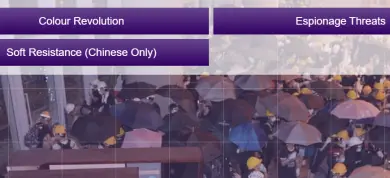
The government presented a video and other materials of its own, which are on this government site titled The Truth About Hong Kong ‘Legislative Amendment Turmoil’. A discomforting mish-mash of Nury Vittachi/tankie stuff and Hong Kong bureaucrat box-ticking. Apparently put together to show someone higher up that it had been put together. A quick sample…
What is a “colour revolution”?
“Colour revolution” refers to the illegal means used by certain countries to plot and subvert the state power of other countries with the ultimate objective to control them. The affected countries will eventually end up suffering from change of government, social unrest, economic collapse, and deterioration in people’s livelihood.
Past “colour revolutions” include the “Velvet Revolution” in Serbia in 2000, the “Rose Revolution” in Georgia in 2003, the “Orange Revolution” in Ukraine in 2004, the “Tulip Revolution” in Kyrgyzstan in 2005, etc.
All “colour revolutions” share some common characteristics, including manipulation or support by certain countries behind the scene; local opposition parties coming out to lead in a premeditated and organised way; using the banner of fighting for so-called democracy, freedom and human rights, with subversion of the existing state power as the ultimate aim; using ad-hoc incidents as flashpoints to create scenes of street demonstrations or flash-mob violence; and making use of social conflicts to shape and sway public opinion so as to incite, deceive and hijack the masses to take part in activities, etc.
The Joshua movie aside – the latest NatSec threat, SCMP reports, is AI. But we’re supposed to be an AI hub, with the latest Policy Address mentioning appointment of an AI Commissioner, right?
AI does potentially pose what most countries refer to as national security risks. For example, a Harvard Law paper mentions AI-assisted drone technology that gives ‘weak states and non-state actors access to a type of long-range precision strike capability’. But outgoing HK NatSec Police boss Andrew Kan is also thinking of a more local version of NatSec…
Discussing the new threat, the outgoing police official said he had seen overseas examples of AI agents launching attacks on critical infrastructure and other companies’ computer systems, as well as generating misinformation.
Anti-government forces could also use AI to commit crimes related to national security, he said.
…Kan pointed to AI tools used to help screen social media posts to identify potential “soft resistance” against the government as an example.
“As computers and AI become more powerful, the chances of successfully hiding your criminal intent or criminal acts are actually getting slimmer. So, it’s better not to test the law,” he warned.
It would be interesting to know what AI prompts they use to identify the dreaded ‘soft resistance’ on Facebook.
“ It would be interesting to know what AI prompts they use to identify the dreaded ‘soft resistance’ on Facebook.”
It’s probably an autonomous or semi autonomous agent that crawls through Facebook / social media looking for thought crime. These can run for hours and even days / months. The prompt would be part of the harness and does not need to be input by the user. They just need to launch the agent sort of like you would launch an autonomous drone and let it do its thing while it’s in flight metaphorically speaking.
I think they are fully capable of sorting what comments are definitely sedition and what comments are grey zone soft resistance that require further monitoring.
Like that list of hubs a commenter posted on Facebook recent. There were many sarcastic comments written in Chinese by other Hong Kongers there. Many of these can be flagged by the agent for close monitoring.
And of course this all helps justify the NS budget.
Spectacular Streisand Effect work by the Wen Wei Po guys. The documentary is currently the most popular Netflix offering in Hong Kong.
The changes in the ten year period since are remarkable.