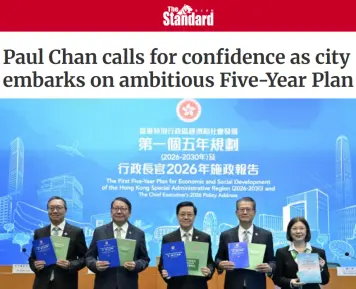
For those of us still unclear about what Hong Kong’s Five-Year Plan is for, Financial Secretary Paul Chan spells it all out…
In his blog, Chan said that it is the first time the city has set a five-year commitment, mapping out directions, goals, targets, and timelines. This framework serves as the city’s development blueprint for the next five years.
…The Policy Address is closely aligned and interconnected with the Five-Year Plan. The significance of the plan lies not just in the document itself, but in adopting a forward-looking perspective, viewing the present through the future, translating the vision into measurable indicators and action plans that can be reviewed year by year, Chan added.
…The government sets the direction, invests in infrastructure, and innovates systems, while the market allocates resources and injects vitality. By bringing the two together, enterprises can see where things are heading five years ahead. This will help make good use of the synergy of a “capable government” and an “efficient market”.
Thank God we’re “translating the vision into measurable indicators and action plans that can be reviewed year by year” and not just making it up as we go along.
Desmond Shum summarizes a conversation with a junior official in local government in China…
This year, the focus shifted to identifying people classified as potential risks to social stability.
Identifying these people becomes a numerical quota that must be met. Officials must identify people in the “eight failures and losses” categories: failed investments, unemployment, setbacks in life, romantic setbacks, strained relationships, psychological imbalance, mental illness, and inadequate supervision of minors. They must also identify those with the “three lows and three fews”: low income, low status, low social standing; few social interactions, few opportunities for upward mobility, and few channels for support.
Superiors demand specific headcounts and percentages. Zero is not an acceptable answer.
And yes, they pad out statistics to make things look better.
A Diplomat piece argues that Beijing’s potentially most problematic audience on Tibet is its own Han citizens…
The CCP understands that its rule in Tibet rests not only on security spending but on the acquiescence of the Han majority – an acquiescence manufactured through decades of disinformation. Since 1959, state propaganda has taught Chinese citizens that old Tibet was a barbaric serf society, that the Dalai Lama was its greatest slaveholder. One particularly enduring myth holds that Tibet’s Buddhist monks made drums out of human skin.
…Han acceptance of this narrative is the foundation for CCP rule in Tibet – but it is more fragile than it looks. In 2025, the Tibet Autonomous Region (TAR) raised just 31.8 billion yuan in local revenue against 310 billion in spending. Central transfers of 253.88 billion yuan, more than 80 percent of the budget according to the TAR’s budget reports, filled the gap, funding both livelihood programs and a vast stability-maintenance apparatus.
“capable government”, if only…
Hong Kong’s “Five Year Plan”?
Sir John Cowperthwaite is rolling over in his grave.
So much for “positive non-intervention”.