In China File, Jeremy Goldkorn goes back to China for the first time in years…
It may be hard to make money in China in 2026, but it is very pleasant to spend it. A major element of involution is the brutal competition in every market that puts downward pressure on prices as consumers, spoiled for choice, demand higher and higher quality. Hotels, trains, flights, food, clothes, cars, phones, electronics, massages, mountaineering gear, Labubus: all are cheap compared to the United States.
But first you have to figure out how to pay for stuff. The country has gone cashless, and you need a mobile phone tied to a verified identity to use Alipay and WeChat Wallet, and these are the only digital wallets that work.
…Aside from the ubiquitous cameras, it is not possible to move around a city on any form of transport or pay for anything without the apps, and they always know who and where you are. In Yangzhou’s Geyuan … you need to watch a video advertisement and scan your face to get toilet paper. Once only: the dispenser remembers who you are and won’t give you seconds. Some parts of Beijing look like a spoof science fiction film about a surveillance state: we visited a friend in a part of Haidian District where there are a lot of government buildings and housing compounds. There are horizontal bars above the street every 50 meters, each bar holding more than a dozen different cameras—we counted them. Our friend pointed out the different types: that one reads license plates, this one is for facial recognition of pedestrians, this one scans the faces of people inside cars, that one is used for gait recognition…
Semafor compares two Chinese tycoons…
…both share one thing in common: They are products of a system that concentrates massive resources at the command of the state, in the process generating colossal waste and leaving a trail of debt and industrial overcapacity. In sum, the pair represent how the business cycle in China plays out.
…Hui [Ka Yan, ex-Evergrand boss now serving life in prison] is the fall guy for China’s real estate meltdown. No doubt his crimes are real, but he was also only playing his part in what was essentially a Ponzi scheme that everybody — from village committees to the Politburo — relied upon to drive growth and generate employment. Real estate speculation wasn’t a flaw in the system; it was for a time China’s primary development model. Developers like Hui came to see the market as a one-way bet — why would the government spoil its own party? — and in a sense, loading up on risky debt was a rational strategy.
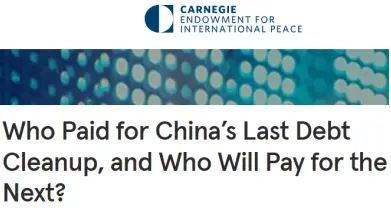
Michael Pettis asks who pays for the clearing of Chinese state banks’ bad debts. Another way of putting it: why is household consumption so weak?
…when the owners or creditors are politically powerful—or when imposing losses on them threatens broader financial stability—governments often intervene to socialize the losses instead. There are many ways to do this, but in almost every case the losses are ultimately transferred, often indirectly, to the household sector. This can occur through explicit fiscal bailouts financed by taxes, through inflation, or through financial repression that transfers income from depositors and other holders of monetary assets to borrowers.
This leads to two fundamental points that are essential for understanding China’s banking cleanup. First, losses never disappear, even when they appear to. They are always absorbed by some sector of the economy. Second, loans that finance projects whose economic value ultimately proves to be less than their cost represent real economic losses, whether or not those losses are immediately recognized. Moving bad loans from one balance sheet to another does not eliminate them. It merely changes the way in which the losses will be allocated.
The Jamestown Foundation on the growing alliance between China and Russia…
While Beijing is in control, and there is real and growing asymmetry between the two countries, excessive focus on Moscow as a weakened “junior partner” that fights costly wars, supplies discounted energy, and repeatedly seeks concessions from Beijing misses both the integration now taking place and the strategic assets Russia still contributes.
Asian Review of Books looks at Entangled Empires: Four Centuries of China-Russia Relations…
Putin and Xi indeed look rather chummy. But how broad, deep and lasting are the ties that bind their two nations? According to Sören Urbansky and Martin Wagner, two historians of Eastern Europe, the answer is not as much as many might think. To their mind, “florid proclamations of friendship are undoubtedly a façade behind which historic rivalries persist.”
While Hong Kong pays lip-service to TCM for patriotic reasons, the city’s government is otherwise sensible about serious public-health measures like vaccinations. In the US, top health officials are pretty much denying that measles can be deadly; RFK Jr – when he’s not swimming in sewage and promoting unpasteurized milk – says chicken soup can cure it. From Science-Based Medicine.

Currently about halfway through 3 Body Problem book 1 (finally getting around to it) and I thought it was quaint that the murder suspect could make their escape into the Beijing night w/o being caught by a security camera. Times have changed a fair bit since that book was released in 2008.
https://x.com/robbystarbuck/status/2093129958512120312