Desmond Shum tweet on Beijing’s tax clampdown on offshore wealth…
Article 11 states that even someone who has obtained foreign nationality or permanent or long-term residence overseas may still be deemed a Chinese domiciled tax resident if his or her “main economic interests” derive from China.
I suspect Beijing’s immediate target is mainland Chinese wealth owners—including those who have recently relocated to Hong Kong while retaining their businesses, assets and economic interests in mainland China.
Those cases are relatively straightforward.
The difficult question is: where do you draw the line?
And another…
For China’s wealthy, the implications extend well beyond paying more tax. Offshore trusts lose much of their value as asset-protection vehicles. Many families will now be looking to diversify not only their assets, but also their residency, citizenship and long-term wealth structures further away from China before additional restrictions emerge.
It is also difficult to see this as positive for China’s domestic investment environment. Private investment has already been in decline since 2023 as economic growth slows and business confidence deteriorates, reached minus 3.8% in 2025. Policies perceived as retrospective and highly discretionary will likely accelerate that trend.
Capital markets are also likely to feel the effects. Hong Kong’s, and to an extent Singapore’s, offshore wealth-management industry has been built in large part around mainland Chinese clients…
China faces serious long-term fiscal challenges on the spending side as well. Dragonometry on Beijing’s drive to boost enforcement of social-security payments…
China’s growth model systematically shifts income away from households and toward producers and the state. As a result, every attempt to patch a symptom without addressing that structure ends up reproducing it. Here is a clean illustration of it. Social security shortfalls are themselves a symptom of an economy that underpays labor relative to what it produces. The fix for that underpayment, as implemented, is to enforce accurate reporting of wages that are already too low, which raises the cost of employing people without raising what they take home. It is, in the plainest terms, private-sector Peter being robbed to pay private-sector Paul. Nothing about the aggregate flow of income between households and the state improves. The accounting gets tidier. The underlying problem does not move.
It would be a mistake to read this as mere incompetence, or a leadership that has failed to notice the contradiction. The more troubling reading is that they have noticed, and are choosing the option that does not require confronting vested interests among employers, local governments and the fiscal authorities who benefit from the current arrangement.
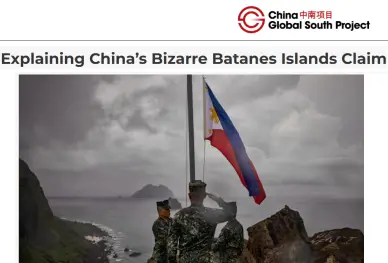
Attendees at a Guangzhou academic symposium in June argued that the Batanes Islands – part of the Philippines – are actually Chinese. China Global South Project on the ‘bizarre claim’…
The most immediate explanation for the surprise claim on the Batanes is that it was a reaction to a May 28 decision by Japan and the Philippines to open formal talks on their maritime boundary, a development that Beijing viewed through the lens of Taiwan and its broader maritime claims.
The Batanes argument also comes at a contentious time for Beijing’s maritime history: it is likely no coincidence that Chinese scholars made their dubious claim less than two weeks before Manila was set to commemorate the 10th anniversary of the ruling in its favor at the Permanent Court of Arbitration (PCA) on July 12th.
After all, the PCA invalidated Beijing’s expansive sovereignty claims in the South China Sea under its “nine-dash line,” which encompasses roughly 85 percent of the sea based on historical rights and in contravention to the UN Convention on the Law of the Sea (UNCLOS) that China itself both signed and ratified.
Is this the flow of argument?
1. China is The Middle Kingdom
2. By definition the Middle Kingdom is the core
3. The core is the heart and centre of everything
4. Therefore everything outside the core is dependent on and belongs to the core
5. China is the Middle Kingdom
6. Therefore everywhere belongs to China.