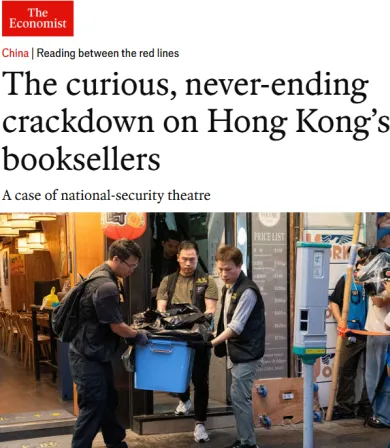
The Economist tries to explain Hong Kong’s obsession with shutting down small bookstores…
Evidently the officers in charge of the raid had not expected such a big haul, or they would have brought more bins. The last of it had to be carried out in a suitcase. After the contraband came the suspect: a bespectacled woman, with a T-shirt printed “I am a bookstore employee”.
The raid on “Have a Nice Stay”, a bookstore in Hong Kong’s trendy Mong Kok district, on July 15th was part of the Hong Kong government’s campaign against retailers of the printed word. Since passing a draconian national-security law in 2020 authorities have gone after shops selling “seditious” texts. This was not even the day’s first operation. Outside the half-closed shutter of the nearby Greenfield bookstore, two plainclothes police officers brusquely told your correspondent to shove off. At least 11 booksellers have been arrested this year.
The government’s heavy-handed approach is puzzling. Any real danger from controversial texts is surely online, where they may be easily shared. And raiding bookshops looks patently repressive, especially to people in Taiwan who watch Hong Kong to see what Chinese rule might be like…
It is not to keep provocative titles out of eager readers’ hands. The government will not say what is forbidden, so booksellers cannot know what not to stock. The day before the raids “Have a Nice Stay” said it was closing, as it could not navigate the government’s “unclear red lines”. The police’s enormous haul suggests they might not know where the lines are either.
The article suggests three reasons for the crackdown: to eradicate spaces where a ‘collective memory’ of 2019 might survive; to display ‘hard power’ against resistance; and to please Beijing…
The police seem eager to justify the HK$18bn ($2.3bn) spent on national security since the law passed … Wang Zhenmin, the former legal chief of China’s Hong Kong liaison office and an influential voice, said on July 14th that national-security risks were “rising significantly” and urged stronger “enforcement mechanisms”.
The author also predicts more to come. After the bookshops, what next? Overseas scholarships, of course – but they’re hard to raid. Independent media, perhaps just a matter of time. Then… Hair salons? Pet shops? 7-Elevens?
For Hong Kong stats followers (or those who rely on stats followers) – Joel Chan has started a blog.
OT-ish
Always break bad news at the weekend in the hope no one will notice. The Electoral Registration Office updating the electoral roll figures did just that. Admitting a net drop of 24,400 since last year, they do boast a record number of new registrations at nearly 64,900. What they carefully do not say is that number giving up the right to vote this year is around 89,000.
That big spike of births between 2006-13: Mainland birthers coming in for a quick pop out and school placement?
The objective is to eliminate any location where people gather that is not under the control of ‘ptriotic’ operators. Like North Korea, note the increase in community porgrammes like ‘Sport For All Day”. Use organized leisure to keep the plebs occupied and managed.