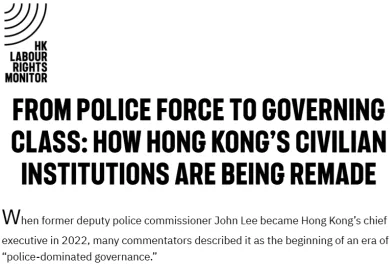
HK Labour Rights Monitor looks at how former members of the Hong Kong Police are moving into senior positions elsewhere in the public sector…
Since taking office, [ex-cop CE John] Lee has appointed at least seven former senior police officers to senior government positions.
Some now oversee public communications, food and environmental hygiene, cybersecurity and the Civil Service College, despite having spent most of their careers in policing rather than in those specialist fields.
The pattern extends beyond government.
Former police officers have also been appointed to senior positions at the Consumer Council, Competition Commission and the Academy for Performing Arts—institutions responsible for consumer rights, market competition and arts education rather than law enforcement.
The latest appointment came this week, when a former assistant police commissioner became Deputy Chief Executive of the Consumer Council, Hong Kong’s statutory consumer watchdog.
The article hints that this trend is a move away from Hong Kong’s public-service traditions of open competition, merit-based appointments and professional expertise. It doesn’t speculate why this is happening, although it points out that…
…Some of those now entering senior civilian or corporate positions were also prominent figures during the 2019 protests.
Among them are officers who publicly defended the police’s use of force throughout the unrest, criticised the then Vice-Chancellor of the Chinese University of Hong Kong, Rocky Tuan, over his response to campus clashes, or acted aggressively during the confrontations between police and protesters.
Their re-emergence in influential civilian roles has added to concerns among critics that political loyalty and service during the 2019 unrest may now be viewed as assets rather than liabilities in public appointments.
Co-opting members of the old power structure is a standard practice by incoming regimes throughout history. Hong Kong’s new rulers would, since the 1980s or earlier, have made a point of identifying and forming relationships with potentially useful local elites and officials. Tycoons, for example, visibly shifted to a ‘patriotic’ stance in the lead-up to the handover. Aiming at longer-term integration, Beijing would have continued and developed this process since 1997.
Why focus on the police? Let’s guess that Beijing did not entirely trust the international-minded, anglophile, AO class of civil servants who traditionally ran Hong Kong and bleated about local values, a free press, judicial independence and civil-service neutrality. When identifying future possible loyalist talent, Mainland officials would probably find more amenable prospects among the less worldly, naturally authoritarian and obedient ranks of the disciplined services.
We will see over time what happens when officials from one relatively small and specialized function fill a broader range of top positions in the wider bureaucracy. As the article suggests, ex-cops are mostly being assigned to publicly visible roles – perhaps with some conceivable ‘national security’ concerns – not to behind-the-scenes technical departments.
Which leads us to a Diplomat piece on the recent clampdown on Hong Kong’s independent bookstores…
…one might argue that even the national security police themselves do not know what or where the red lines are. Communities, civic spaces, and speech in Hong Kong will come under increasing examination as the government uses an ever-finer comb to find supposed threats. With the obvious targets out of the way, the range of what will be allowed seems set to shrink still further. Meanwhile, the police, whose budget has ballooned in the past years, need to justify their existence even as there is less and less to scrutinize. The attention being paid to bookstores therefore shows a new development in the approach of the national security police toward perceived threats.
…In the book “China’s Hong Kong,” Jiang Shigong, a well known legal scholar who worked for the Hong Kong Liaison office, the representative office of the PRC in Hong Kong, wrote that the British colonial period had altered the “deep consciousness and the psychological structure of the Hong Kong people, leading to their extreme fear of ‘the leftist,’ ‘the Communist Party,’ ‘the Mainland’ and ‘socialism.’” He argued that it is the task of the post-handover government to rectify these mistakes and make the Hong Kong people remember their “Chinese hearts and souls.” The censure of independent bookstores – together with the assemblage of other measures taken to advance one sense of Hong Kong society, identity, history, and culture – are part of a larger campaign to re-align Hong Kong’s “hearts and souls.”
“ Meanwhile, the police, whose budget has ballooned in the past years, need to justify their existence even as there is less and less to scrutinize. ”
As has been pointed out in these comments, they don’t need to justify their existence nor their budget. The budget is a state secret for one, and two the CCP will always want multiple tiers of national security departments, local committees, and Offices for redundancy and critically to protect their own existence which is more than enough justification for the Party-State.