From China Unofficial Archives, an introduction to the Hong Kong Research Database at Taiwan’s Academia Sinica – with an emphasis on their collection of T-shirts…
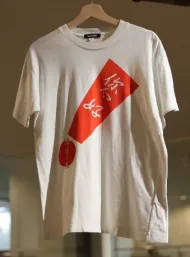
The words on the T-shirt, “Hello, Please Step Down,” seem quite mild. But in fact, this was borrowed from a political slogan from 1984—during China’s National Day military parade in 1984, a large banner reading “Hello, Xiaoping” appeared on the streets of Beijing, expressing the public’s support for Chinese leader Deng Xiaoping. By 1989, the meaning of this phrase was completely turned upside down. “Hello, Please Step Down” conveyed another layer of meaning: Deng Xiaoping had stayed “for too long,” and the Chinese people now wanted him to hand over power and step down from the political stage.
Notably, the top of the T-shirt reads “Giordano.” Giordano was one of Hong Kong’s most famous casual wear brands at the time, and the company’s founder was Jimmy Lai. Jimmy Lai later founded Apple Daily, making it one of Hong Kong’s most influential pro-democracy newspapers. In 1989, Jimmy Lai was just a businessman, not yet a media tycoon. The Tiananmen movement deeply moved him, and he decided to publicly take a stand and support the student movement. His story also reflects the immense political changes that Hong Kong has experienced since then.
The Wire China on Taiwan’s economic transformation in the last 10 years…
[Taiwan] exported $116.1 billion in goods and services to the U.S. in the first five months of this year, according to U.S. government data. That compares with $105.5 billion from China, home to 1.4 billion people and the world’s second-largest economy. (The China figure includes Hong Kong.) The last time this happened was 1992, when China’s economy was only about twice the size of Taiwan’s. Now it is 21 times bigger.
The U.S. has also displaced China as Taiwan’s top trading partner, another development that would have been unimaginable not long ago. In 2016, Taiwan-U.S. trade totaled $85 billion, less than half of the $180 billion in Taiwan-China trade that year.
Foreign Affairs on how China depends upon the Western world it seeks to displace…
If Europe and the United States decisively reassert control over their external accounts, China would face a fundamental constraint: the external markets for its excess production would be closed off. Other advanced economies are unlikely to offer alternative markets, while most developing countries lack the financial capacity to sustain the deficits required. Under such conditions, China would sooner or later be forced to reconfigure its economic model at home.
In principle, this could produce the most constructive outcome for all sides. A successful reorientation of China’s growth model would require a substantial transfer of income toward Chinese households, boosting consumption, reducing domestic inequalities, and making growth less dependent on exports and industrial investment. These redistributive policies would ensure that a larger share of the gains from economic growth accrues to ordinary households rather than to businesses, local governments, and state-favored sectors. Paradoxically, to safeguard the long-term well-being of its people, China may have to become more socialist again: this time, not by socializing production but by socializing prosperity.
Such a shift would also ease tensions with the United States and Europe, reduce global imbalances, and weaken the logic of Beijing’s beggar-thy-neighbor economic nationalism. In practice, however, changing China’s economic model would be an immense undertaking. Moreover, in order to raise household income significantly as a share of GDP, China’s leaders would need to make a corresponding reduction in the resources currently controlled by businesses and local governments, a shift that would be economically and politically costly for Beijing.
If Beijing’s immediate problem is how to persuade the world to continue absorbing its excesses, its longer-term challenge is finding a path to prosperity that no longer depends on them. If the immediate question for the United States and Europe is how to regain control over their external balances and rebuild their productive economies, their own longer-term task is figuring out how to engage China in redefining its rise in a manner that is more compatible with a sustainable international order.
OT, so apologies.
The Judiciary looks after its own. From the Standard. (SCMP carries the story but merely mentions “again”.)
High Court judge Wilson Chan Ka-shun has been found to have engaged in judicial copying for the fifth time, with the Court of Appeal ordering a retrial in the Nam Tai Property case after nearly 95 percent of his judgment was found to have been copied from one party’s submissions, the judiciary said.
…
Chief Justice Andrew Cheung and Chief Judge of the High Court Jeremy Poon will again issue a serious reprimand to Chan and require him to undergo targeted training.
https://www.thestandard.com.hk/news/article/337857/
Surely on a FIFTH occasion the only outcome should be removal from the High Court bench and prosecution for gross misconduct in public office at least.
Chan presided over the early proceedings of the 47 democrats national security case LA.
Say no more
“Surely on a FIFTH occasion the only outcome should be removal from the High Court bench and prosecution for gross misconduct in public office at least.”
Indeed. I doubt this will happen. He will likely engage in judicial copying for a 6th time, after all not much happened after the first 5 times despite how it negatively affected all parties.
Judges have very little accountability even in supposedly respectable jurisdictions like US. In the past few years I’ve grown cynical to the concept of rule of law since it seems to disappear when you need it the most and rule by man emerges in its place. Rule of law is a nice ideal, but it’s more like a fairytale than fact.
Also this guy is an NSL judge. Says everything about the quality of our judiciary.