
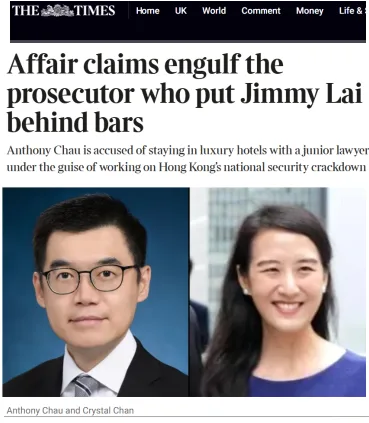
The UK’s most prestigious paper picks up the story the Hong Kong Justice Dept wants the press to ignore. (Paywalled, ironically.)
Chau led the prosecution team at Lai’s trial last year, telling the court that the state did not need to provide specific details around the publisher’s alleged “conspiracy to commit collusion with foreign forces” to prove that he was the “mastermind” behind a plot against the government.
Instead, the prosecutor highlighted Lai’s trips to the US at the time of democracy protests in Hong Kong in 2019, which included a meeting with the then vice-president, Mike Pence.
AFP report via HKFP on the plight of Hong Kong people living in subdivided apartments following the government’s recent attempt to enforce minimum standards on landlords…
Subdivided flats like Lau’s three-square-metre (32-square-feet) home — made by splitting up an apartment into smaller units — are being phased out after a law to regulate them came into effect in March.
Chinese President Xi Jinping has ordered the wealthy finance hub to resolve housing woes that are the result of decades of pervasive inequality, an acute housing shortage and eye-watering rents.
The Hong Kong government has given owners who register under the new system until 2030 to renovate their subdivided flats, but some landlords have already issued eviction notices to their tenants.
More probably, the housing woes are the cause of pervasive inequality. But Xi Jinping is surely right in seeing housing as the number-one reason for the longstanding widespread discontent that came to a head in 2019.
His predecessors must share some of the blame. In the 1960s-1990s, colonial Hong Kong governments built at least one New Town a decade to (barely) keep up with a fast-growing population. But after the Joint Declaration was signed in the 1980s, Beijing insisted on tight limits on land sales (for reasons that were never clear, though officially Chinese officials said the Brits might ‘run away’ with the money in 1997). Cue a massive housing bubble, and vast profit margins for the big developers.
After the bubble burst soon after the handover courtesy of the Asian financial crisis, Hong Kong’s leaders could have set about adjusting to a more normal system of land use and housing. Beijing mildly urged them to tackle ‘deep-rooted’ problems. Instead, they essentially engineered another artificial shortage of housing supply. At the same time, the number of Mainland immigrants coming into Hong Kong – many of them low-skilled – increased.
Since the ‘second handover’ of 2019-20, previously ‘unusable’ space in the New Territories has mysteriously been identified as suitable for residential use. But bureaucrats still seem to try hard to keep housing scarce. They allocate land for superfluous office blocks, malls, highways and arts centres. They rule out using thousands of mini-homes built as Covid isolation facilities. They rule out using the to-be-demolished Wang Fuk Court site for housing. They insist that the additional apartments in the New Territories must be small, so as not to upset existing property owners. And measures to improve conditions in shoe-box homes lead to tenants being evicted.
If the authorities had treated housing in the past as seriously as they treat ‘national security’ today, there would have been far less reason/pretext to introduce the post-2019 new order.
I fear it is just the last lifeline the city is leaning on. “so as not to upset existing property owners.”
Government income, (not a small portion of) citizens’ assets, people’s self esteem and values, the near irrational optimism of a never failing property market, a forever accelerating train to wealth.
Strip it, what’s left of the city ?
The only effective way to make property affordable is to drastically increase supply. However, this would do far more than merely “upset” existing property owners; it would mean throwing many of them into negative equity. The consequent defaults would probably trigger a banking crisis. Something needs to be done, but no responsible government should rush into simplistic solutions without considering all the likely consequences.
“If the authorities had treated housing in the past as seriously as they treat ‘national security’ today, there would have been far less reason/pretext to introduce the post-2019 new order.”
Too perfect; cannot be improved upon.
“(Paywalled, ironically.)”
With an equally ironic button that says “Start trial”.