From HKFP…
The founder and three staff members of Hong Kong independent bookshop Book Punch have been released on bail after they were arrested by national security police over allegedly selling “seditious books.”
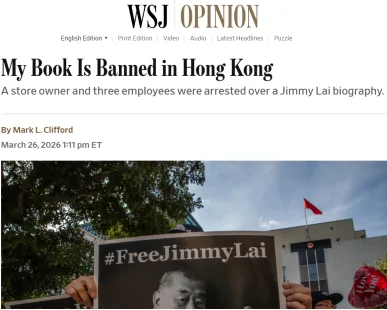
Mark Clifford, author of one of the ‘seditious’ works, writes in a WSJ op-ed…
Book Punch is a shop that hits above its weight. One of Hong Kong’s last independent bookstores, it has been harassed by the government for years. Owner Pong Yat-ming has been dragged into court for giving Spanish lessons and serving sake at a Japanese-themed event.
On Tuesday police charged Mr. Pong and three employees with selling seditious books, including “The Troublemaker,” my biography of Jimmy Lai. Under Hong Kong’s vague and sweeping national-security laws, that offense carries a penalty of up to seven years in prison. The defendants were released on bail Wednesday, but the store remains closed.
Can a jurisdiction that doesn’t want its citizens to read books or learn Spanish seriously call itself a global financial center? Financial centers need freedom—to speak, to debate, to discuss, to argue. Free speech in a modern economy is not a luxury. It’s needed for economic efficiency, price discovery, efficient financial markets and good policy.
Throwing booksellers in prison is a major stumble for any government interested in prosperity. Nobody understands that better than Mr. Lai, 78, who has spent decades fighting for Hong Kong’s freedom. In early February, a kangaroo court sentenced him to 20 years in prison for practicing journalism…
Now, along with hundreds of other political prisoners, Mr. Lai is behind bars. But as the example of Book Punch’s brave owner and staff shows, the spirit of freedom remains in Hong Kong’s DNA. Pro-democracy candidates have enjoyed great support in elections since the 1990s and did so well in 2019 that Beijing changed the electoral system to guarantee the election of more pro-Beijing candidates. Six years after forcing a repressive national-security law on Hong Kong, thin-skinned authorities have been fretting about “soft resistance.” Well, resistance doesn’t get much softer than books.
Referring to NatSec justice (no jury, hand-picked judges, 99% conviction rate, etc) as a ‘kangaroo court’ is presumably what upsets the authorities so much – it’s ‘vilification’, if not ‘incitement’. At the same time, Clifford is being generous in saying the new election rules guarantee ‘more’ pro-Beijing candidates, when results so far suggest the word ‘only’ would be more appropriate.
NatSec measures do have a tendency to produce bad PR for Hong Kong – almost as if the government is vilifying itself. A security alert from the US Consulate in Hong Kong…
It is now a criminal offense to refuse to give the Hong Kong police the passwords or decryption assistance to access all personal electronic devices including cellphones and laptops. This legal change applies to everyone, including U.S. citizens, in Hong Kong, arriving or just transiting Hong Kong International Airport. In addition, the Hong Kong government also has more authority to take and keep any personal devices, as evidence, that they claim are linked to national security offenses.
Authorities are now feeling the need to ‘clarify’ that the new updates to the NatSec Law do not mean cops can force you to hand over your phone on the street (RTHK, Standard).
A Joel Chan thread on the latest population figures in Hong Kong by region and district shows that the population of Hong Kong Island has fallen 7% since mid-2019, and that of Wanchai by 10.1%.
Hong Kong Island’s population is just one-seventh of the whole city’s. Kowloon’s population has fallen 2.7% since mid-2019. But the New Territories – where the majority of the city’s people live – has risen by 3.2%, so the total population decline nets out at just 0.3%.
Not sure how the government compiles such precise numbers, given that no full census has taken place in that period. But, if they’re accurate, you have to wonder what sort of impact the disappearance of a tenth of residents must have on a neighbourhood. (Or not. It’s not as if Wanchai seems any less crowded.)
Lingua Sinica report on the Hong Kong Newspaper Association’s annual Best Journalism Awards. The main winner: Ta Kung Pao…
…run by the PRC government’s Liaison Office in Hong Kong, took home 29 prizes. It was record for the group and the largest haul for any media outlet in this year’s competition … The result [offers] plaudits to a state-run outlet that has been on the front lines in attacks on independent journalists and institutions (including the Hong Kong Journalists Association)…
It does seem Wanchai is less crowded though, going by the night-life areas at night when compared before the 2020 NSL apocalypse though.
“Lingua Sinica report on the Hong Kong Newspaper Association’s annual Best Journalism Awards. The main winner: Ta Kung Pao…”
About as significant a recognition as the “FIFA Peace Prize”.
Oh! And how could I forget the newly minted “America First Award” created by the U.S. Republican party to be given to a certain oranged hued geriatric every year he has left on this earth??
Wanchai is a lot less crowded. All the empty shops on Lockhart, Hennessy and QRE testify to that fact. They’re everywhere if one bothers to look. The foot traffic is mainly elderly people wandering around.
Friday nights in Wanchai are deserted after 8 pm. Waves of forlorn taxis cruise for passengers on all of the main thoroughfares. The pavements are uncrowded. The only sign of nightlife is at Thaiwan in Ship Street.
50 years no change? In a pig’s eye.
Sorry, my comment above was unfair.
The grubby Wan Chai bars catering to overweight beer-drinking Poms in need of a shower are still in business.
Some traditions die hard.
Wan Chai in a word feels dead. Also the Canny Man is no more. Rest in pieces haggis carbonara my beloved – you leave the world a better place by your absence.
Scrap
I do not want to be reflective any more.
The tide comes in and goes out again; I do not want
To be always stressing either its flux or its permanence,
But to keep my eye only on the nearer future
And after that let the sea flow over us.
In a yard behind a light-rail platform
Scrap is slowly, steadily amassed.
A little old lady pushes in a trolley
Piled with cardboard boxes; throws them
Into a lorry’s massive mouth. Steady her pace,
Steady and calm. She presses a button –
Massive teeth mash the boxes.
A young man, bare above the waist, one arm tattooed,
Throws old metal into another lorry,
Slowly and steadily. A microwave oven of the 1990s,
And then – where from? – an enormous metal bowl.
I do not want to feel responsible, and fuss
About material waste and heaving landfills.
Calm and steady in the scrap-yard,
Things are ticking over nicely.
Things are all right, really. Aren’t they?
– – – – – – – – – –
The first five lines are from a poem by Louis MacNeice.
There is a scrap-yard behind Ho Tin light-railway stop, Tuen Mun.
JOIN THE DOTS …………………….
Hong Kong’s 2025–26 budget introduces significant education funding cuts, aiming to reduce expenditure by over HK$6 billion to tackle a fiscal deficit.
The Hong Kong government is cutting subventions to 59 major NGOs by 2% in 2025-26 and 3% in 2026-27. Non patriotic NGOs will receive zero grants.
WHILE
26 Mar 2025 – Hong Kong is planning a sweeping change to its rules on carried interest that could allow many asset managers to earn their performance fees free of all tax.
2 Mar 2026 — Hong Kong will expand its tax exemptions for operators of family offices. This in addition to 0% profits tax for eligible Family-owned Investment Holding Vehicles (FIHVs) managed by single family offices, effective from 1 April 2022.
Reminder for Joe Public: If you carry on any trade, profession or business in Hong Kong, you have to pay tax on your profits
The Taties are the tip of the iceberg.
@Mary Melville
The money laundry is humming and gearing up for expansion.
Apologies, the contribution by asset managers to the Common Prosperity measure should read 26 Mar 2026