
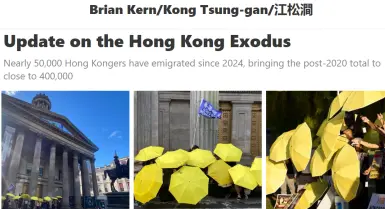
Hong Kong’s population reaches 7.58 million – a 0.3%/19,400 increase year on year. After some 30,000 births and 50,000 deaths, that means a net inflow of around 40,000…
The government spokesman said that various measures to attract talent and import labor continued to bring people from around the world to Hong Kong…
Brian Kern has another angle…
…[his estimates] should be regarded as indicative rather comprehensive—an incomplete portrait and an almost-certain undercounting. But the updated numbers do give a fuller picture of emigration patterns and provide more concrete evidence that a substantial exodus of about five percent of Hong Kong’s 2020 population of 7,481,800 has occurred.
Kern says the main destinations for emigrating Hongkongers from 2020-mid-2026 have been: the UK (234,000); Taiwan (59,000); Canada (54,000); and Australia (33,000).
Compared to countries like Syria and Venezuela, which have seen immensely higher levels of emigration, five percent may not seem like so very many, but it’s worth emphasizing that about one in twenty people moving away from a well-developed, economically stable society that is not at war or suffering some other catastrophe is almost unheard of.
…That brings the total number who have left Hong Kong with the intention of settling abroad to 384,269—about 5.1 percent of Hong Kong’s population in 2020, when the exodus began. And that’s including only the four countries for which statistics are most readily available. An educated guess is that the overall number by now most surely exceed 400,000.
From 2020 to 2024, there was an average of about 5,625 Hong Kongers per month emigrating. From 2025 to the middle of 2026, the average has been 2,595. That’s a reduction of more than half, a big decrease, but emigration is still occurring at a pace perhaps somewhat faster than expected, especially considering, as we will see below, that there are backlogs in Australia’s and Canada’s processing of applications for residency through Hong Kong-specific immigration programs.
Anecdotal evidence, falls in junior/secondary school enrolment and Census Dept district population figures from the last few years all suggest that much of the 5% are younger people with kids and/or educated/middle class. In other words, an even larger portion of those groups left. Hence the Hong Kong government’s strenuous efforts to attract more immigrants from the Mainland (or ‘around the world’).
5% is nothing. They are being quickly replaced by more politically palatable mainalnders anyway.
Anecdotally I know of one local politically yellow BNO person who moved to the UK and after two years was disillusioned. Hard to blame him when the west is eating its own tail and has plenty of its own problems. Now he is a Greater Bay Area citizen enjoying cheap eats in Shenzhen. He hated the food and weather in the UK.
There must be a research that can be set up that involves setting up a mic in different areas and use (*whisper*) AI to determine the mix of dialects on the street.
Because my brain tells me in central putonghia accounts for about at least a quarter of Central lunchtime pedestrian chatter. I went to ICC for a mooring meeting recently, and I swear I didn’t hear any Cantonese on the way towards the offices.
I believe that the census data (ca. 7.6M) reported by the government includes ca. 350+K Foreign Domestic Workers. If this is correct, the percentage of the population that could generally be considered as “citizens” with the right of permanent abode here that have left is actually higher than 5%.
HKFP Headline:
“Hong Kong court orders now-defunct Apple Daily to pay HK$1.5 million to couple in defamation lawsuit over 2019 articles.”
Just so you know, the HKSAR is busy tying up all sorts of legal loose ends in the Apple Daily cases. Maybe it’s simple housekeeping, or maybe they’re laying the groundwork for something more significant.
Data here:
https://www.censtatd.gov.hk/en/web_table.html?id=110-01001
Mid-2023 vs Mid-2026
Ages 0-40= -197,500
Ages 0-64 = -210,000
Ages 65+ = +179,700
Ages 40-49 = +26,200
Pct Population:
75+ = 10% vs. 8.6% mid-2023
65+ = 24.3% vs. 21.7% mid-2023
0-29 = 21.8% vs 24.2% mid-2023
Hong Kong is getting really old, really fast.
Would be interesting to see the numbers since mid-2020.
Anyone have those numbers?
Found them.
Pct. 0-29 = 41.5% mid-2020 vs. 35.8% mid-2026
Pct. 0-55 = 73.4% mid-2020 vs. 67.1% mid-2026
Pct. 20-64 = 66.7% mid-2020 vs. 62.5% mid-2026 (working age)
Pct. 65+ = 18.5% mid-2020 vs. 24.3% mid-2026
Just a rough guess, but it appears that the average age of the Hong Kong population has gone from 44 to 47 in the past six years.
Three years older in six years….wow.
If the trend continues, the average age of someone in Hong Kong will be 50 years old by 2032…..
How long before census data is classified?
@Citizen Kane—the Apple Daily case is bizarre. The court has ordered a newspaper that no longer exists to pay damages out of assets it no longer possesses, because the government has seized them all. Apple Daily was not represented in court, but since it has been declared a “prohibited organisation”, it is not clear whether anyone could legally represent it without being arrested. Justice? You decide.
@Poor Man
I think with the big uptick in mainland immigration, it’s actually a lot worse — 174,000 immigrants came in 2023 against 41,000 in 2018 and 55,700 in 2017.
And the HKSARG admitted the labour force dropped by 140,000 in 2020-2022.
All in all, it points to significantly more than 5% emigrating. Probably, mostly young & middle class with enough qualifications and spare cash to emigrate (which also goes a ways to explaining the death of the F&B sector and the rise of Shenzhen trips).
https://www.migrationpolicy.org/journal/feature/brain-drain-and-brain-gain-hong-kongs-population-shuffle
Biggest drops in ages were as following (mid-2020 – mid-2026)
0-4 = -35.0%
5-10= -20.8%
20-24 = -19.3%
25-29 = -21.6% (e.g. 480,000 vs. 376,400)
Largest gains by age group:
65-69 = +29.4%
70-74 = +38.8%
75-79 = +87.4%