By Bangkok officials, at least.
Thailand has 463 times the land area of Hong Kong, and a population nearly 10 times bigger – the kingdom has 363 people per square mile, versus Hong Kong’s 18,200. The kingdom’s nominal per capita GDP is a seventh of Hong Kong’s. Last year, Thailand had around 33 million tourist arrivals last year, while Hong Kong had nearly 50 million.
Which of the two places wants to boost tourist arrivals, and which wants to curb the numbers?
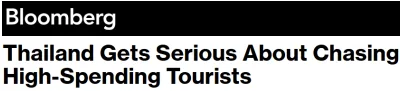
Bloomberg (paywalled) reports…
The Southeast Asian nation, famed for its beaches and city nightlife, is only targeting about 33 million foreign visitors this year, well below the nearly 40 million who arrived in 2019.
…“We’re not too worried about the number of tourists because we want to generate more revenue from each visitor,” [Thai tourism official] Nithee said. “We focus on quality markets.”
We leave the riffraff to Hong Kong.
…The agency is targeting travelers drawn by medical care, wellness retreats, concerts, festivals, golf, marathons and other sporting events because these visitors tend to stay longer and spend more.
The agency’s website also leans heavily into the luxury and wellness angle…
…But with tourism accounting for about one-fifth of Thailand’s economy, the ecosystem of hotels, restaurants, food markets, transport operators, dive shops and tour companies which has sprung up around that depends on large volumes of visitors.
Thailand has the space – and the low-paid workforce – to accommodate more low-end tourists. But they think they can and should do better than that.
Some weekend reading…
From Postcolonial Politics, a short (by which the authors mean ‘long’) article on how Hong Kong has never decolonized. The analysis has to produce results that support an ideology – so partly interesting, partly a bit loopy…
After the failure of the “Umbrella Movement” in 2014, localist and “anti-mainland” sentiment grew further and faster, pushing more young people to declare themselves “localists” in order to counter the increasing influence of the mainland Chinese government, and a new form of colonialism. …demonstrators claimed the right of Hong Kong people to elect their own government and employed the argument of the specificity of Hong Kong’s socio-cultural identity. But where does this specificity come from?
Wishing to avoid having a population that was either pro-CCP or pro-KMT, and unable or unwilling to Anglicize floods of new arrivals, the 1960s colonial government cunningly engaged in…
…the construction of a Hong Kong identity, based on an American and European-style consumer society. The worker, the producer must become the consumer. The political and social changes of the 1960s and 1970s therefore closely resembled the transformation of everyday life, especially in the sphere of leisure, which took place in Britain and Western Europe in the late 1950s and 1960s. It was above all the privatization of daily life, the withdrawal into the home and the family facilitated by the miniaturization of the media for the consumption of cultural products (transistors, inexpensive televisions, and later the audio cassette), which were significant for the construction of this new identity. Such privatization implied the fragmentation of collective life, especially with regard to workers and their unionization.
It was nothing compared with what smartphones were to do.
The authors are essentially seeing the 1967-97 development of a Hong Kong identity as a contrived plan to maintain British rule. Beijing officials would of course heartily agree. Certainly, administrations during that era laid on the ‘community’ stuff with gusto. But it was likely as much to do with keeping up with changing public attitudes as managing them. Hong Kong during that period was pretty much the freest society in Asia, and the local population had the opportunity and means to carve their own identity – and did. Leftists often find it hard to imagine that non-Westerners have their own minds. But they sort of anticipate this criticism…
In the construction of the Hong Kong identity, the worst aspect was the institutional denial of the agency of the Hong Kong people by the colonial authorities. In the twenty-first century, historical reality has constituted many parts of Asia as constituents of modernity and not merely its exploited objects. It is a modernity that bears the marks of colonialism, is full of contradictions, unfinished processes, turmoil and hybridity. But is it really any different from the rest of the modern world where women and the working classes constitute the domestic colonized? In Asia, these contradictions and consequences of capitalist development have simply been exacerbated causing a concomitant amplification of the human suffering and dilemmas that go hand in hand with urban capitalist industrialization in general.
Entertaining if you have nothing important to do.
War on the Rocks looks at the challenges of a Chinese invasion of Taiwan…
Three key missions at the heart of any cross-strait campaign have never been successfully executed under modern threat conditions: an amphibious landing against a credible coastal anti-ship missile threat, a large-scale airborne drop against modern air defenses, and a large, opposed air assault at extended range. In other words, the People’s Liberation Army would have to make history three times in the same campaign.
…The familiar point is that invasion would be difficult. The sharper point is that Taiwan would not need to defeat the invasion force outright. It would only need enough surviving capability to disrupt the sequence. In a campaign built around tight timing and limited lift, the threshold for disruption is far lower than the threshold for destruction. China would have to move, land, reinforce, and sustain exposed forces under fire. Taiwan would only have to break that sequence.
Lift makes the problem more concrete: China would need to deploy sufficient combat power ashore in the opening hours to prevent the beachhead’s isolation before follow-on forces arrive. That makes amphibious lift central to the campaign. If China cannot meet that threshold in the opening waves, it must either accept a dangerously thin landing force or compensate with airborne and air assault operations. Those workarounds create the second and third Nevers.
Essentially, you can’t launch an invasion without large, slow ships and planes full of troops and equipment moving right up to the defenders. Unlike in the past, defenders today have numerous smaller and faster missiles and drones to mess things up.
“ Leftists often find it hard to imagine that non-Westerners have their own minds. ”
Leftists AKA tankies are some of the most obnoxious douche bags on the planet. And yeah they love taking away agency from non-westerners yet somehow think they are anti racism. 🤡
https://www.chinatalk.media/p/taiwans-war-on-renewables holds numbers I hadn’t heard about Taiwan’s energy independence, especially in the face of a potential blockade. tl;dr 97% of their energy is imported there are about ~40 days of reserves.
Life would be so much easier for everyone, including the CCP, if they simply said, “Do whatever you want except: do not criticise the Party,” but they lack the self-belief to do so.
“If something cannot go on forever, it will stop.” – Stein’s Law
Speaking of riffraff…the new direction of the Thai government must be a direct reaction to all the press these days about “budget” Israelis behaving badly in places like the Philippines, Thailand and Indonesia.
Hey, maybe they’ll all come to HK and try their “settler” tactics in Lantau???
Entertaining if you have nothing important to do.
From the extract, I’m torn between wondering if the authors are (a) pretentious, (b)pompous, (c)programmed or simply (d)fucking stupid.
“. tl;dr 97% of their energy is imported there are about ~40 days of reserves.”
Exactly. I read this too. Taiwan’s energy policy leaves them extremely vulnerable so I am in no way as optimistic as that “War on the Rock” column. China will do a blockade before they do an invasion and once their supply of energy is depleted those fast missiles and nimble drones will be grounded. I also have doubts that Taiwanese resistance can hold the line and push back like the Ukrainians who are used to hard living. I have fears the Taiwanese resistance will collapse rapidly similar to what happened in HK.
I would love to be wrong. Please let me be wrong. But I am very skeptical about overconfidence.
@Chinese Netizen
And bad-behaving Russians and Ukrainians avoiding the meat grinder.
When one country invades another, the invading country needs to gain complete control. The invaded country only needs to make the price of doing so too high. China could certainly win, but how much of the PLA is it willing to lose to achieve this?
The renegade province of Toiwaan has always been a bit lacking in domestic energy sources.
That the defenders of the renegade province of Toiwaan haven’t squirreled away what’s needed would be a massive cock-up that would have Zoeng Gaai-sek’s bones spinning like a fusion reactor.
IMHO, it’s the civil population & economy that would suffer first due to a blockade.
Nearly a quarter century ago, my Toiwaan colleagues enjoyed making the Glorious Motherland’s hackers of our employer’s systems bog off with taunts that they’d not be able to find a wife. An invasion would likely reverse that trend.
Israelis: Beware those who have just completed their first round of compulsory service. I rather doubt they’re any better now than they were in the 80s.
https://www.youtube.com/shorts/zYHnF3C0dqg
What if Taiwan mandated that every adult male over 18 be required to own a gun with a minimum of 100 rounds of ammunition along with a requirement to practice at least twice a year. Wouldn’t that make an invasion basically impossible when every Taiwanese could take shots at invaders from every apartment?
So Willlie Wongka had to fall on his sword and resign from Leggers.
This is going to leave a big hole in its Northern Metropolis charm campaign. He was a frequent speaker, English media, at least, on the topic having both engineering knowledge and excellent English.
Now they will have to rely on less than erudite and expert members, like the FTU, to try and convince us that the plans are actually implementable.
What is it with our legislators and cars? Perhaps because driving is the only way they can exrt any control?
“China could certainly win, but how much of the PLA is it willing to lose to achieve this?”
Does it matter? It’s not like the CCP needs to worry about focus groups and popular opinion. Especially when the overriding story is “Reuniting the nation for the good of ALL Chinese worldwide”.
(see? I worked in the new Ethnic Unity Law)
@Strategist
Indeed you make a good point. This was shown pretty clearly with the Iran war too.
@HK-Cynic – this is basically the Swiss model of national defence. But why only males?
“ What is it with our legislators and cars? Perhaps because driving is the only way they can exrt any control?”
Ironically even there they lose control hence the need to apologise and/or resign.
Our beloved exiled and jailed pan-democrats never had this issue. The biggest scandal was Albert Ho looking at women in bikinis while some brainless so called patriot was droning on. They were’t even *naked* but I remember the usual DAB piles of shit making a lot of noise about it. They finally jailed him over his words
O/T
Senior Inspector: Charges dropped, bound over in the sum of $1500, $300 court costs.
I wonder if a non-policeman would get the same treatment?
https://www.thestandard.com.hk/news/article/336339/Suspended-senior-police-inspector-bound-over-after-assaulting-wife-in-parenting-dispute
Catching up on the week’s ‘good stories’ came across this
June 29: The Security Bureau today held a launch ceremony for the new TV series “NS-files: Decoded”, which is scheduled to premiere tomorrow to mark the 6th Anniversary of the promulgation and implementation of the Hong Kong National Security Law.
https://www.news.gov.hk//eng/2026/06/20260629/20260629_181859_823.html
The show will be aired on HOY 78 at 8.15pm every Tuesday starting from tomorrow.
So presumably no English language option but could be interesting to see how footage is manipulated
What does this mean: “ a modernity that bears the marks of colonialism, is full of contradictions, unfinished processes, turmoil and hybridity.”? Can someone please translate it into English?
@Boris Badanov: “real life is complicated”.
@Netizen I sense a ‘Settler Hub’ opportunity here for the HK government