That was quick. The Standard reports…
The Hong Kong Legislative Council swiftly completed a clause-by-clause review of newly amended national security subsidiary legislation on Thursday afternoon. The fast-tracked process, driven by cited geopolitical risks, centers on a mechanism allowing the Chief Executive to certify criminal cases as national security offenses.
…Secretary for Justice Paul Lam Ting-kwok explained that the Chief Executive certificate mechanism aligns with established common law principles, noting that courts traditionally respect the executive branch’s specialized experience and assessment of security risks.
Lam also clarified that the regulation carries no retrospective effect and will not apply to already completed legal proceedings.
Tang refuted public claims that the mechanism would arbitrarily expand the scope of national security crimes to cover minor, ordinary offenses.
He described such allegations as misleading attempts to incite public distrust, emphasizing that the classification will only apply to cases with a genuine national security background, a scenario he expects to be extremely rare.
From HKFP…
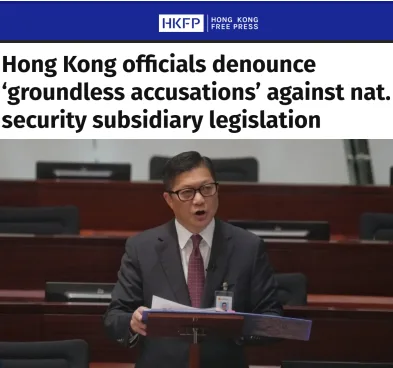
Two Hong Kong officials have condemned “groundless accusations” against a recent update to the city’s homegrown national security law, which empowers the chief executive to certify any criminal case as a national security offence.
Secretary for Security Chris Tang told the Legislative Council (LegCo) on Thursday afternoon that he noticed some people had misunderstood or “deliberately misinterpreted” the subsidiary legislation.
They tried to intimidate the public by claiming that the subsidiary law would widen the scope of national security offences, turning minor offences into national security crimes, he said.
The security chief called the accusations “false, misleading, deceptive, and scaremongering” and said some people were attempting to incite hatred towards the government.
“Some people delivered alarmist remarks, saying that the government can randomly certify any acts of the public as national security offences. Those people may have ulterior motives or are cruel-hearted, hoping to incite others’ hatred of the HKSAR,” Tang said in Cantonese.
Also speaking at LegCo, Secretary for Justice Paul Lam said he noticed “some media outlets with ulterior motives, foreign forces, and fugitives” had made “groundless accusations” against the national security law.
The phrases ‘incitement of hatred towards the government’ and ‘foreign forces’ hint at NatSec offences sedition and collusion respectively. ‘Cruel-hearted’ is a new one. Makes me want to grab a tissue and burst into tears.
RTHK says…
[Chris Tang] … said some “bad actors” have been spreading misinformation about the subsidiary legislation in an attempt to scare the public and incite hatred towards the government.
This showed that threats to national security still exist, Tang said.
This looks like an endless loop: ‘spreading misinformation’ about NatSec legislation is proof of a need for NatSec legislation?
Paul Lam says only the executive has the intel to decide whether a normal offence should be recategorized a NatSec one…
At a Legco subcommittee meeting on Thursday to discuss the matter, the justice minister said many common law jurisdictions, such as the UK and US, defer to executive authorities to decide whether a criminal act infringes on national security matters.
“For you to make an appropriate judgement in defence of national security, you need to consider a host of information, including confidential, sensitive information,” Lam said.
“So the question is, is it what lawyers, judges are trained to do? The answer is definitely not. The most reasonable [course of action] is for the executive authorities to shoulder the responsibility to carry out the intelligence, analyse intelligence and so forth.”
He also said that giving the CE the authority in national security cases won’t undermine judicial independence.
“The chief executive’s role is only to decide whether a case is related or involves national security. The certificate cannot [possibly] be made or seen as having an effect on sentencing or the final judgement of the court.”
This last point seems to be a core line-to-take. But maybe not everyone would agree that transfer from a regular court – with, say, a jury – to one with only a government-picked judge and a 99% conviction rate ‘cannot possibly have an effect on the final judgement’. How to convince them otherwise? Cue Ronny…
Executive councillor and senior counsel Ronny Tong said subsidiary legislation clarifying the classification mechanism for “other offences endangering national security under the law of the HKSAR” will not affect the substantive rights of defendants.
…”And since this is simply a change or improvement of procedure, it doesn’t affect the substantive rights of the defendant.
“It does not affect the nature of the offence, it does not affect the punishment to be dished out in the case of a conviction, and it doesn’t deal with or change the governing principles regarding those offences.”
And maybe there’s more to come…
Tong also said moving forward, there might be a need to consider amending the law to include new conducts that pose a threat to national security.
“Conviction of an offence and a threat to national security are two different things. And sometimes – although it may be very rare – a threat to national security may not constitute a criminal act. It all depends on how the criminal act is framed by the legislature.
“It might mean that in the future, we might find that there are conducts which constitute a threat to national security but it’s not yet a national security offence, then we may need to consider amending our national security law to include that conduct.”
Or maybe you could just allow the CE to issue a certificate deeming – on a very rare, case-by-case basis – any legal thought, word or deed a NatSec offence.
“ the justice minister said many common law jurisdictions, such as the UK and US, defer to executive authorities to decide whether a criminal act infringes on national security matters.”
Yes but in the US and UK it is not possible to arbitrarily certify a non national security crime as a national security crime. Also national security crimes in US and UK have jury trials and under normal courts instead of through a special parallel court system.
I don’t even think Singapore has that flexibility and their internal security act rivals the NSL when it comes to extensive powers. You don’t even get a kangaroo court there for political crimes.