An academic paper titled The Economic Consequences of Protest Repression: The Case of Business Activism in Hong Kong. – essentially an analysis of the ‘yellow economic circle’. The link goes straight to the paper – no weird academic journal paywall stuff. From the abstract…
…the implications of repression on economic phenomena have received little attention. This study [examines] the impact of protest repression on business activism. Business activism refers to businesses taking a public stance on controversial social-political issues, a subject that has been understudied in academic research. We examine the effect of protest repression on business activism through the case of the “yellow economy circle” since the 2019 Anti-ELAB Movement in Hong Kong, in which some businesses publicly took a pro-movement stance by labeling themselves as “yellow businesses.” Utilizing a novel dataset containing geographical information about pro-movement “yellow restaurants,” we find that constituencies that experienced tear gas had a higher proportion of yellow restaurants. We provide two explanations for the causal effect, one from the financial-profit perspective and the other from the socio-psychological perspective…
Never noticed it before – but ‘buycott’ is a word…
…business owners had three options regarding their attitudes towards the movement, namely taking a pro-movement stance, taking a pro-government stance, or remaining neutral to the movement. If businesses joined the yellow economy, they could expect the pro-movement residents would buycott their businesses … but they risked losing pro-government consumers. Empirical research on political consumerism in Hong Kong suggests some additional financial benefits for being buycotted as a yellow restaurant: consumers supporting yellow shops were often willing to pay a higher price and be more tolerant of the quality of goods… In some cases, consumers furthermore deliberatively overpaid to support the movement… In contrast, if businesses publicly took a pro-government stance, pro-movement residents would boycott their businesses, but pro-government residents would support their businesses. Alternatively, a business could choose to be neutral to avoid either boycotting or buycotting. The optimal decision for a specific restaurant to reveal a political leaning or remain neutral depended on its customer base.
…owners of restaurants located in areas that were tear gassed were likely to experience anger and disruptions of their daily operations. Consequently, the use of tear gas could strengthen in-group identity and trigger emotional response among pro-movement business owners, which would make them more likely to take a public stance by joining the yellow economy.
The research confirms what many of us perceived at the time: the extreme levels of tear-gassing alienated significant numbers of moderate or neutral people – culminating in the resounding turnout and pan-dem victory in the November 2019 District Council election. They expressed their anger through consumer choices, and some previously neutral businesses joined the trend by embracing the ‘yellow’ cause as a marketing strategy.
The ‘yellow economic circle’ still exists, though websites that list pro-movement businesses are less used, and many of the restaurants and other outlets have discreetly removed more obvious signs of their stance. Several have gone out of business, either because of problems with officialdom or simply emigration. If you patronize only overtly yellow businesses, you will find yourself with a more limited range of options.
Instead, many people deliberately try to avoid businesses whose owners are known to be actively pro-government. One person I know still refuses to travel on the (government-run) MTR – which is rather extreme, not to say onerous. Is it realistic to insist that a large public company with responsibilities to shareholders, employees and customers (think HSBC) should have attracted certain retribution and ruin from the authorities by openly siding with ‘CIA-backed black-clad rioters’? Even in the US, where rule of law is supposed to still exist, big media, tech and other companies appease Donald Trump out of fear. What is less understandable, or excusable, is the massive pre-emptive cringe. Especially when the organization concerned is not even a profit-making company. Which brings us to…
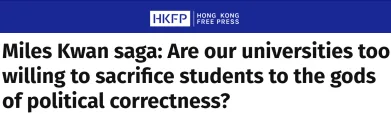
An HKFP op-ed on Chinese University’s decision to expel undergraduate Miles Kwan after he was arrested for ‘seditious intention’ – launching a petition…
…this gradual change of focus [since Baptist U became more research-focused] pales into insignificance compared with the state of near-open warfare that local universities now wage against some of their students. No university now tolerates a student union. Many student publications have closed.
And now we have the case of Miles Kwan, a student at the Chinese University of Hong Kong (CUHK).
After the Wang Fuk Court fire, Mr Kwan organised an online petition calling for an investigation of the fire, accountability for those responsible, resettlement for the residents, and a review of construction supervision.
You would think this was harmless enough. All the things Mr Kwan had suggested were promised by Chief Executive John Lee a day or two later. Can it be an offence to agree with the CE too early?
…[Kwan’s arrest] does not look much like the majestic machinery of the law rolling on its impervious and impersonal way; it looks more like a deliberate act of intimidation by a regime which cannot tolerate any spontaneous expression of opinion not controlled by itself.
You might also think that all this had nothing to do with CUHK, where Mr Kwan was a student. What students get up to in their off-duty hours is generally nothing to do with their university authorities…
In any case, if a student is arrested, prudent universities stand back to await the result of the proper prosecution. The police case should go first. This sensible policy is, in fact, enshrined in the CUHK’s published procedures for handling student discipline cases.
How will the university respond to the petition calling on it to reinstate Kwan?
Fair play in modern Hong Kong is a quaint notion.
One must live without blinders or all is lost.