The HK Democratic Party decides to disband. (You mean it hadn’t already?) Reuters report via Guardian here. Meanwhile…
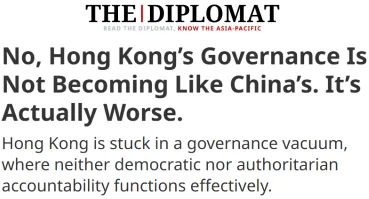
An opinion piece in the Diplomat on the Hong Kong government’s reaction to the Tai Po fire…
…Instead of demonstrating accountability and responsiveness to public concern, authorities have adopted a defensive posture centered on political security.
Many observers see the official handling of the aftermath as another sign that Hong Kong is becoming more like mainland China. In reality, the situation is more troubling. Hong Kong has weakened its own accountability mechanisms without acquiring the governance tools that operate in the mainland.
…From the outset, the government’s approach to the fire was highly politicized and combative.
…The government … moved quickly to cast expressions of public concern as a security threat. The National Security Office warned of “hostile forces” using the disaster to disrupt Hong Kong, framing individuals who voiced dissatisfaction as “distorting the efforts of the government.”
…In today’s Hong Kong, public sentiment and civic engagement are treated as potential security concerns. While the situation in Hong Kong is often described as resembling that in the mainland, this comparison overlooks crucial distinctions. Despite the authoritarian system under Beijing’s rule, mainland authorities do possess institutional mechanisms that absorb public pressure and enforce administrative responsibility in ways Hong Kong currently does not.
…Instead of demonstrating administrative responsibility, the Hong Kong government’s primary tools were centered on information control and political containment.
…Many of [Hong Kong’s] key accountability mechanisms were designed and institutionalized during the final decades of British rule, when the colonial government sought to develop Hong Kong into a prosperous global city grounded in professionalism, public accountability, and the rule of law. For instance, the Commissions of Inquiry Ordinance, enacted in 1968, was designed precisely to handle major incidents requiring independent scrutiny. The Legislative Council also possessed meaningful powers to investigate official misconduct under the Powers and Privileges Ordinance.
These mechanisms, however, can function effectively only in a political environment that favors checks and balances…
…Hong Kong has hollowed out the institutional mechanisms that once ensured accountability and effective governance, but it has not developed the structures that support stability in mainland China. The result is a governance vacuum, in which neither democratic nor authoritarian accountability functions effectively.
…As a Special Administrative Region, senior officials are appointed by and report directly to Beijing. Any admission of administrative error thus risks reflecting poorly on the central government’s oversight. The political cost is even higher today, as Beijing has constructed a narrative of having restored stability and governance effectiveness in Hong Kong following recent crackdowns. Acknowledging serious failures by the city’s government would undermine the rationale for its post-2019 political restructuring.
…The Tai Po fire … exposed deeper structural problems in Hong Kong’s current governance model. The city has moved away from the institutional traditions that once made it administratively credible, yet it cannot adapt the mechanisms that enable mainland China to maintain stability through performance and accountability.
As long as Beijing values the appearance of “One Country, Two Systems,” Hong Kong will not be able to replicate the mainland’s approach to crisis governance. But without rebuilding its own institutions of transparency and responsibility, the city risks further erosion of public trust and administrative capacity.
Hong Kong is not becoming more like mainland China. It is becoming something more fragile and less capable of governing itself effectively.
In other words, Hong Kong either needs to go back to its old ‘high degree of autonomy’ (the core of post-1997 ‘One Country, Two Systems’) – or extend Mainland-style controls, such as widespread censorship of the Internet and foreign media.
The first isn’t going to happen under Beijing’s current leadership (see an interview with Minxin Pei on China’s trend to more authoritarianism). The second means giving up any claim to being an international business/cultural/etc hub, leaving Hong Kong simply a Mainland city with some niche sidelines thanks to the absence of capital controls.
The government’s decision to focus on ‘defensive political security’ as soon as volunteers and activists emerged after the Tai Po fire was perhaps a good example of why English needs a word for ‘shocking but not surprising’.
It looks like underworked but eager locally based Mainland national security officials swiftly stepped in and ordered local counterparts into action. If anyone sincerely believes ‘black-clad colour revolutions’ exist and pose an imminent threat, this might make sense. (Maybe someone does.) But even some pro-government figures must be cringing in embarrassment at the response itself and the way it backfired. Rather than prioritize empathy, which should have been natural and relatively easy, the authorities portrayed volunteers and activists – and by extension much of the broader community – as a possible enemy. Predictably, overseas media picked up on that and made it a big story. Next thing, the authorities are denouncing them as ‘anti-China’.
It would have been so easy to avoid such a PR mess in the old days – but now it’s almost inevitable. Until/unless the authorities take full control over the Internet and ban the foreign press.
The ‘anti-China’ coverage keeps coming. From Timothy McLaughlin in the Atlantic…
As the housing market generated greater wealth for Hong Kong’s tycoons, the construction and real-estate industries achieved growing immunity from regulatory oversight. Government deference, in turn, allowed corruption and corner cutting to proliferate, particularly among contractors involved in renovating the city’s limited housing stock.
This dynamic most likely played a key role in last month’s fire.
…Last weekend, authorities summoned international media organizations to an in-person meeting with national-security officials, who issued an apparent threat about spreading “false information and smear campaigns,” according to a statement from the Office for Safeguarding National Security. “Don’t say that you weren’t warned,” an official who declined to give his name told the assembled journalists.
…[Beijing’s] fear of history [mourning after Hu Yaobang’s death in 1989] repeating may explain the absurd accusation from a Hong Kong spokesperson that recent gatherings of mourners at memorial sites were really the work of “foreign” forces seeking to “maliciously smear” the government’s relief efforts. Beijing’s national-security office in Hong Kong claimed that bad actors were using the tragedy to revive “protest memories” of the city’s 2019 pro-democracy demonstrations and possibly launch “another ‘color revolution.’”
In a recent Twitter thread (starts here), McLaughlin refers to earlier public discontent over property tycoons and the construction industry…
Remember, this was all supposed to be fixed by Beijing after the imposition of the national security law, helped in part by the fact that the pesky pro-democracy lawmakers would be out of the way.
How is that working out?
Writing this as the LegCo election happened it is clear that the 7th LegCo session will be seen as a transition, or bridge, between the old LegCo and a new truly patriots only chamber. Some of the old guard, [Abraham] Shek etc., were told not to run in 2021, now the old guard is truly gone.
The next big Hong Kong story for the overseas media will feature trials without juries and appointed NatSec judges and starts at 10am today: after 1,800 days in prison – the Jimmy Lai verdict, which everyone expects to be ‘guilty’ .
Speaking of “banning the foreign press”, the FCC’s lease is up for renewal (or not) at the end of this month…
The BBC must have had an inkling of the way the HK administration was likely to react – from the beginning they filed all their stories on the fire with a Singapore byline.
An interesting bit of information in the SCMP.
The 78-year-old founder of the now-defunct Apple Daily has spent most of the past five years in solitary confinement, an arrangement made at his own request, after he was first denied bail in December 2020.
Why only now is this being reported?
“[Judge] Toh says Lai’s “constant invitation” to the US to help bring down the Chinese government would be analogous to a situation where an American asked for help from Russia to bring down the US government.”
But you can legally do this in the US. Nobody is going to get arrested and thrown in prison for openly inviting the Russian state to interfere. And besides the Russians helped themselves to Facebook’s self serve ad platform to help Trump win his first term.
I’m neither shocked or surprised that Jimmy has been found guilty.
I’ll not be shocked or surprised when there is international condemnation
I totally expect for resolute outrage and refutation with glitter, tinsel & fairy lights on the turf of a response from HKG government when this happens.
@someone: I caught that SCMP tidbit too. It’s interesting, if true.
@ zatluhcas @someone
I would guess the fact that this hasn’t been relentlessly repeated by the HKSARG at every opportunity probably means it isn’t true but it may be the OAPs in Zhongnanhai trying out a new “hey we’re a good oppressive totalitarian regime, honest” revisionist spiel. But then I’m a dreadful cynic.
@someone
@zatluhcas
It’s only the first time you’ve read it. Old news.
@zatluhcas @someone
I saw this too. But this isn’t the first time I have seen this. I have seen this statement made from government press releases; they also would claim that Jimmy Lai requested solitary confinement.
Meanwhile Jimmy Lai’s family claim solitary confinement was done against his will. Furthermore, simple pleasures like curry with Jimmy’s rice was also taken away from him.,
Who is the more trustworthy source? Who has repeatedly proven to be incredibly petty and shameless?
There will be hell to pay if he dies in prison. Even a blind dissident barefoot lawyer was given the chance by CCP to live in exile in Germany. If mainland justice can arrange something this humane, will the same opportunity be given to Jimmy when sentencing by the three stooges is completed? I have zero respect for this court.
@zatluhcas
Ah, yes! IF true, why was it not mentioned, rather than frothing at the gills with indignation, whenever anyone dared to criticise his being held in solitary? Now Lai is a convicted felon he presumably doesn’t have the privilege of voluntary solitary so I’m curious to see if he will be moved into the general prison population.
@someone
Nobody is frothing at the gills. The government isn’t exactly a trustworthy source if you haven’t already figured this out. Furthermore they are ultimately jailing him over words and non-violent actions.
The pro CCP parrots are already repeating that if Jimmy did this in the US as a US citizen he would be charged with treason and thrown in prison in gitmo but truth is mere words, even inviting a foreign power to issue sanctions, will not land you in prison in the US as this is constitutionally protected speech.
@Mark Bradley
Nobody is frothing at the gills. The reference was to the usual confrontational style of the administration’s press release writer in response to any and all criticism, as illustrated so many times by our host.