Twelve pro-democrats’ appeals are rejected in the HK47 case. HKFP story …
In May 2024, the court found 45 of the defendants guilty over their roles in an unofficial primary election in July 2020. The primary aimed to maximise the pro-democracy camp’s chance at winning a legislative majority, enabling them to threaten a veto of the government budget to press for political demands like universal suffrage. Legal scholar Benny Tai received the heaviest jail sentence of 10 years.
…“The scheme was conceived, advocated and pursued by [Tai] as a ‘constitutional mass destruction weapon’ for the purpose of toppling the constitutional order in” Hong Kong, Judge Jeremy Poon said during Monday’s hearing.
“A LegCo [Legislative Council] member could not act in contravention of the overarching constitutional duty of upholding the constitutional order” in Hong Kong, the judge also said. “If a LegCo member joined the scheme… he must have necessarily acted in breach of such constitutional duty.”
Benny Tai’s plan to – potentially/ultimately – force the government to stand down by vetoing a budget always seemed fanciful and unnecessary; it would have been simpler just to declare that the aim of the pan-dem primaries was to win an election in order to increase popular political power. The National Security Law criminalizes attempts to overthrow or undermine the government, and the court’s 2024 guilty verdict rested on the notion that such a veto would be ‘indiscriminate’ (the Basic Law makes no mention of the purpose behind any budget veto) and would cause constitutional ‘mass destruction’ (actually, a new Chief Executive election).
The bottom line is that Beijing cannot tolerate a system in which an elected legislature can meaningfully pressure the executive. The Basic Law provision on budget votes clearly allows for LegCo to force a government to stand down, regardless of any ‘crisis’ or other repercussions. So the NatSec Law overrides Hong Kong’s constitution.
None of these 12 defendants committed an internationally recognized crime; they have been serving lengthy sentences simply for exercising their rights to freedom of expression, association & participation in public affairs
The HK47 case also gave the authorities an opportunity to imprison most of Hong Kong’s most popular politicians. Which leads us to…
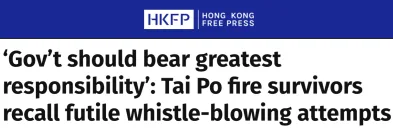
HKFP story on how residents of Wang Fuk Court tried to warn the government of hazardous renovation work before the deadly fire last November…
In the string of emails seen by HKFP, the [Housing Dept] got back to Chris on October 31. “The safety of residents and workers has always been our group’s top priority,” the email read. “The inspection found that some of the external wall protective facilities still have deficiencies… Regarding the aforementioned issues, our group has instructed the contractor to complete the repairs as soon as possible.”
The response did not put Chris at ease, as the ICU did not mention whether it had inspected the quality of the scaffolding nets. “And if there were deficiencies, why did they not order the contractor to cease the operation until everything was fixed?” he told HKFP.
…“I think the government should bear the greatest responsibility. However, I dare not speak up,” Chris told HKFP in Cantonese, pointing out the sentencing of pro-democracy media tycoon Jimmy Lai and prominent democrats in landmark national security trials in recent years.
He refused to use his real name, citing Hong Kong’s current political climate.
Are you ‘inciting hatred of the government’ – thus liable for imprisonment under sedition laws – if you complain about official shortcomings? Some Wang Fuk residents clearly think so. Pre-2020, LegCo had democratically elected representatives who would have given the residents a voice, and possibly convinced officials to monitor the renovation work more effectively. Now, those lawmakers are barred from LegCo or are even in prison (see HK47 case), and their replacements are picked for loyalty to the government. Who can the public turn to? How can the rulers know what their subjects really feel (see bus seat belts mess)? It looks like a recipe for increasingly bad governance.