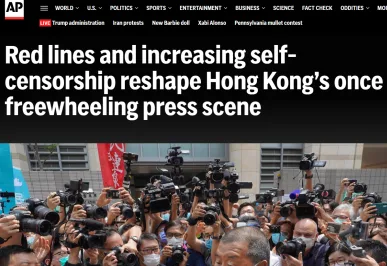
AP describes the collapse of Hong Kong’s ranking in RSF’s World Press Freedom Index in the last 20 years…
Behind the decline are the shutdown of pro-democracy newspaper Apple Daily, more red lines for journalists and increasing self-censorship across the territory. The erosion of press freedom parallels a broader curtailment of the city’s Western-style civil liberties since 2020, when Beijing imposed a national security law to eradicate challenges to its rule.
…A massive fire that killed at least 161 people in an apartment complex in late November revealed some of these shifts.
After the fire broke out on Nov. 26, reporters, including those from newer online outlets, went out in force to cover Hong Kong’s deadliest blaze in decades. They interviewed affected residents, investigated scaffolding nettings that authorities said had contributed to the blaze’s rapid spread, and reported on concerns over the government’s oversight.
Cheng was encouraged by the coverage of the aftermath. But warnings and arrests followed.
Beijing’s national security arm in Hong Kong summoned representatives of several foreign news outlets, including The Associated Press, on Dec. 6. The Office for Safeguarding National Security said some foreign media had spread false information and smeared the government’s relief efforts after the fire and attacked the legislative election.
After arrests of non-journalists who posted allegedly seditious content online or organized a petition, public voices grew quieter, leaving reporters with fewer interviewees, Lee said.
A planned news conference related to the fire, organized by people including former pro-democracy district councilors, was canceled. Bruce Liu, an organizer, was summoned by police for a meeting the same day. An investigative report on the maintenance project by a pro-Beijing newspaper is no longer viewable on its website.
Ellie Yuen, who wrote a social media post questioning regulators’ oversight that went viral, said she stopped posting about the fire for “obvious reasons” without elaborating.
Which brings us to Jimmy Lai’s mitigation hearing. No mention of press freedom (other than publish and speak, your honour, what did he actually do?) But we learn that Judge Esther Toh gains weight when she’s on holiday and sitting at home.
The castration of the media and the community has allowed the administration to guide the agenda.
A good example is the URA Sai Yee Street / Flower Market Road Development Scheme. The focus has been steered to the impact on the Flower Market, all couched in references to commercial potential.
Not a peep that most of the development is effectively an invasion and appropriation of community facilities including a sports ground, two sports centres, open space / sitting out areas, children’s playground, ping pong tables where the elderly hang out, etc. Over 100 mature trees, already a rarity in this densely developed district, to be felled.
Local residents will be deprived of recreational space for a decade and the compensatory facilities will eventually be provided on a podium. As for trees, more of those short spindly flowery varieties. And of course, lots of paving. Not a peep about the provision of alternative sports facilities to accommodate the many facilities currently provided that serve the wider community.
With most avenues for media and community voices now shut down, the URA is now free to take over ever more public open spaces and parks in order to fund its activities via injections of free-of-charge Government Land. Every project comes with a diminishing amount and quality of public recreational space. Many at grade locations have already been eliminated. Those that are reinstated are invariably transformed to nothing more than potted plants and paving surrounded by high wall effect.
That this body has failed to make money on property development in sharp contrast to the fortunes reaped by our property developers is never allowed to be questioned.