Not a great holiday season for the man in his 70s who was badly injured in Yuen Long on Saturday when – walking on a sidewalk separated from the road by railings – he was hit by a car. The car was a Porsche, complete with tacky spoilers on the back. (Spoilers help keep specialized sports cars in contact with the road surface at high speeds; on city streets, they are also a sign that the vehicle owner might just be an asshole.)
There’s more. The driver, who was arrested ‘on suspicion of dangerous driving causing serious bodily harm’ turns out to be a cop.
Two questions. The car looks like one of these models, costing in the HK$1.5 million range. How can a policeman afford one? Given the generosity of public-sector salaries in Hong Kong, the answer is probably ‘quite easily’. (Online chatter considers it possible that he rented it, or borrowed the thing from a friend of some sort.) More puzzling: why do the Hong Kong transport authorities – which ban e-bikes on public highways – allow cars with top speeds of around 280kph/170mph on the streets of this crowded city?
You won’t see it in Sing Tao or the SCMP – a big investigative piece on the corruption behind the Tai Po tragedy, from the NYT…
…residents of the Wang Fuk Court estate spent years warning Hong Kong officials about a renovation project they feared was becoming dangerous.
The government had ordered repairs on the eight aging towers in the complex. But residents complained they were paying extortionate sums for shoddy work that used flammable materials, and they suspected it was because a corrupt syndicate had taken over the project.
They told the authorities that the leaders of the owners’ board and the construction firms were acting at times against residents’ interests and safety. They told local news media that a politician was most likely working with the board’s leaders. At least one resident burned a piece of the polystyrene foam used in the renovation to show how easily it caught fire.
Their complaints led various government agencies to conduct inspections and to issue warnings, notices and citations to the contractor. But there were also mixed messages, and no one stepped in to address the dangers on the whole. In an email to residents, one official described the fire risk from netting on the scaffolding as “relatively low.”
Now, 161 people are dead and thousands are displaced.
…regulators also failed to act decisively on repeated warnings about potential corruption in the renovation project, which may have contributed to the use of the materials.
The Hong Kong authorities have long acknowledged corruption in the construction industry. Activists have warned that some companies inflate costs while using cheap materials. Those same practices went unchecked at Wang Fuk.
Residents’ emails and official statements suggest that multiple government agencies played down concerns, performed perfunctory inspections or relied on reassurances from contractors. Officials also missed other lapses, including fire alarms that failed in seven buildings.
…A local politician, Peggy Wong, who did not live on the estate, got involved in key decisions, residents said. The Wang Fuk homeowners board had long encouraged residents to vote for Ms. Wong, a district councilor for the pro-Beijing Democratic Alliance for the Betterment and Progress of Hong Kong since 2003. (She briefly lost her seat during antigovernment protests in 2019.)
She served the board as an adviser while in office, according to records of the board’s meetings.
She generally urged residents, many of whom are retirees, to back the board’s decisions and sometimes went from door to door, persuading people to sign letters authorizing her to vote on their behalf, according to seven residents who spoke on the condition of anonymity for fear of retribution.
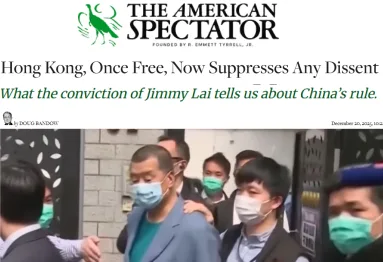
Following the Jimmy Lai verdict, an op-ed on NatSec-era Hong Kong In the American Spectator…
National Security Law on June 30, 2020. The measure proved to be the perfect toolkit for the CCP, criminalizing “secession, subversion, terrorist activities, and collusion with a foreign country or with external elements to endanger national security, and stipulates the corresponding penalties, which in the most serious cases, could result in life imprisonment.” This effectively banned opposition to and even criticism of the CCP as well as the local, Beijing-imposed authorities. No resistance has been too minor to punish. Amnesty International reported that people “have been targeted and harshly punished for the clothes they wear as well as the things they say and write, or for minor acts of protest, intensifying the climate of fear that already pervaded Hong Kong.”
…The conviction rate [for NatSec trials] is 95 percent. The abuse rate is similarly high. Reported Amnesty International: “(1) 85 percent of concluded cases involved only legitimate expression that should not have been criminalized; (2) the courts denied bail in 89 percent of national security cases; and (3) the average length of pre-trial detention is 11 months. Taken together, these findings show that the implementation of national security legislation in Hong Kong has violated international human rights law and standards, including freedom of expression and right to liberty.”
The largest NSL trial was of 47 Hong Kong legislators, academics, journalists, union leaders, and other activists, prosecuted for organizing a political primary, which was legal at the time. Forty-five were convicted and sentenced to prison terms varying from four to ten years. Why? The defendants were charged with conspiracy to commit subversion since their purpose, in what officially remained a free election, was to elect candidates who would oppose the SAR’s chief executive and other Beijing factotums.
[Jimmy Lai] chose to remain in Hong Kong after passage of the NSL. He was thrice arrested, starting in August 2020, held in solitary confinement (for more than 1800 days, and counting!), and subjected to seven different trials, starting in 2021, which resulted in collective sentences of nearly ten years. His NSL trial ran for 156 days and was anything but fair. Detailed HRW: “Lai’s prosecution was marred by multiple serious violations of fair trial rights, including being tried by judges hand-picked by the Hong Kong government, denied a jury trial, subjected to prolonged pretrial detention, and barred from having counsel of his choice.” The three jurists issued an 855 page opinion, which claimed that Lai was the “mastermind” of a conspiracy against the PRC. Added Judge Esther Toh, who was chosen to convict, he “had harbored his resentment and hatred of the PRC for many of his adult years.”
…Hong Kong Chief Executive John Lee (Ka-chiu), the SAR’s top security apparatchik before being selected by Beijing to replace the stumbling Carrie Lam in 2022, has been regularly praised by Xi. Lee denounced Lai: “Some organizations, particularly foreign media organizations, deliberately mislead the public and deliberately whitewash the criminal acts of Lai under the cloak of a so-called ‘media tycoon,’” and seek to “obscure Lai’s shameless acts and subversive actions as an agent of external forces to infiltrate and brainwash young people, through manipulating the media to incite the public and betraying the interests of the country and the people.”
Lai’s conviction offers further evidence, as if any more was needed, to Taiwan that the “two systems, one country” model inevitably means only one, very authoritarian system. Although Hong Kong remains distinct from the mainland — more open to foreigners, foreign commerce, and information — there is no meaningful difference in the totality and brutality of CCP rule.
“… or borrowed the thing from a friend…” Would that perhaps be a triad friend, of which there are many in sunny Yuen Long?
NYT claims to have reviewed hundreds of documents but adds nothing new. Literally a rehash of weeks-old HK01 or InMedia reporting. You won’t see this in ST or SCMP indeed cos it’s weak-ase cosplay journalism.