While the Hong Kong government engages in heavy-handed attempts to silence anyone ‘sabotaging’ society after the Tai Po disaster, international media wade in (some links are paywalled).
From the WSJ…
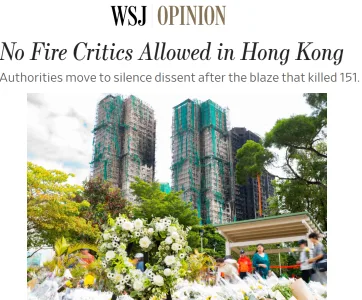
At least 151 died as flames engulfed high-rise towers at Hong Kong’s Wang Fuk Court housing complex last week. The official response shows how this once free city is becoming more like mainland China by the day.
Authorities are seeking to chill speech related to the fire. Several civil-society figures had planned to hold a news conference Tuesday to discuss the response to the blaze. But the event was cancelled after one participant, solicitor Bruce Liu, was “invited to a meeting” with national-security police, the local press reports. Mr. Liu, former chair of the pro-democracy Association for Democracy and People’s Livelihood, reportedly left the police station later Tuesday.
…Hong Kongers have legitimate questions about what went so lethally awry. Before the blaze, residents of Wang Fuk Court had repeatedly raised safety concerns, and authorities now say some of the protective mesh around the buildings failed to meet flame-retardant standards. Other reports describe flammable construction materials and faulty alarms.
A decade ago the scrappy reporters at the Apple Daily newspaper might have followed up on residents’ complaints and exposed wrongdoing before tragedy struck.
…There’s early evidence of government shortcomings. Hong Kong’s Labor Department had told Wang Fuk Court residents that the fire risks were “relatively low,” Reuters reports. Hong Kong’s Fire Services Department conducts inspections and can take enforcement actions regarding fire safety at construction sites. Where were they?
By the way, the fire department is a subordinate agency of Hong Kong’s Security Bureau, and the bureau’s Secretary is Chris Tang, who is also in charge of implementing the national-security law that outlaws dissent. On Saturday Beijing warned “anti-China and pro-chaos elements who attempt to ‘use disasters to disrupt Hong Kong’” would be “severely punished” under the same law. Hong Kongers have little recourse as authorities tolerate neither scrutiny nor criticism.
From the NYT…
The authorities quickly arrested critics demanding accountability, signaling an expansive use of the security law to silence dissent over nonpolitical tragedies.
Hong Kong’s deadliest fire in decades had barely been extinguished when the city’s authorities began working to contain something else: public anger at the government.
…Over the weekend, Beijing’s national security office in Hong Kong issued a statement warning of consequences for “anti-China elements” who are looking to use the fire, which started last Wednesday and lasted more than 24 hours, “to cause trouble.”
“They have lost their humanity, disregarded facts, spread false information, maliciously attacked” the Hong Kong government’s efforts, the statement said.
…“If the committee is seen to not be independent, that will only further disillusion people who are currently dissatisfied,” said Stuart Hargreaves, an associate professor of law at the Chinese University of Hong Kong.
…The law has also made it risky for local journalists to conduct investigative reporting, for lawyers to analyze the government’s legal liability, and for activists to organize street demonstrations demanding transparency.
Also from NYT…
“The lesson the party drew from Tiananmen is: You cannot wait for events to escalate,” said Minxin Pei, a political scientist at Claremont McKenna College. “Problems must be crushed at the earliest stage.”
Disasters, he explained, pose a unique threat to authoritarian governments because they solve the two classic obstacles to collective action: motivation and coordination. People are already angry, and they know where to gather. That is why the party focuses so intensely on the first 48 to 72 hours after a tragedy, when emotions are raw and solidarity is easiest to form. The goal is not simply to respond to the crisis but to pre-empt the possibility of collective expression.
The Hong Kong government’s response to the fire has followed this script with precision. The detention of the university student, the official “warning” visit to the site and the ominous national security statement happened shortly after the fire was put out. The student’s detention can be interpreted as striking at anyone who stands out.
…Thousands of people queued for hours to lay flowers at the complex. Volunteers delivered supplies, raised funds and assembled resources for the displaced. Journalists and citizens documented not only human stories but also the government’s response. Experts offered assessments of possible causes, gaps in oversight and policy failures.
None of this resembled the “anti-China, anti-Hong Kong” conspiracy that the authorities claimed was lurking in the shadows. It looked instead like a community doing what communities everywhere do in moments of crisis: grieve, help out and insist that the dead be honored and the living protected.
The Chinese and Hong Kong governments are “terrified of anything that can generate a sense of collective identity or bring people together around the idea that this is our city, our loss, our grief,” said Chung Ching Kwong, a Hong Kong activist and senior analyst at the Inter-Parliamentary Alliance on China, an international alliance of parliamentarians.
From Bloomberg…
Interviews with roughly a dozen residents and homeowners, as well as a review of project documents, show a series of missed opportunities to prevent the tragedy. They include several that have been previously unreported, such as misleading statements by the contractor and an appeal in early 2024 for the Independent Commission Against Corruption — Hong Kong’s anti-graft agency — to investigate the company. That’s on top of moves by residents to replace the homeowners’ committee that oversaw the bidding process, seek action from the Labour Department and alert local media about their concerns.
Outrage over the catastrophe now threatens to rekindle dissent the Communist Party has devoted the past six years to eradicating, with Chief Executive John Lee under pressure to deliver justice while also preventing the kind of mass street protests that erupted back in 2019. Growing calls for him to establish an independent inquiry — echoing the “five demands” that galvanized demonstrators back then — are testing the extent to which Hong Kong’s separate legal system is being transformed by Beijing’s playbook, which seeks to quell public anger without a transparent investigation.
…Luk Yu Yeung, who lost his 71-year-old mother in the fire, posted the four demands from the petition on X on Monday, after his mother’s body was found. “These demands are actually very basic and simple,” he said by phone. “These are things they should be doing — they shouldn’t need to be told.”
…The fire has shone a spotlight on persistent social tensions in one of the world’s most unequal cities, where millions of people cram into tiny apartments as the government restricts land available for housing, giving local billionaire family developers outsized market power. That’s driven up property prices and squeezed together high-rises like those at Wang Fuk Court, where the towers stood as little as 7.5 meters (25 feet) apart — even less with the bamboo scaffolding, which allowed the fire to quickly jump from one building to the next.
…In a statement to Bloomberg, the Labour Department said the objective of its inspections was to assess whether conditions at the construction site posed any safety risk to workers. “The materials used to seal windows in residential units are generally not a priority in our inspections,” it said.
From Nathan Law in the Telegraph…
Democracy is vital not only because our rights should be protected, but also because the mechanisms of checks and balances, and division of powers, builds resilience against those in power misbehaving. The collapse of political diversity and the rise of authoritarian governance come with consequences much more far-reaching than the imprisonment of political figures.
In the face of the tragedy, people demand answers about why so many safety procedures and warnings are being ignored. There should not only be arrests of advisors and contractors, but also a truly independent investigation, expanding the scope for civil actors to hold the government accountable.
From ABC…
The blaze … did more than destroy homes. It revived one of Hong Kong’s most visceral fears; that lives can be reduced to collateral in a system that no longer listens.
What should have been a moment of collective mourning instead widened the fracture between Hongkongers demanding accountability and a government increasingly shaped by Beijing’s doctrine that sovereignty sits above all else.
…Hong Kong’s housing crisis has long fed collective anxiety, but this disaster struck its deepest nerve. In a city where ordinary families already struggle with extremely unaffordable flats, even the illusion of safety can no longer be taken for granted.
The sense of betrayal deepened when Beijing issued a warning not to let “a disaster disrupt Hong Kong”, reinforcing the belief that the state prioritised protecting its authority, not its people.
…Under the national security regime, the line between civic action and political threat has blurred beyond recognition.
What used to be routine — filing complaints, demanding accountability, launching petitions, helping neighbours — now carries an implied risk.
Beijing’s insistence that sovereignty cannot be challenged has reshaped even the vocabulary of disaster. A call for answers can be reframed as agitation. Grief can be interpreted as defiance. Volunteerism can be treated as “gathering”.
This worldview stands in stark contrast to Hong Kong’s own political culture, shaped over decades by courts that earned public trust, an investigative tradition that valued transparency, and a society that once expected — even demanded — accountability from those in power.
From Asia Times…
Hong Kong is now following the same cycle [as the authorities after the 2022 Urumqi fire] —not solving the problems but targeting the people who speak out about them. Lee Ka-chiu, Hong Kong’s chief executive, has defended himself during the crisis, rejecting criticism of failings in light of his promise to lead Hong Kong “from chaos to order.”
…this shows how much Hong Kong’s freedom of speech and assembly has eroded, as the government appears to fear both the truth about the disaster and the solidarity it has raised among the people.
Long story short: it looks like, following the fire in Tai Po, Beijing officials swiftly assumed control of the Hong Kong government’s messaging/narrative and ‘guidance’ of public opinion/discourse. To people who think this approach prevents ‘colour revolutions’, it might seem worth it. Others might wonder if a more relaxed and empathic response would have been more helpful
Universities are entering into the panicky spirit. An HKFP report on Baptist U says…
The signs on the student message board said: “Deep condolences to the deceased from the great fire of Wang Fuk Court. We are Hongkongers. We urge the government to heed public concerns. Respond to public’s requests. Justice must be served.”
…Posts on Threads and Reddit appeared to show the sign being slowly boarded up throughout the day.
The plastic barriers had signs on them that read “temporary material storage zone,” and “work in progress.”
Before and after shots here.
Removing the poster would be seen as censorship and/or provocative or an infringement of academic freedom – but paying a crew to move large barriers in front of the wall and claiming it’s about routine work is merely pathetic, which is OK (presumably).
The SCMP explains something everyone has long known about…
Hong Kong’s worst blaze in seven decades has exposed an ugly open secret of a murky and rapacious building renovation business that is plagued by bid-rigging and skyrocketing costs even as it staves off feeble official efforts to tackle collusive conduct.
Experts and former insiders offered this grim assessment, pointing to the city as a gold mine for such syndicates given its ageing stock of high-rise properties ripe for renovation.
They made a collective call for an overhaul of the industry as the government announced on Tuesday an independent committee to investigate the cause of the deadly fire at Wang Fuk Court in Tai Po – which has claimed 156 lives so far – and to review systemic problems, including alleged bid-rigging.
Personally, I feel totally reassured by the HKG’s actions.