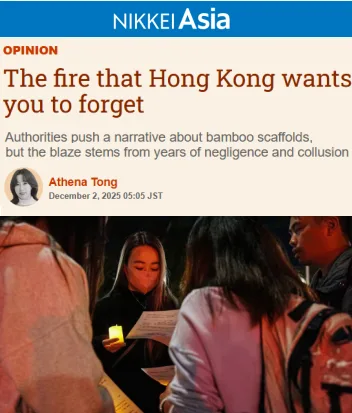
A Nikkei Asia op-ed…
When the inferno tore through the Tai Po renovation site in Hong Kong on Nov. 26, the flames consumed more than the homes of the thousands residing in Wang Fuk Court. They revealed the deeper rot beneath Hong Kong’s governance — years of corner-cutting, collusion and censorship wrapped in the language of progress and stability.
…Concerns about how such contracts are awarded are not new. In 2017, investigative outlet FactWire used tender data to identify irregular, “rotating” bidding patterns among several major contractors in Hong Kong, including [Wang Fuk Court renovation contractor] Prestige, across at least 13 residential refurbishment projects. The reporting showed these patterns as consistent with bid-rigging schemes, where pre-selected firms alternate winning bids while keeping outsiders at bay and prices high. FactWire closed in 2022 amid mounting pressure under Hong Kong’s National Security Law. When institutions capable of exposing collusion are dismantled, risks do not disappear; they accumulate quietly in concrete, wiring and facade systems.
…Arresting a few mid-level site managers may satisfy public anger temporarily, but it leaves untouched the chain of political and bureaucratic negligence above them.
…Volunteer groups quickly organized relief and donated supplies in the area. The founder of a petition demanding thorough independent investigation and support for affected residents was soon questioned by national security police. What began as an act of compassion became treated as subversion.
…The “bamboo problem” is not just a weak explanation; it functions as a tool of cognitive warfare. Its purpose is to guide the public toward forgetting — either to forget the Tai Po fire entirely once the news cycle moves on, or to forget who was actually responsible and treat it as something closer to a natural disaster than an engineered failure.
In the Globe and Mail…
…the timing of the election is awkward nonetheless, because it highlights the degree to which Hong Kongers have little say in how they are governed just as serious questions are being raised by the Wang Fuk Court fire about government oversight and responsiveness.
…The dilemma the government faces is one of its own doing. By revamping elections to be “patriots only,” the authorities have removed a potential release valve for public anger. They have also lost a vital source of accountability and responsiveness, particularly at the local level, where fully-elected District Councils have been replaced by largely appointed bodies run by government bureaucrats, and “care teams” akin to mainland China’s red-armband-wearing neighbourhood watch organizations.
In the past, district councillors and elected members of Hong Kong’s legislature were easily accessible, often distributing their WhatsApp numbers to all residents in their constituency, and sending out newsletters detailing the work they were doing. Many ousted former councillors have been involved in the Wang Fuk Court fire response, organizing on the ground and online.
By comparison, representatives of the new system feel to many like extensions of the government, equally distant and unaccountable.
More hyper-nervousness about activists discussing the Tai Po fire…
Local media reported on Tuesday that Bruce Liu, a solicitor and former chair of the Association for Democracy and People’s Livelihood (ADPL), was taken in by the police force’s national security department.
Shortly before Liu was taken in, organisers of the event sent a statement to media, including HKFP, saying: “The civil society press conference scheduled for 3pm today regarding Hong Kong’s high-rise building maintenance policy has been cancelled due to notification from relevant departments.”
The cancellation notice was sent out less than four hours before the event was scheduled to be held.
The press conference would have covered topics including support for affected residents, the establishment of a commission of inquiry, potential bid-rigging, substandard materials, and the roles of regulatory bodies including the government.
Other speakers at the press conference included Kwok Wai-shing and Jay Li, both of the ADPL, as well as town planner and former opposition Democratic Party member Stanley Ng.
The government is allowed to hold press conferences. And it uses one to announce an independent inquiry in the Tai Po fire. (Unlike Miles Kwan, the government is also allowed to call for an independent inquiry.) Then again, it is an ‘independent review committee’, which is not the same thing…
…An independent review committee differs from a commission of inquiry, which has been established five times since 1997 under the Commissions of Inquiry Ordinance to investigate matters of public importance.
Although both are chaired by a judge, a commission of inquiry has a high level of independence and extensive investigative powers. It can summon anyone to attend and give evidence, receive and consider materials that might not be admissible in standard court proceedings, and punish any contempt of the commission, such as refusing to answer questions.
…By contrast, an independent review committee was set up for other issues … including [in 2012]…
to review rules to prevent potential conflicts of interest, following a series of allegations.
…Those reviews focused on the regulatory framework and monitoring system.
Kevin Yam claims a review committee will be ‘toothless’.
Can’t see AFP being allowed to ask questions at government press conferences again after this one. Transcript here. HKFP reports on the CE’s comments…
Hong Kong will not tolerate those who “exploit” the fatal Tai Po fire and “sabotage” society’s effort to support the victims, chief executive John Lee has said, following three reported arrests for alleged sedition.
…Asked about the arrests on Tuesday, Lee said: “I will not tolerate any crimes, in particular crimes that exploit the tragedy that we are facing now.”
“Society [and] everybody in Hong Kong are uniting to help those who suffer… Anybody who dares to sabotage this attempt, this commitment of society, we will do anything we can to ensure that justice will be done.”
How do petitions or concerned citizens’ press conferences ‘sabotage’ anything? Do the authorities expect everyone to pretend the tragedy hasn’t happened? What are they afraid of? This isn’t how you win public trust.
From literary journal Cha, an eloquent piece by Stuart Lau Wai-shing, translated by Tammy Ho Lai-ming…
When I saw, beyond the police cordon, the platform where survivors of the Wang Fuk Court fire had gathered, I watched them staring at their own homes as they burned. Some cried out that they had lost contact with their families. Some covered their eyes, unable to bear the sight, yet still peered anxiously through their fingers, tears blotting the gaps between them. In those eyes one saw not only sorrow but desolation, anger, and self-reproach. These emotions weigh heavily for the people of Tai Po, and empathy renders them piercingly clear. Yet have any officials perceived them? Are they reduced to nothing but “mouths”, given only to sophistry and evasion?
…During my run this morning I saw police driving away the volunteers and the Care Teams taking full control of the collected goods, treating those who had hurried to aid the victims as though they were thieves. The absurdity of it left me dazed, as if I had strayed into another land…
To achieve a record turnout at the Selection, the addition of an option on the lines of:
Support the Wang Fuk fire be subject to TICK BOX
Commission of Inquiry
or
Independent Review Committee
would bring voters out in droves.