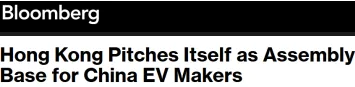
I think this was supposed to be kept under wraps before tomorrow’s policy address. Either way, this Bloomberg story is a sign of desperation among Hong Kong officials trying to reposition the city’s economy…
Hong Kong is in talks with several Chinese electric-vehicle makers to establish local EV manufacturing, according to people familiar with the matter, as the financial hub looks to advanced industries to diversify its ailing economy.
The city’s officials aim to develop an EV assembly base — a relatively complex process requiring advanced skills, the people said, asking not to be identified discussing private deliberations. They are weighing potential sites in Hong Kong’s New Territories that border mainland China, they added.
The talks have included state-owned automaker FAW Group, one of the people said.
Hong Kong has “been proactively facilitating the development of strategic industries, including advanced manufacturing” as part of its 2022 I&T development blueprint, the city’s Innovation, Technology and Industry Bureau said in response to a Bloomberg News query. FAW didn’t immediately respond to a request for comment.
Hong Kong is turning to new industries to spur growth after years of economic challenges fueled by political crackdowns, Covid isolation and a property slump, which have undermined the city’s status as a premier financial hub.
What ‘advanced skills’ would be needed, and does Hong Kong have them? And what competitive advantages does Hong Kong offer? As the story mentions, Hong Kong has high land and labour costs. While you can import workers, you can’t import sites suitable for large-scale manufacturing complexes. How can an EV plant possibly be viable unless the taxpayers subsidize it with cheap land? Then there’s existing overcapacity in the Mainland’s EV industry…
…with factories producing only half of their planned output — and a bruising price war that has forced a rare government intervention.
One possible reason for locating such operations offshore would be to avoid tariffs on Mainland-produced EVs. But surely it would make more sense to build the plants in Vietnam, Indonesia, Brazil or somewhere where costs are much lower and there’s a sizable and growing local market as well as export opportunities.
Mega-events that fall flat, endless ‘hubs’, visas for supposed talent, an insatiable longing for millions more tourists, crypto, and now car assembly. Perhaps we should have some sympathy for the civil servants who are given a near-impossible mission: come up with ideas to rejuvenate the economy – but keep real-estate prices/land valuations high and (if you’re getting funny ideas about creative industries) put ‘national security’ above everything.
Transit Jam digs into the Missouri Synod Lutheran church’s complaint against HK International School and finds that they are demanding…
- all other religious teachings … are dropped … no comparative religious studies;
- festivals outside Christian festivals to be strictly prohibited;
- an end to all acceptance and promotion of homosexuality, same-sex marriage and transgender-affirming care…
Whenever I think about Lutherans (about one minute once every five years), I have visions of trendy female Swedish pastors and that completely nuts architecture in Iceland – and forget who they are named after. It seems these guys (no women clergy) are pretty orthodox. Could be an interesting court case.
Ronny Tong’s think tank used to be called Path of Democracy, but has now renamed itself PoD Research Institute. Adjusting to the new order in Hong Kong. It still conducts a survey asking people if they are satisfied with the Legislative Council’s performance. The question might have made sense when the public elected representatives of their choosing to hold the government to account. But these days, LegCo members are, in effect, appointed by the government specifically to agree with it. It’s not a question of whether the public are satisfied with the legislature so much as whether they perceive one actually exists in any meaningful way. (For the record, the majority are dissatisfied.)
Update from HKFP…
[Tong] said the think tank did not intend to avoid “democracy” in its name, but added that the word could have a political connotation that may impact the credibility of its research.
By ‘did not’, we mean ‘obviously did’.
The idea that Hong Kong can compete against China in any manufacturing sector whatsoever is laughable. Our land costs are the highest in Asia and there’s not enough of it. Our software engineers are amongst the most expensive and least talented in Asia. Homegrown mechanical skills are a joke. Fewer than five out of 100 Hongkongers can hang a picture or change a tire. You think they can build an automobile? They can’t even inflate a balloon.
Hong Kong should stick with its historical strengths: money laundering, smuggling, re-invoicing, investment scams, property speculation, gambling and commercial sex.
That will be the winning strategy, as long as the U.S. dollar peg holds.
“Hong Kong is turning to new industries to spur growth after years of economic challenges fueled by political crackdowns, Covid isolation, an all encompassing national security law that assumes guilt before trial and a property slump, which have undermined the city’s status as a premier financial hub.”
There, fixed it.
Maybe the Misery Synoids will also demand a Charlie Kirk portrait draped in black at the head of every classroom?
@Milton: HK has excellent universities and training. we don’t have the competencies because we don’t have the opportunities. any graduate with the right skills knows their career will be made in the mainland and heads they’re upon graduation. we waste massive amounts of land for far less noble purposes than establishing a manufacturing base, and cost of labour is all relative – places like SZ, BJ or SH aren’t actually any cheaper to employ an educated workforce. while I agree broadly with your points, the fact is HK has to do something to end the slow decay. this might not be it, but we should evaluate on their merits whatever new ideas our inane government can pitch
Ummm, advanced tech manufacturing in a city that cannot even handle dripping air cons…………………………….
“They can’t even inflate a balloon.”
Maybe not an actual balloon, but inflating assets is something Hong Kongers are good at.
@Milton Bradley
Perhaps even more importantly, while everyone seems to think that more manufacturing jobs are desirable these days, no one in Hong Kong actually wants to work in a factory, and they certainly don’t want their kids to.
@James
Thank you for your thoughtful and earnest reply.
When was the last time you saw a Hong Kong man under the age of 60 not on a construction site with a screwdriver or spanner in his hand who looked like he knew what to do with it?
Half the reason why Hong Kong taxi rides are often unpleasant is because men here have no knowledge or interest in anything mechanical. They beat on the brakes and transmissions of their automobiles the way a drunken peasant beats on a donkey.
I dunno–how functionally “Lutheran” is the International School? One of the places I taught in HK was Baptist U, and aside from having a chapel on the campus that hardly anyone visited there wasn’t a scriptural dimension to anything I ever saw. Like every HK university, course content was almost never an issue until the NSL jackboot came down. Jerry Falwell never turned up once.
Hong Kong has changed in many ways – one of which is to totally reject the role of Government in the economy that was advocated in the 1960s and 1970s by Sir John Cowperthwaite and his acolytes.
Official opposition to overall economic planning and planning controls has been characterized in a recent editorial as “Papa knows best”. But it is precisely because Papa does not know best that I believe that Government should not presume to tell any businessman or industrialist what he should or should not do, far less what he may or not do; and no matter how it may be dressed up that is what planning is.
March 30, 1962, page 133.
Over a wide field of our economy it is still the better course to rely on the nineteenth century’s “hidden hand” than to thrust clumsy bureaucratic fingers into its sensitive mechanism. In particular, we cannot afford to damage its mainspring, freedom of competitive enterprise.
March 30, 1962, page 133.
I largely agree with those that hold that Government should not in general interfere with the course of the economy merely on the strength of its own commercial judgment. If we cannot rely on the judgment of individual businessmen, taking their own risks, we have no future anyway.
March 24, 1966, page 215.
I still believe that, in the long run, the aggregate of the decisions of individual businessmen, exercising individual judgment in a free economy, even if often mistaken, is likely to do less harm than the centralized decisions of a Government; and certainly the harm is likely to be counteracted faster. As I said earlier in this debate, our economic medicine may be painful but it is fast and powerful because it can act freely.
March 24, 1966, page 216.
“The credibility of its research”!
Pull the other one, Ronny. You’re said to be good at that.
Incidentally, nice to see that your patriotism does not preclude your continued enjoyment of the accolade, “King’s Counsel”.
His Majesty must be ever so thrilled to have you on board.